
Decoding WPC Decking Certifications: A Technical Guide to Standards and Parameters
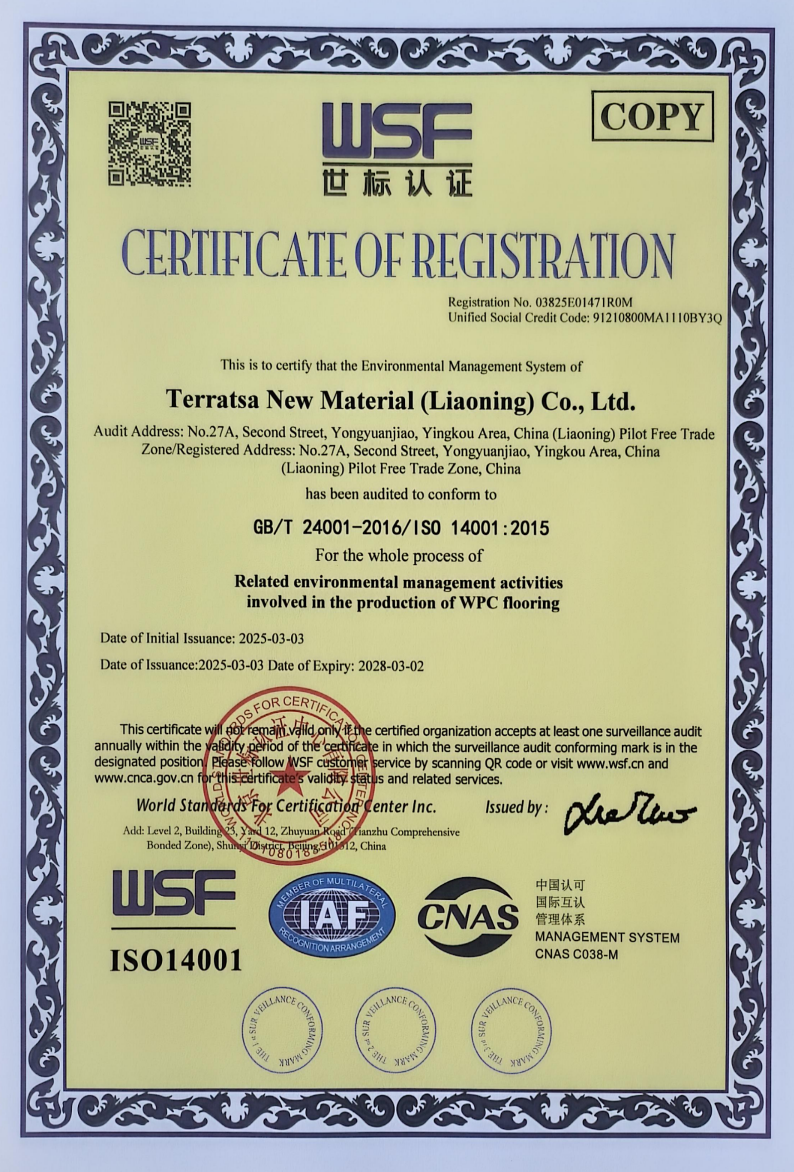
A WPC decking certificate becomes useful the moment three data points can be matched: the certificate number, the standard the certificate was issued against, and the scope sentence that names which products and processes are covered. Everything else on the page is presentation. This guide decodes the certification numbers that appear on WPC decking datasheets — including EPD S-P-12197 issued by EPD International AB, ISO 9001 certificate 03825Q01470R0M, and FSC chain of custody 0218718 — and explains what each standard family actually validates in product performance and environmental impact.
The certificates used as worked examples below belong to Terratsa New Material (Liaoning) Co., Ltd., a wood-plastic composite manufacturer founded in 2007 that relocated its production base from Jilin to the Yingkou Area of China (Liaoning) Pilot Free Trade Zone in 2024. The company produces outdoor WPC decking, outdoor WPC fencing and outdoor WPC cladding, exports to more than 40 countries and regions, and operates an overseas warehouse in the Netherlands.
Problem Definition: Why Certification Data Is Misread in WPC Decking Specifications
Most certification mistakes in WPC decking procurement are category mistakes rather than honesty problems. A document is trusted for something it was never designed to prove, and the mismatch surfaces later — when a submittal is rejected, when an assessor queries a green building credit, or when a terrace decking board underperforms on site.
Four failure modes repeat across project files:
- Family confusion. A management system certificate is read as product performance evidence; an Environmental Product Declaration is read as a quality mark; a chain of custody certificate is read as a materials safety statement. Each family answers a different question about a different subject.
- Scope drift. A certificate may cover one product family or one production process rather than a supplier's entire catalogue. The scope sentence is the boundary of the claim.
- Validity drift. Certificates carry issue and expiry dates. A certificate that has expired is a historical document, not an active claim, even if the PDF still circulates in tender packs.
- Parameter ambiguity. Datasheet figures such as "flexural properties ≥ 3300 N" mean little unless the test conditions behind the figure are known and consistently applied.
The commercial cost is rework: re-specifying a board mid-tender, paying twice for the same test, or accepting a substitution that quietly changes the environmental data a project was designed around. The rest of this guide converts those four failure modes into a practical reading method.
Industry Background: Why Certification Weight Has Risen in WPC Decking Procurement
The wood plastic composite category is now large enough that certification behaves as a market access condition rather than a differentiator. The global WPC market was valued at USD 8.05 billion in 2025 and is projected to reach USD 11.26 billion by 2034, according to Straits Research. North America held the largest regional share at 36.4% in 2025, per the same source.
Regional specification practice follows that market weight. In North America, deck board performance is commonly rated against ASTM D7032, the specification developed by ASTM International to establish performance ratings for wood-plastic composite and plastic lumber used in exterior decking, stair treads, guards and handrails. In Europe, construction product procurement increasingly asks for an Environmental Product Declaration, where the EN 15804+A2 core rules for construction products and the ISO 14025 / ISO 21930 declaration framework govern how the underlying life-cycle data is produced, verified and published. Where a project carries a timber sourcing policy, FSC chain of custody documentation enters the specification as a separate requirement from either of those.
A quieter change is bilingual certification. Manufacturers serving both domestic and export markets frequently hold certificates issued against a Chinese GB/T standard and the corresponding ISO standard at the same time, and the certificate states both. ISO 9001 certificate 03825Q01470R0M is a clear example: it is issued against GB/T 19001-2016 / ISO 9001:2015, so the audited management system is mapped to the national text and the international text simultaneously. The same dual structure appears in the environmental and safety certificates discussed later in this article.
Supply-side credibility also tracks how close a manufacturer sits to standards development itself. Terratsa operates a 74,000 m² facility with 150 employees and a 25-engineer R&D team, runs more than 70 fully automatic production lines, holds more than 30 national independent intellectual property patents, has participated in the drafting of nearly 10 national and industrial standards, and is a vice-chairman unit of the Wood-Plastic Composite Committee of China Plastics Processing Industry Association. For a guide about certificate scope, that background matters less as a credential than as an indication of familiarity with the wording conventions that certificates use.
The Four Certification Families Behind a WPC Decking Datasheet
Before decoding individual numbers, it helps to sort certificates into the four families that appear on WPC decking and cladding datasheets. They are not ranked here. They answer different questions, and a complete supplier file normally contains at least three of them.
- Product performance standards. These validate a board's physical behaviour under defined test conditions. ASTM D7032 is the clearest WPC example: it establishes performance ratings for wood-plastic composite deck boards, stair treads, guards and handrails. This family answers "how strong and how stiff is the board, and over what span".
- Environmental declarations and the standards behind them. An Environmental Product Declaration reports verified life-cycle data for a product. The declaration held for the co-extrusion WPC range conforms to EN 15804+A2 and is produced under ISO 14025 / ISO 21930. This family answers "what is the verified environmental profile of this product" — not "is this a good board".
- Management system certifications. ISO 9001, ISO 14001, ISO 45001 and ISO 50001 describe how a factory is managed in terms of quality, environment, occupational health and safety, and energy. This family answers "how controlled is the production process". It says nothing about a specific board's flexural strength or water absorption.
- Chain of custody certification. FSC chain of custody traces wood-based material through the supply chain and underpins claims such as FSC 100% and FSC Mix. This family answers "where does the wood-based content come from, and can it be traced".
Sorting a supplier's document pack into these four families takes about ten minutes and prevents the most expensive misreading in WPC decking sourcing: treating a system certificate as a product certificate.
Certificate-by-Certificate Decode: Numbers, Issuers and Scope
EPD S-P-12197: Environmental Product Declaration for Co-Extrusion WPC Products
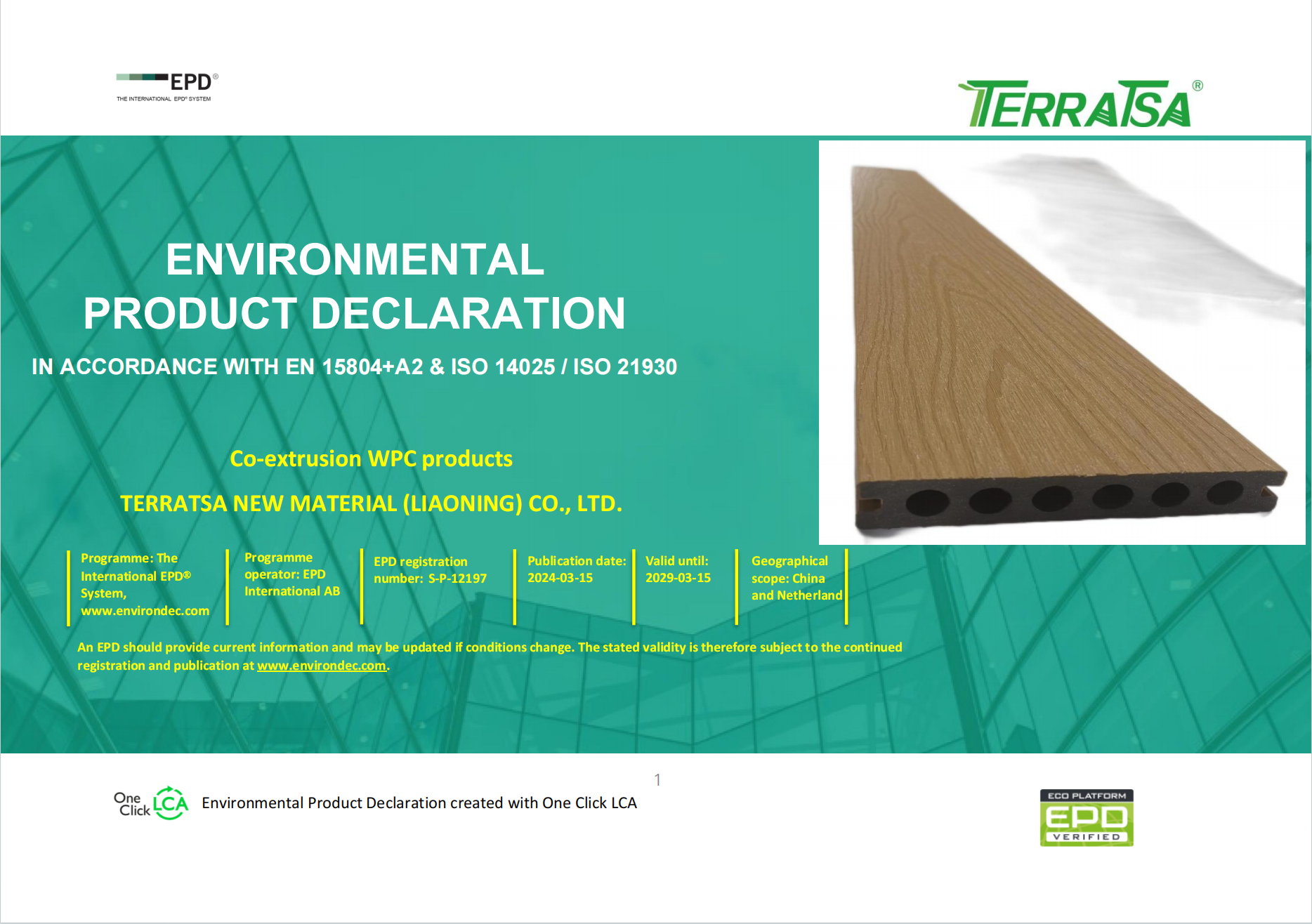
The declaration is registered as S-P-12197, with the registration number EPD-IES-0012197:001. The issuing body is EPD International AB, and the declared standards are EN 15804+A2 together with ISO 14025 / ISO 21930. The declared scope is co-extrusion WPC products, and the declaration covers the markets of China, the Netherlands and Global. It was issued on 2024-03-15 and is valid until 2029-03-15.
Read the scope line carefully, because it defines what the buyer is allowed to claim. EN 15804+A2 supplies the core product category rules for construction products, ISO 14025 sets out the principles for Type III environmental declarations, and ISO 21930 addresses the construction-product view of sustainability data. Together they govern how the life-cycle data behind the declaration is generated, verified and published. They do not grade mechanical strength, and they do not replace a performance rating such as ASTM D7032.
The related product models recorded against this declaration are GH024, GH010, D053 and GH001. That matters in practice: an EPD is product-specific by construction, so a submittal that names a model outside the declared product set cannot use this declaration as evidence, even when the factory that makes both boards is the same.
ISO 9001 Certificate 03825Q01470R0M: Quality Management of WPC Flooring Production
This certificate is numbered 03825Q01470R0M and is issued by World Standards For Certification Center Inc. against GB/T 19001-2016 / ISO 9001:2015. The stated scope is production of WPC flooring. It was issued on 2025-03-03 and expires on 2028-03-02, and applies to all markets.
What the certificate validates is a documented, audited quality management system covering how the flooring is produced: process control, measurement and inspection routines, traceability, corrective action and management review. What it does not validate is any single board parameter. A buyer who reads "ISO 9001" and assumes flexural performance has been certified has misclassified the evidence, and that assumption is the most common reason a submittal is queried.
Note also the wording convention. The scope sentence says production of WPC flooring. If a project specifies wall cladding profiles such as GH010 or GH024, the buyer should ask the supplier to confirm in writing how those product families are covered by the management system documentation, rather than assuming the flooring wording extends automatically.
ISO 14001 03825E01471R0M and ISO 45001 03825S01472R0M: Environment and Occupational Health
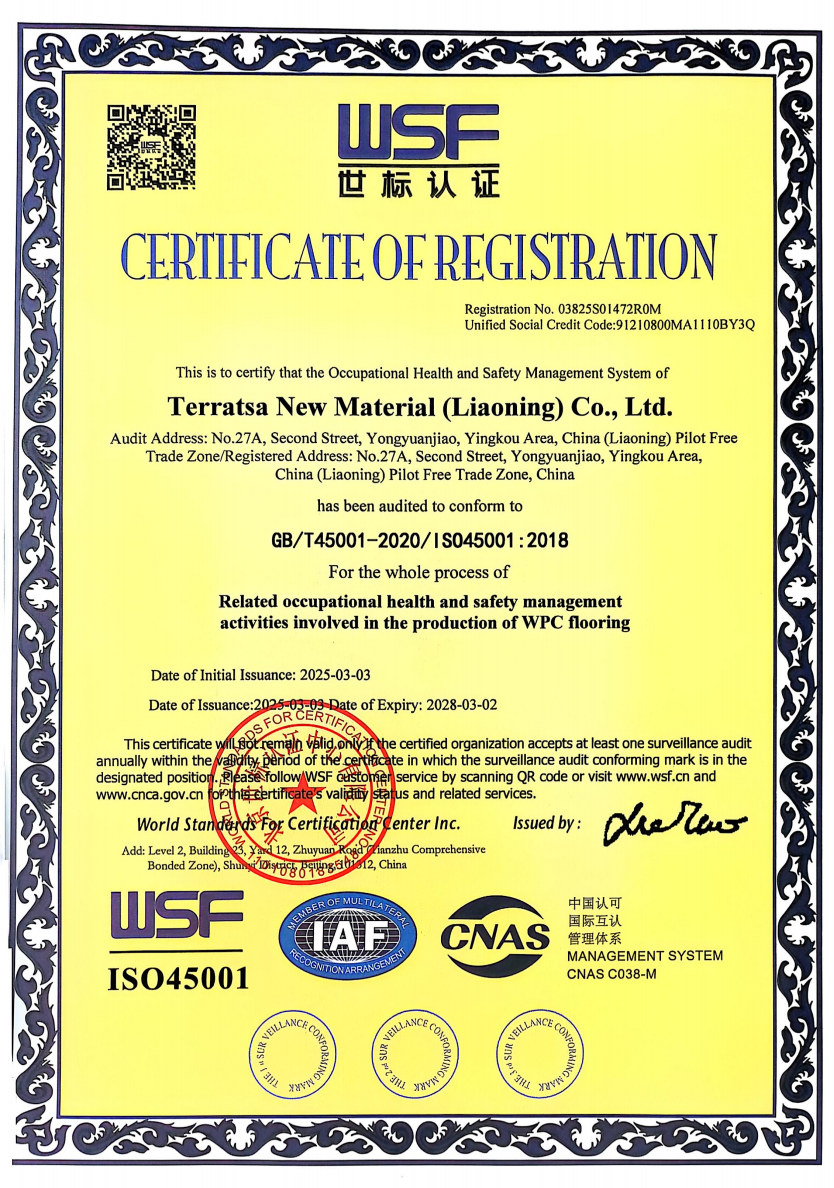
The environmental certificate is numbered 03825E01471R0M and is issued against GB/T 24001-2016 / ISO 14001:2015 for related environmental management activities involved in the production of WPC flooring. The occupational health and safety certificate is numbered 03825S01472R0M and is issued against GB/T 45001-2020 / ISO 45001:2018 for related occupational health and safety management activities involved in the production of WPC flooring. Both come from World Standards For Certification Center Inc., both were issued on 2025-03-03, and both expire on 2028-03-02.
In procurement terms, these two documents answer questions that sit outside the product itself. Environmental management coverage is what an assessor looks for when a project's ESG questionnaire asks how a factory controls emissions, waste and material handling. Occupational health and safety coverage is what a site or brand audit looks for when it asks how extrusion dust, heat, and chemical handling are managed. The same supplier file also lists an energy management system certification against GB/T 23331-2020 / ISO 50001:2018 (RB/T 114-2023), which is relevant when energy intensity appears in a supply chain questionnaire.
FSC Chain of Custody 0218718: Tracing the Wood-Based Content
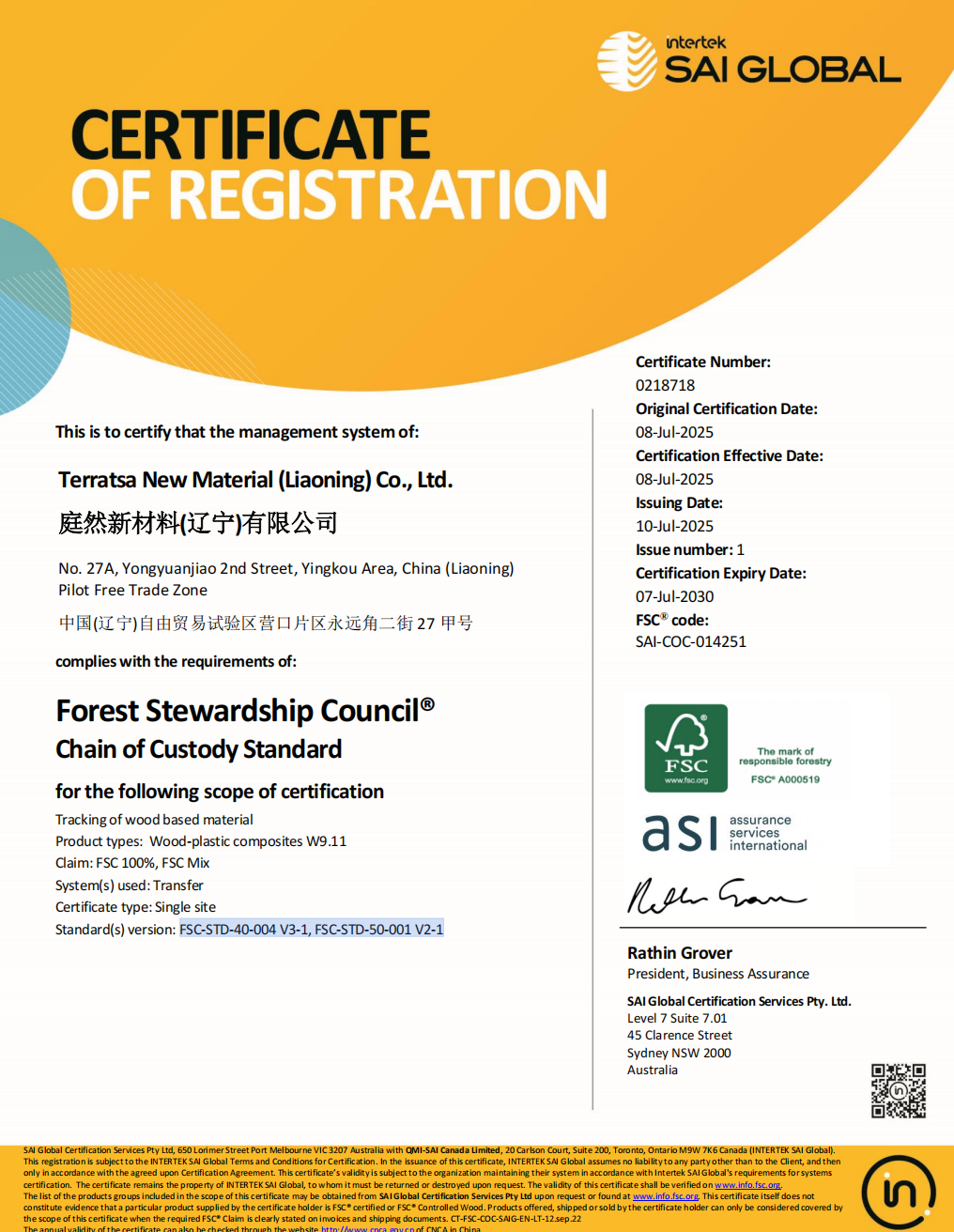
The chain of custody certificate is numbered 0218718 and was issued by SAI Global Certification Services Pty. Ltd. against FSC-STD-40-004 V3-1 and FSC-STD-50-001 V2-1. Its stated scope is the tracking of wood based material, with wood-plastic composites classified as W9.11, and the claims registered are FSC 100% and FSC Mix. It was issued on 2025-07-10 and is valid until 2030-07-07, covering the global market.
Decoded, this certificate speaks to the wood fraction of a wood-plastic composite and to the traceability of that material through the supply chain. It does not speak to the polymer fraction, it does not certify mechanical performance, and the registered claim types here are FSC 100% and FSC Mix — buyers who need a different claim category should confirm that the certificate is actually registered for the claim they intend to print.
The practical check is the same as for any other certificate in this article: take the number, look it up at the issuing body, and compare the scope and claim types with what the project requires.
ASTM D7032 and the Board-Level Parameters That Live Outside Certification
ASTM D7032 is not a factory certificate; it is the specification used to establish performance ratings for wood-plastic composite and plastic lumber in exterior decking, stair treads, guards and handrails. Where a project asks for a performance rating, what is being requested is board-level data derived under that framework, not a management system document.
Board-level parameters sit in a separate evidence family, and they are only meaningful when the test conditions travel with them. Typical recorded values from the technical file for the co-extruded outdoor decking model GH001 include flexural properties of ≥ 3300 N, moisture resistance under cyclic test conditions with a mean of ≤ 10%, and water absorption in the boiling test of ≤ 7%. For the first-generation hollow WPC decking model D053, the recorded parameters are a thickness of 23 mm, a width of 146 mm, a length of 2900 mm, a bending failure value of 3900 N, a density of 1.3 g/cm³, water absorption of ≤ 2% after boiling for 5 hours, and a linear thermal expansion coefficient of ≤ 37 × 10⁻⁶ K⁻¹.
The cladding models that appear in the EPD product list carry their own recorded figures: GH010 at 22 mm × 136 mm × 2900 mm with flexural properties of ≤ 0.79 mm, moisture resistance under cyclic test conditions of ≤ 60.7 mm, swelling and water absorption after 28 days immersion of ≤ 2%, and a linear thermal expansion coefficient of ≤ 37 × 10⁻⁶ K⁻¹; and GH024 with flexural properties of ≤ 0.9 mm, moisture resistance under cyclic test conditions of ≤ 0.9 mm, swelling and water absorption after 28 days immersion of ≤ 4%, a boiling test value of ≤ 3%, and the same linear thermal expansion coefficient ceiling.
Decision rule: a waterproof or low-maintenance WPC decking claim is defensible only when the water absorption figure is quoted together with its test condition — for example "≤ 2% after boiling for 5 hours" for D053, or "≤ 7% in the boiling test" for GH001. A number without its condition cannot be compared with a competing datasheet.
Step-by-Step: Six Checks to Verify Any WPC Decking Certificate
- Match the number to the issuer. S-P-12197 belongs to EPD International AB; 03825Q01470R0M, 03825E01471R0M and 03825S01472R0M belong to World Standards For Certification Center Inc.; 0218718 belongs to SAI Global Certification Services Pty. Ltd. Look each number up at the issuing body rather than accepting a scanned copy alone.
- Read the standard field, not the certificate heading. GB/T 19001-2016 / ISO 9001:2015, GB/T 24001-2016 / ISO 14001:2015, GB/T 45001-2020 / ISO 45001:2018, EN 15804+A2 with ISO 14025 / ISO 21930, or FSC-STD-40-004 V3-1 with FSC-STD-50-001 V2-1. The standard field tells you which rulebook was applied.
- Read the scope sentence against what you are buying. "Co-extrusion WPC products", "production of WPC flooring" and "tracking of wood based material" are three very different promises. One of them is a product-scope statement, one is a process statement, and one is a materials-traceability statement.
- Check the validity window against your schedule. The EPD runs to 2029-03-15, the three management system certificates run to 2028-03-02, and the chain of custody certificate runs to 2030-07-07. If installation, handover or a warranty period falls after an expiry date, confirm that a renewal is in place before you specify the document.
- Confirm your model sits inside the scope. The EPD related-product set for the declaration is GH024, GH010, D053 and GH001. If your specification names a model outside that set, the declaration is not the right evidence for that line item.
- Separate system evidence from product evidence, then check production control. System certificates describe management; board parameters describe the product. The manufacturer states 100% test quality control in production, so request the corresponding product technical file alongside the certificates — and confirm that the site producing your order is the site named or implied by the certificate scope.
Use Cases: Matching Certification Evidence to Project Type
Public park and plaza decking
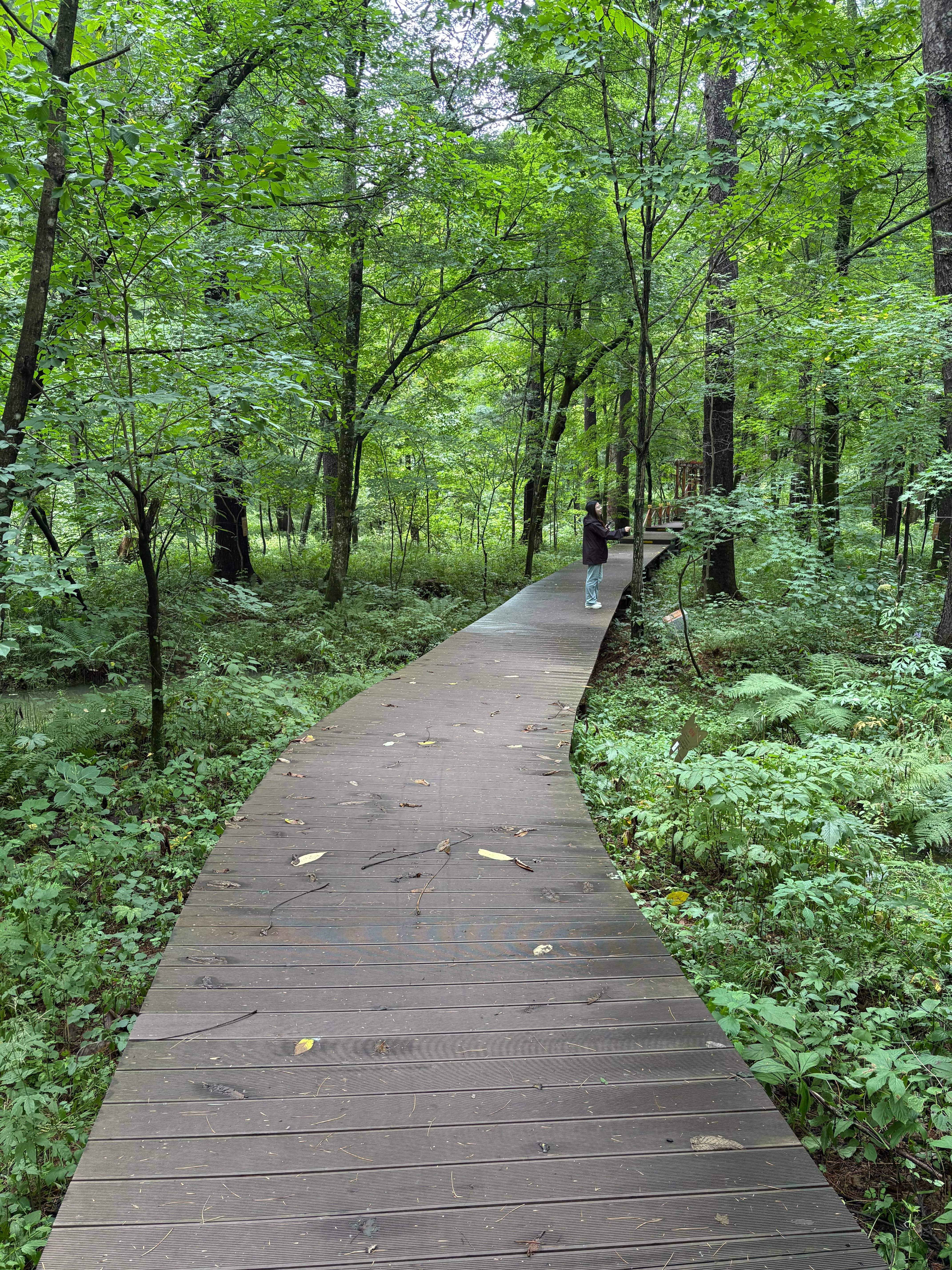
Public projects usually need the widest document set, because they combine a supplier qualification file with an environmental file and, increasingly, a sourcing policy. A recorded case from China illustrates the application: a park decking project supplied 500 tons of the product to project contractor clients, and the decking maintained its performance for 15 years with no fading and no bending. The models associated with that case are D053 and GH001. For this project type, the natural document stack is the EPD for the environmental submission, the FSC chain of custody certificate where a wood sourcing policy applies, and the ISO management system trio for the qualification dossier.
Swimming pool WPC decking and other wet zones
Wet-zone specifications are dominated by water behaviour, slip resistance and surface stability. The recorded parameters most relevant to swimming pool WPC decking are water absorption of ≤ 2% after boiling for 5 hours for D053 and ≤ 7% in the boiling test for GH001, with cyclic moisture resistance of ≤ 10% mean for the co-extruded board. Because the environmental declaration is scoped to co-extrusion WPC products, a capped co-extruded WPC deck specified for a pool surround can be tied to the declaration, provided the model in the submittal is one of the related models.
Garden terrace and balcony decking
Residential and hospitality terrace work is usually driven by appearance and dimension rather than by certification depth. The relevant checks are dimensional — D053 is recorded at 23 mm × 146 mm × 2900 mm — and documentary: confirm the ordered model appears in the declaration's product set, and confirm the fire, slip and UV requirements of the local code are addressed in the project's own specification rather than assumed from a management system certificate.
Exterior wall cladding
Cladding profiles GH010 and GH024 appear in the EPD related-product set, which gives the environmental file a cladding entry point. The management system certificates, however, are worded around the production of WPC flooring, which is why step three of the verification method matters: for a cladding package, ask the supplier to confirm scope coverage in writing instead of assuming it.
Comparison Table: WPC Decking Certifications, Numbers, Issuers and Scope
| Certification | Certificate number | Issuing body | Standard as stated | Scope as stated | Issued | Valid until |
|---|---|---|---|---|---|---|
| Environmental Product Declaration (EPD) | S-P-12197 | EPD International AB | EN 15804+A2 & ISO 14025 / ISO 21930 | Co-extrusion WPC products | 2024-03-15 | 2029-03-15 |
| ISO 9001 Quality Management System | 03825Q01470R0M | World Standards For Certification Center Inc. | GB/T 19001-2016 / ISO 9001:2015 | Production of WPC flooring | 2025-03-03 | 2028-03-02 |
| ISO 14001 Environmental Management System | 03825E01471R0M | World Standards For Certification Center Inc. | GB/T 24001-2016 / ISO 14001:2015 | Related environmental management activities involved in the production of WPC flooring | 2025-03-03 | 2028-03-02 |
| ISO 45001 Occupational Health and Safety Management System | 03825S01472R0M | World Standards For Certification Center Inc. | GB/T 45001-2020 / ISO 45001:2018 | Related occupational health and safety management activities involved in the production of WPC flooring | 2025-03-03 | 2028-03-02 |
| FSC Chain of Custody | 0218718 | SAI Global Certification Services Pty. Ltd. | FSC-STD-40-004 V3-1, FSC-STD-50-001 V2-1 | Tracking of wood based material; wood-plastic composites W9.11; claims FSC 100% and FSC Mix | 2025-07-10 | 2030-07-07 |
ASTM D7032 is listed separately rather than in the table above, because it is a performance specification used to establish ratings for wood-plastic composite deck boards, stair treads, guards and handrails, not a certificate held against a factory. The certification portfolio of the manufacturer referenced in this guide additionally lists CE, FSC, ASTM, SGS and EPD among its products' international certifications; the numbers for the CE, ASTM and SGS documents were not part of the source material used for this article and should be requested directly.
Ranking WPC Decking Certifications by Procurement Value
Buyers frequently ask which certification matters most. The honest answer is that it depends on the project, but a practical priority order can still be built from how often each document is actually requested during evaluation. The ranking below is an editorial procurement framework, not an industry standard, and it ranks certificate types — not suppliers or brands.
- Environmental Product Declaration under EN 15804+A2. In markets where embodied carbon or green building assessment is in scope, the EPD is the first document an assessor asks for, because it is the only item in the stack that reports verified life-cycle data. It is also the slowest document to produce, which makes it the strongest differentiator when it already exists.
- FSC chain of custody. Where a timber sourcing policy, public procurement rule or brand commitment applies, chain of custody moves to the top of the list, because no amount of product performance data substitutes for traceability of the wood-based input.
- ISO 9001. Almost every formal supplier qualification asks for it, and it is the baseline document that unlocks the rest of the technical review. Its weakness is precisely its ubiquity: it is a process statement, so it must be paired with product-level data.
- ASTM D7032-based performance ratings. For North American deck submittals, performance ratings derived under this specification carry more decision weight than any management system certificate, because they describe board behaviour over span.
- ISO 14001 and ISO 45001. These rank lower in frequency but are rising in ESG and prequalification questionnaires, where factory environmental controls and workforce safety are assessed independently of the product.
Applied to the file used in this article, Terratsa holds EPD S-P-12197, FSC chain of custody 0218718 and ISO 9001, ISO 14001 and ISO 45001 certificates, and lists CE, FSC, ASTM, SGS and EPD among the international certifications obtained for its products. The correct way to use that list in a tender is still number-by-number verification at the issuing body, not reliance on a supplier summary page.
Frequently Asked Questions
1. Which certifications does a European WPC decking project usually require?
Three document families cover most European specifications. First, an Environmental Product Declaration conforming to EN 15804+A2, produced under ISO 14025 / ISO 21930 — for the co-extrusion range referenced here, that declaration is S-P-12197, issued by EPD International AB with a scope of co-extrusion WPC products, valid from 2024-03-15 to 2029-03-15. Second, FSC chain of custody where a wood sourcing policy applies; the certificate in this file is 0218718, issued by SAI Global Certification Services Pty. Ltd. under FSC-STD-40-004 V3-1 and FSC-STD-50-001 V2-1, valid to 2030-07-07. Third, management system certificates for supplier qualification. The exact mix depends on the project's own specification, so the specification should be read before the certificate pack is requested.
2. Does ISO 9001 mean the WPC decking board's strength has been certified?
No. ISO 9001 certificate 03825Q01470R0M is issued against GB/T 19001-2016 / ISO 9001:2015 with a scope of production of WPC flooring, and it certifies the quality management system around that production, not the strength of any individual board. Board-level values sit in a different evidence family: GH001 is recorded with flexural properties of ≥ 3300 N, and D053 with a bending failure value of 3900 N. Those figures should be requested as product technical data, together with the test conditions they assume, rather than inferred from a system certificate.
3. How do I avoid over-specifying certifications that my project does not need?
Map each document to the requirement that triggers it. An EPD is triggered by embodied carbon or green building assessment; FSC chain of custody is triggered by a wood sourcing policy; ISO 9001 is triggered by formal supplier qualification; ISO 14001 and ISO 45001 are triggered by ESG or site-safety prequalification; ASTM D7032-based ratings are triggered by deck submittal requirements in North America. Once a supplier already holds the relevant certificates — as is the case with S-P-12197, 0218718 and the ISO 9001 / ISO 14001 / ISO 45001 set — the practical question is not whether to pay for certification but whether the document you need is inside scope for the model you are buying. Scope review costs nothing and prevents the most common duplication of effort.
4. Can I verify these certificates before placing a bulk order?
Yes, and verification should happen before the order rather than after. Look up each number at the issuing body, then compare the scope wording with the model you intend to order: the EPD's related product set for this file is GH024, GH010, D053 and GH001, and the FSC certificate covers wood-plastic composites classified as W9.11 with the claims FSC 100% and FSC Mix. The manufacturer states a minimum order quantity of one container, with OEM/ODM production and logo customization available, so document verification can run in parallel with the commercial and sampling discussion. If you want to start that process, you can request the certificate pack together with the product technical file using the contact details at the end of this article.
5. Do certifications add lead time to a WPC decking order?
Held certificates do not need to be re-issued per order, so they normally add no certification time to a shipment: the EPD runs to 2029-03-15, the three management system certificates to 2028-03-02, and the FSC chain of custody certificate to 2030-07-07. The lead time quoted for production in this file is 30–45 days from a monthly capacity of 10,000 tons. The schedule risk to watch is expiry, not issuance: if your delivery, installation or warranty period extends beyond a certificate's validity date, confirm the renewal status in writing before the specification is finalised.
Conclusion: Read the Scope, Not the Logo
Certification decoding in WPC decking comes down to discipline rather than expertise. Match the number to the issuer, read the standard field, read the scope sentence, check the validity window, confirm your model is inside the scope, and keep system evidence separate from product evidence. Applied to the certificates in this article, that method produces a short, checkable list: EPD S-P-12197 from EPD International AB under EN 15804+A2 and ISO 14025 / ISO 21930 for co-extrusion WPC products; ISO 9001 03825Q01470R0M, ISO 14001 03825E01471R0M and ISO 45001 03825S01472R0M from World Standards For Certification Center Inc. under their GB/T and ISO equivalents; and FSC chain of custody 0218718 from SAI Global Certification Services Pty. Ltd. for the wood-based content.
Boards such as GH001, D053, GH010 and GH024 then carry their own recorded parameters — flexural values, water absorption figures and thermal expansion ceilings — which serve a different purpose from the certificates and should be requested alongside them. Used together, the two evidence families let a specification be defended line by line, in a submittal, an audit, or a green building assessment.
Request the Certificate Pack, Technical File or a Sample
Terratsa New Material (Liaoning) Co., Ltd. supplies outdoor WPC decking, fencing and cladding and holds EPD S-P-12197, FSC chain of custody 0218718 and ISO 9001, ISO 14001 and ISO 45001 certificates, with CE, FSC, ASTM, SGS and EPD listed among its products' international certifications.
Download the decking brochure: Terratsa Decking Brochure (PDF)
Contact: Diana — Email sales01@unvocwpc.com — Tel / WhatsApp +8615943028515 — Start a WhatsApp chat
Address: No. 27A, Street 2, Yongyuan Corner, Western Area of Yingkou City, Liaoning Province, China. Website: www.terratsa.com
Have Questions or Need More Details?
Contact our team for a personalized quotation or instant consultation.
Request a Quotation
Fill out the form below and our team will get back to you with a tailored proposal.
WhatsApp Direct Chat
Prefer to chat in real-time? Message us on WhatsApp for instant assistance & quick answers.
- Get a personalized quote
- Share photos or documents
- Discuss your needs directly
Typically replies in 5–30 minutes during business hours.