D053 vs GH001 WPC Decking: EPD Scope and Buyer Criteria
Both D053 outdoor hollow WPC decking and GH001 co-extruded outdoor decking are covered by Environmental Product Declaration S-P-12197, issued by EPD International AB and valid until 2029-03-15, with conformance to EN15804+A2 and ISO 14025 / ISO 21930. The purchasing decision therefore does not turn on whether a declaration exists. It turns on which board's construction, declared parameters and commercial terms match the acceptance criteria you write into the purchase order.
Problem Definition: Why an EPD Number Does Not End the Choice
D053 and GH001 share one declaration, one manufacturer and the same MOQ basis. That is exactly why the comparison goes wrong so often. Buyers see one certificate number, assume the boards are technically interchangeable, and then discover the difference later — in surface durability, in colour retention, in the format of the test values they need for their submittal.
Four recurring errors sit behind most of these procurement disputes:
- Treating the EPD as a product approval. An EPD reports declared environmental performance across a declared product list; it is not a fitness-for-purpose certificate and it does not rank boards.
- Ranking declared values that were produced under different protocols. D053 declares water absorption of ≤2% after a 5-hour boil; GH001 declares ≤7% in a boiling test. Different test bases and different reported scopes mean the two numbers cannot be placed on a single scale.
- Assuming one surface system fits both boards. D053 is a first-generation hollow board; GH001 is a co-extruded board with a full cap layer. Their maintenance and colour behaviour are not the same specification item.
- Citing a certificate number without its supporting detail. A purchase order that names “EPD” but omits the registration number, the standard version, the validity date and the covered product is difficult to audit later.
The practical answer for a research-to-evaluation buyer is to separate the decision into three layers: certification scope (what is declared), board performance (what is declared for each product), and commercial terms (what you can actually order, inspect and receive).
Industry Background: Why EPD Scope Now Sits Inside the Purchase Order
Wood-plastic composite decking has moved from a niche alternative to a mainstream construction product. Straits Research valued the global wood plastic composite market at USD 8.05 billion in 2025 and projected USD 11.26 billion by 2034, with North America holding the largest regional share at 36.4% in 2025. On the supply side, trade data for HS Code 39189090 recorded China as the dominant exporter of WPC decking at 97.81% of monitored imports — a data point that reflects concentrated sourcing rather than a quality judgement.
Two documentation regimes shape how buyers now evaluate boards. In Europe, EN 15804+A2 provides the core product category rules for construction-product declarations, which is why an EPD built on EN 15804+A2 together with ISO 14025 / ISO 21930 is the version specifiers expect in green-building submittals. In North America, ASTM D7032 is the primary standard specification for establishing performance ratings for wood-plastic composite deck boards, stair treads, guards and handrails — the reason performance ratings are requested in an ASTM-format table rather than as raw laboratory output.
The result is a procurement environment in which two boards can be equally compliant and still be poor substitutes for one another. Certification narrows the field; acceptance criteria decide the board.
Detailed Solution: What Each Board Actually Is
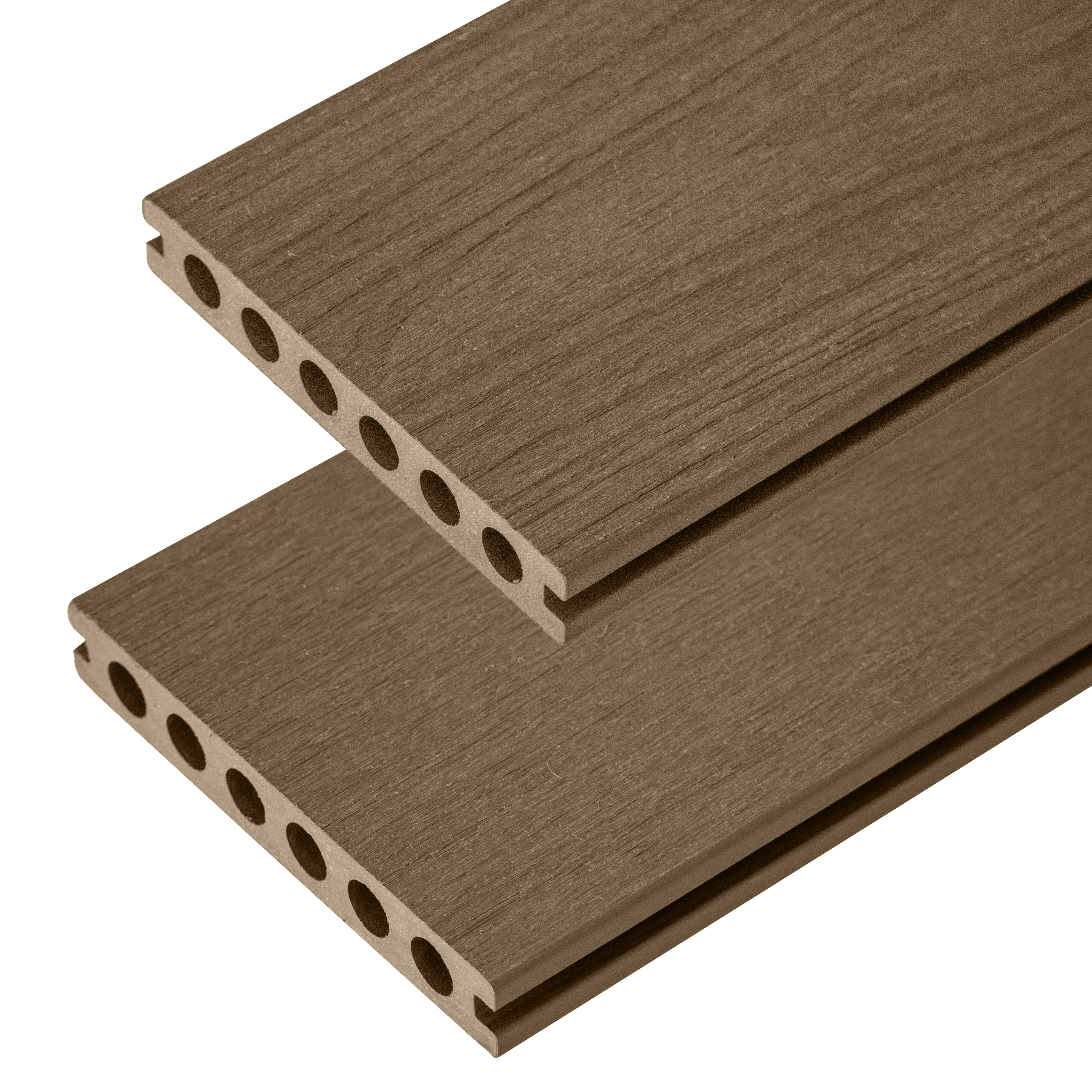
D053 outdoor hollow WPC decking
D053 is a first-generation outdoor hollow WPC decking board made from wood powder and plastic, with a declared profile of 23 mm thickness, 146 mm width and 2900 mm length. Its declared values are a bending failure of 3900 N, a density of 1.3 g/cm³, water absorption of ≤2% after a 5-hour boil, and a linear thermal expansion coefficient of ≤37 × 10⁻⁶ K⁻¹.
Functionally, D053 is specified for what a hollow first-generation board does well: it is waterproof and rot-proof, resistant to termites and wood-boring insects, retains a natural wood texture, and carries a grooved or textured anti-slip surface. It requires no painting, staining or sealing, cuts and drills with standard woodworking tools, and works with hidden clip systems.
Commercially, D053 is positioned as the cost-effective option — the board intended for large-area installations where capital cost per square metre and basic durability are the primary requirements, such as public parks, plazas, scenic boardwalks and community pathways.
GH001 co-extruded outdoor decking
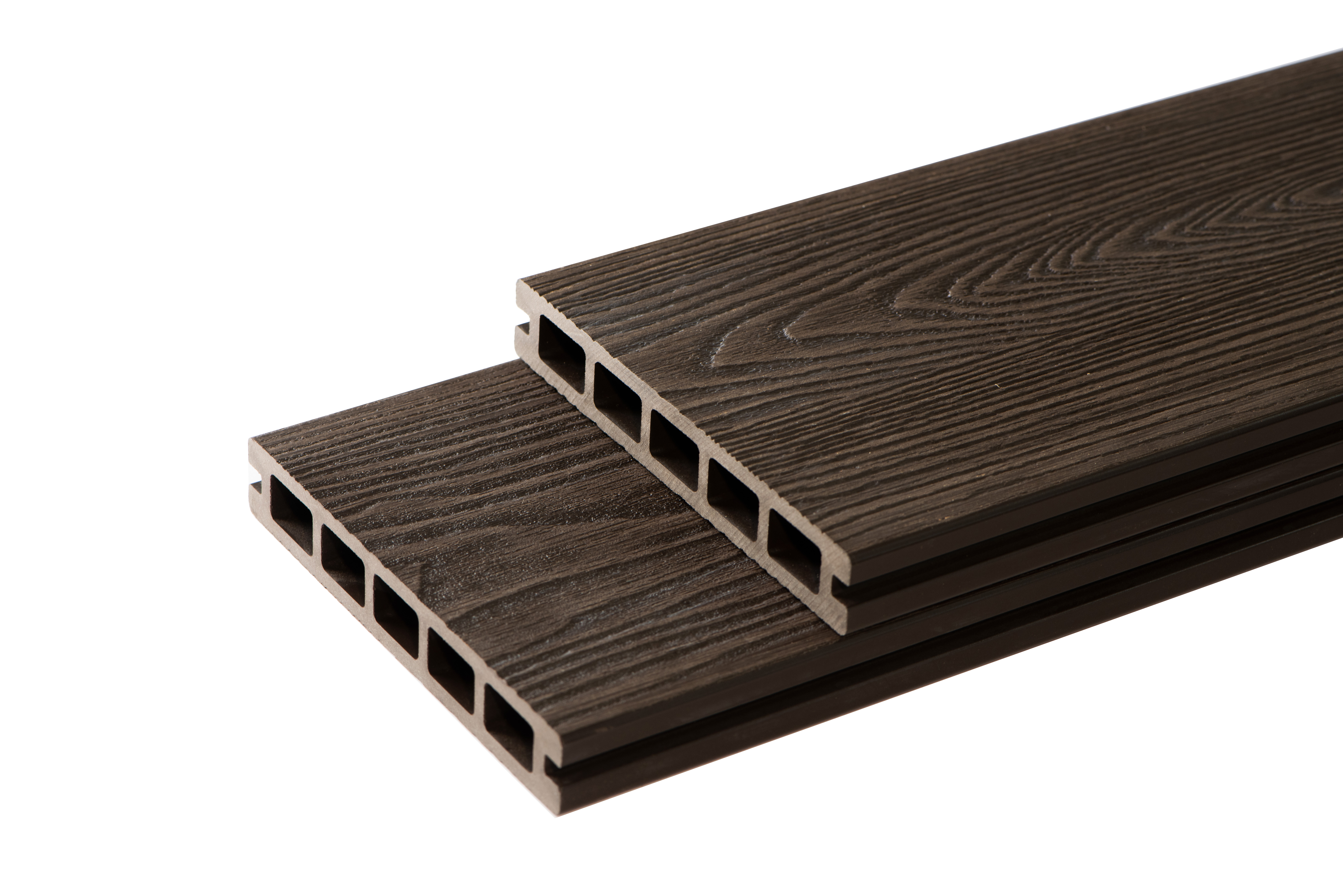
GH001 is a co-extruded outdoor decking board made from wood powder and plastic, in which a second-generation co-extruded polymer cap layer fully encapsulates the core. Its declared values are flexural properties of ≥3300 N, moisture resistance under cyclic test conditions with a mean of ≤10%, and water absorption of ≤7% in a boiling test. The board is engineered to withstand temperatures from −40 °C to 75 °C.
The cap layer is the technical core of the product. The outer shell is formulated with advanced UV-resistant components such as ASA materials, which supports colour retention and reduces fading and greying. The supplier describes the capped surface as offering up to five times better abrasion and scratch resistance than traditional WPC, and the embossed 3D wood grain and brushed finishes give the board a deeper texture than a first-generation profile. GH001 is fully recyclable, free from formaldehyde, benzene and toxic chemicals, and available in a range of standard colours and custom finishes.
The functional consequence for specifiers is a board aimed at residential and commercial terraces, balconies, swimming pool surrounds, waterfront boardwalks and park pathways — locations where foot traffic, wet-dry cycling and UV load all act on the same surface.
What EPD S-P-12197 covers — and what it does not
The Environmental Product Declaration for these products is registered as S-P-12197 with EPD International AB. It was issued on 2024-03-15, remains valid until 2029-03-15, and conforms to EN15804+A2 and ISO 14025 / ISO 21930. The declaration's product coverage includes GH001 co-extruded outdoor decking and D053 outdoor hollow WPC decking, and recognition is stated for the China and Netherlands markets.
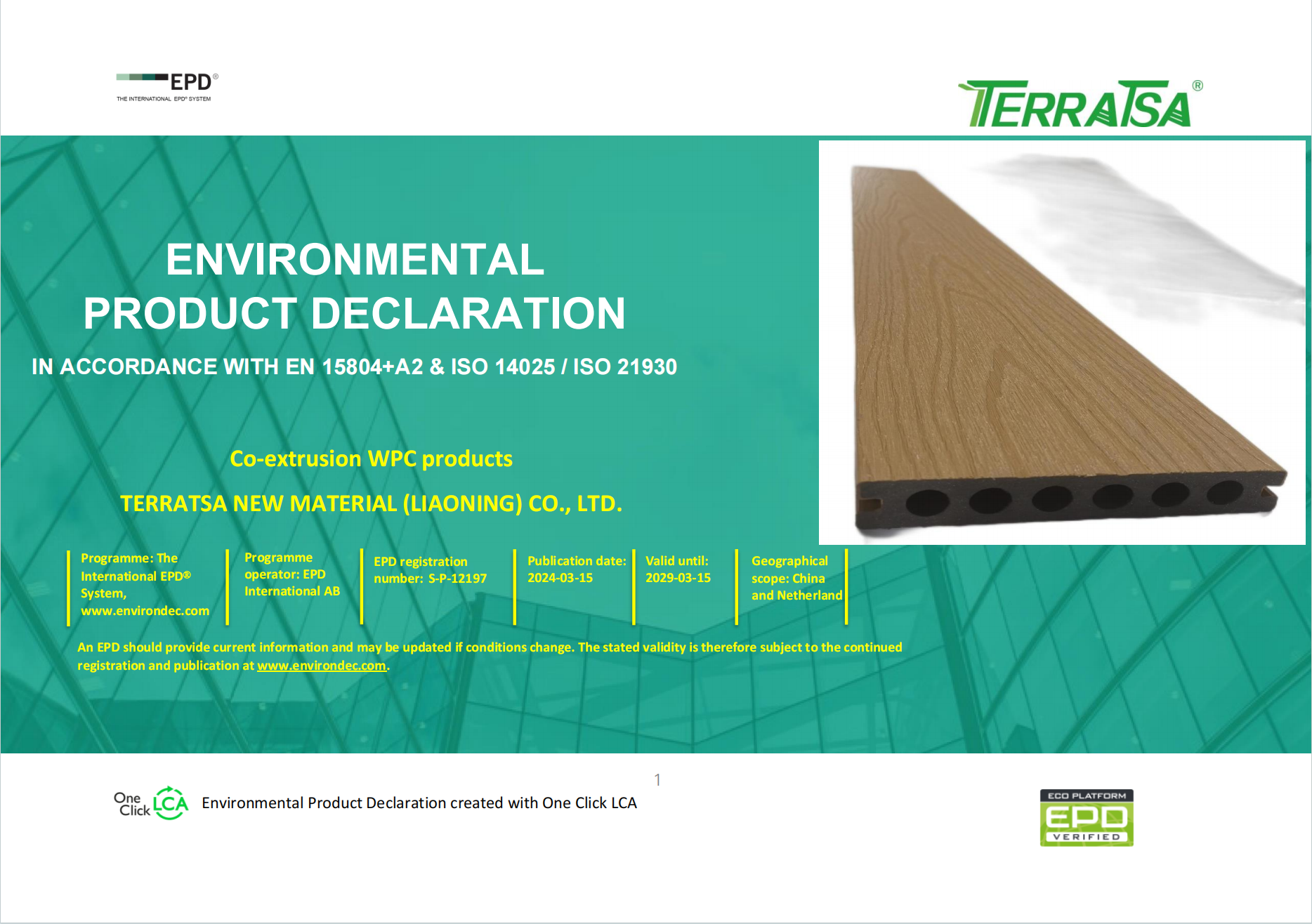
Verification note for buyers: the certificate record describes the declared scope as co-extrusion WPC products, while the declaration's product list includes both GH001 and D053. Before a tender submission, open the S-P-12197 entry in the EPD library, confirm the exact product-list entry for the board you are specifying, and archive that page in the submittal file. That single step prevents the most common documentation query at bid stage.
What the EPD does not do is separate the two boards. Because the same declaration number covers both, an EPD line item cannot be used as a tie-breaker between D053 and GH001. It only proves that both boards sit inside the same declared environmental assessment boundary.
The rest of the document pack
Terratsa New Material (Liaoning) Co., Ltd., founded in 2007 and operating a 74,000 m² production base in the Yingkou Area of the China (Liaoning) Pilot Free Trade Zone, supports the EPD with additional certificates that buyers typically request alongside it:
- FSC Chain of Custody, certificate 0218718, issued by SAI Global Certification Services Pty. Ltd., valid from 2025-07-10 to 2030-07-07, covering tracking of wood-based material and wood-plastic composites W9.11 with FSC 100% and FSC Mix claims under FSC-STD-40-004 V3-1 and FSC-STD-50-001 V2-1. The certification applies globally and covers the WPC decking products, including D053 and GH001.
- ISO 9001:2015, certificate 03825Q01470R0M, and ISO 14001:2015, certificate 03825E01471R0M, both issued by World Standards For Certification Center Inc., valid from 2025-03-03 to 2028-03-02 and covering production of WPC flooring.
- ISO 45001:2018, certificate 03825S01472R0M, from the same body and valid over the same period, covering occupational health and safety management activities in WPC flooring production and applicable to all market regions.
- CE, ASTM and SGS certification listed among the company's product certifications, alongside the EPD.
Step-by-Step Breakdown: Building an Acceptance-Ready Specification
Step 1 — Fix the exposure profile before comparing boards
Write down the project type, climate, traffic class and wet exposure. A Polish terrace project with low winter temperatures and high humidity, where the stated requirements are weather resistance, UV resistance, low water absorption, anti-scratch and anti-slip performance, is a different brief from a Chinese park decking installation where high humidity and public footfall drive the requirement list. The exposure profile determines which GH001 characteristics (−40 °C to 75 °C envelope, capped surface, UV-resistant shell) are mandatory and which are optional.
Step 2 — Write parameter lines using one protocol per line
Never place a bending failure figure next to a flexural property figure as if they were the same measurement. If your submittal language is based on ASTM D7032 ratings, ask for the performance rating table. If your specification is written around a specific test method, ask for the value in that method's format. For D053 this means the 3900 N bending failure, the ≤2% water absorption after a 5-hour boil, the 1.3 g/cm³ density and the ≤37 × 10⁻⁶ K⁻¹ thermal expansion coefficient. For GH001 it means the ≥3300 N flexural properties, the ≤10% mean moisture resistance under cyclic conditions and the ≤7% boiling-test water absorption. Each figure belongs on its own line with its own test basis.
Step 3 — Verify the certificate pack
Confirm four things for the EPD: registration number S-P-12197, issuing programme operator EPD International AB, validity to 2029-03-15, and standard conformance to EN15804+A2 and ISO 14025 / ISO 21930. Then confirm FSC 0218718, ISO 9001 03825Q01470R0M, ISO 14001 03825E01471R0M and ISO 45001 03825S01472R0M against their issuing bodies and expiry dates. All four management-system certificates remain valid to 2028-03-02.
Step 4 — Attach the documents to the purchase order
A purchase order that references certification without listing documents leaves acceptance open to interpretation. A workable annex lists: the EPD with registration number and validity date; the FSC certificate with certificate number and claim type; the ISO certificates with numbers; the declaration of conformity; the batch-level test record; and the board's declared parameter sheet with test methods stated.
Step 5 — Validate with samples and pre-shipment inspection
Production quality control is stated as 100% test, and OEM/ODM customization including logo is supported. Use a sample to check the surface finish, colour tone, cut behaviour and clip fit before releasing volume. Because the MOQ is one container, a sample round is cheap compared with correcting a mixed container after arrival.
Step 6 — Lock the commercial terms
The quoted lead time is 30–45 days, the MOQ is one container, and after-sales support is delivered remotely. Terratsa exports about 85% of output to more than 40 countries and operates an independent overseas warehouse in the Netherlands, which is relevant for European restocking and for buyers who want to inspect a physical board before committing to a project quantity.
Use Cases: Where the Two Boards Separate
Large public decking where capital cost dominates
Parks, plazas, scenic spots and community boardwalks run to large areas, and the cost difference between board families scales with square metres. D053 was developed for this band: a hollow first-generation profile with basic outdoor durability, anti-slip texturing and a natural wood appearance, installed with hidden clips. One project contractor in China installed approximately 500 tons of WPC decking in a park application; the boards were reported as durable after 15 years in service with no fading and no bending.
Residential terraces, pool surrounds and high-UV or cold-climate sites
GH001 fits where the surface itself is the specification issue. The capped shell supports colour stability under UV, the embossed grain and brushed finish hold texture, and the engineered −40 °C to 75 °C range covers cold-winter and hot-summer markets. Around swimming pools and spa decks the textured anti-slip surface matters most, because barefoot traffic on a wet board is the failure mode that generates complaints.
Mixed specifications
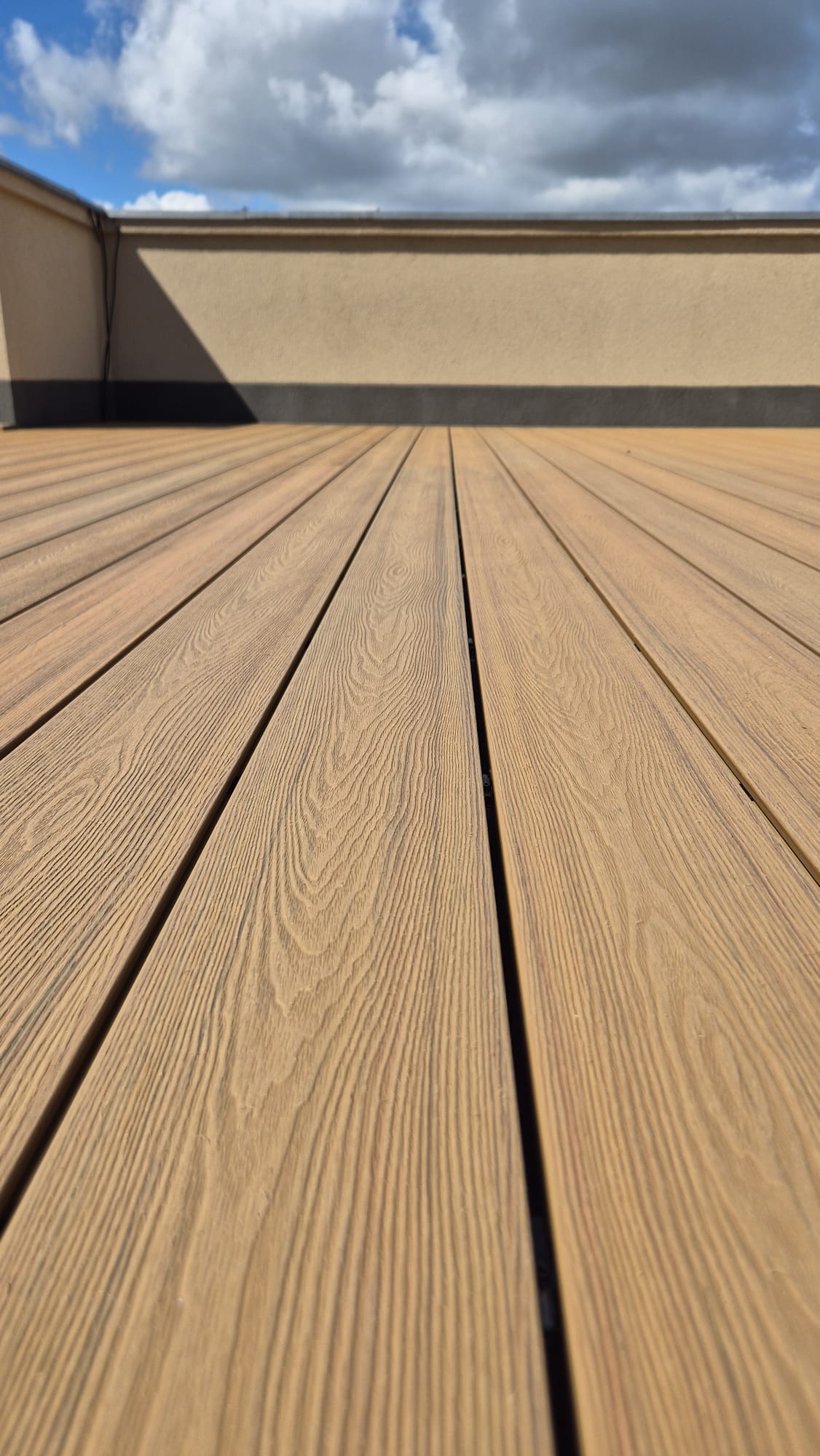
Many projects are better served by a split specification: D053 for the large field areas where the budget is set by area, and GH001 for pool edges, transition zones, entrance platforms and high-traffic corners where the cap layer earns its cost. Because both boards sit under the same EPD number, a mixed specification still produces one coherent compliance story.
Distributor and OEM programmes
Distributors carrying both boards can serve two price bands from one supplier and one certificate pack. OEM/ODM support with logo customization covers private-label terrace decking ranges, and the one-container MOQ keeps a first stocking order within a manageable commitment.
Comparison Table: D053 vs GH001
| Criteria | D053 outdoor hollow WPC decking | GH001 co-extruded outdoor decking |
|---|---|---|
| Construction | First-generation hollow profile, wood powder and plastic | Co-extruded profile with a second-generation polymer cap fully encapsulating the core |
| Declared profile | 23 mm × 146 mm × 2900 mm | Not stated in the available product data — request the current drawing with the quotation |
| Mechanical value as declared | Bending failure 3900 N | Flexural properties ≥3300 N |
| Density | 1.3 g/cm³ | Not declared in the available product data |
| Water absorption as declared | ≤2% (boil for 5 hours) | ≤7% (boiling test) |
| Moisture resistance, cyclic test | Not declared in the available product data | Mean ≤10% |
| Linear thermal expansion | ≤37 × 10⁻⁶ K⁻¹ | Not declared in the available product data |
| Temperature envelope | Not declared in the available product data | Engineered for −40 °C to 75 °C |
| Surface system | Natural wood texture; grooved or textured anti-slip surface; standard colours | Deep embossed 3D wood grain and brushed surfaces; UV-resistant shell components such as ASA; standard colours and custom finishes |
| EPD coverage | Covered under S-P-12197, EPD International AB, valid until 2029-03-15 | Covered under the same declaration, S-P-12197 |
| FSC coverage | Covered under FSC CoC 0218718 (global) | Covered under FSC CoC 0218718 (global) |
| Facility management systems | ISO 9001 03825Q01470R0M, ISO 14001 03825E01471R0M, ISO 45001 03825S01472R0M | Same certificates, covering WPC flooring production |
| Typical best fit | Large-area public decking where capital cost per m² sets the budget | Terraces, pool surrounds, high-UV and cold-climate sites where the cap layer and colour stability matter |
| Commercial terms | MOQ 1 container; lead time 30–45 days; OEM/ODM available | MOQ 1 container; lead time 30–45 days; OEM/ODM available |
Values are as declared for each product. Where a value is not declared in the available data, it is marked accordingly rather than estimated.
FAQ: D053, GH001 and EPD S-P-12197
Does EPD S-P-12197 cover both D053 and GH001?
Yes. The declaration is registered as S-P-12197 with EPD International AB, was issued on 2024-03-15, is valid until 2029-03-15, and conforms to EN15804+A2 and ISO 14025 / ISO 21930. Its product coverage includes GH001 co-extruded outdoor decking and D053 outdoor hollow WPC decking, with recognition stated for the China and Netherlands markets. Because the certificate record describes the declared scope as co-extrusion WPC products, confirm the exact product-list entry for your board in the EPD library before citing the declaration in a tender document, and keep that page in the submittal file.
Which board has the stronger mechanical and water data?
The two products are not directly rankable. D053 declares a bending failure of 3900 N, a density of 1.3 g/cm³ and water absorption of ≤2% after a 5-hour boil. GH001 declares flexural properties of ≥3300 N, moisture resistance under cyclic test conditions with a mean of ≤10%, and water absorption of ≤7% in a boiling test. Because the metrics and test protocols differ, the correct action for a specifier is to name the test method and require the value in that format, rather than to compare the numbers across boards. Where a performance rating is required, ASTM D7032 is the reference standard for establishing ratings for wood-plastic composite deck boards.
Which board sits in the lower price band?
D053 is positioned as the cost-effective, first-generation option for budget-conscious and large-volume projects, while GH001 carries a full co-extruded cap layer plus UV-resistant shell components, so the two boards do not occupy the same commercial band. No list prices are published in the available data; pricing is confirmed by quotation, and the MOQ for both boards is one container. When comparing quotations, include fixing clips, screws, joists, installation labour and the maintenance both boards avoid, so the comparison reflects installed cost rather than board cost alone.
Can we validate a board before committing to a container?
Production quality control is stated as 100% test, and OEM/ODM customization including logo is supported. Sample and specification requests are handled directly by the manufacturer: email sales01@unvocwpc.com or WhatsApp +8615943028515, quoting the board model, project location and required declaration documents. Physical validation should cover surface finish, colour tone, cut behaviour and clip fit before a container is released, since the MOQ is one container and a mixed-container correction after arrival is far more expensive than a sample round.
What lead time and delivery terms should we plan for?
The quoted lead time is 30–45 days and the MOQ is one container, with remote after-sales support. Terratsa New Material (Liaoning) Co., Ltd. exports about 85% of its output to more than 40 countries and operates an independent overseas warehouse in the Netherlands, which shortens restocking for European projects. To move from evaluation to quotation, send the board model, area, project type and required certificates to sales01@unvocwpc.com — the full decking range and declared parameters are in the Terratsa decking brochure, available for open download.
Conclusion: The Decision Rule
EPD S-P-12197 gives D053 and GH001 a shared compliance baseline — same programme operator, same standard conformance, same validity to 2029-03-15. That is useful for the submittal and neutral for the decision.
The choice comes down to which constraint dominates your project. If the driver is capital cost per square metre across large public areas, with basic outdoor durability, anti-slip texturing and low maintenance as the requirement set, D053 is the fit. If the driver is surface performance — colour stability under UV, a fully encapsulating cap layer, an engineered −40 °C to 75 °C envelope, and anti-slip behaviour around pools and wet zones — GH001 is the fit. Where both pressures exist in one project, split the specification by zone and keep a single EPD reference across the whole deck.
In every case, the acceptance criteria decide the outcome: name the board in the purchase order, attach the certificate numbers, state the test method beside each declared value, and verify the product-list entry in the EPD library before you sign. Certification narrows the field; the specification does the rest.
Next Step: Sample, Specification Sheet or Quotation
Terratsa New Material (Liaoning) Co., Ltd. — founded 2007, 74,000 m² production base in Yingkou, Liaoning, China, with a 25-engineer R&D team and OEM/ODM support for decking programmes.
Email: sales01@unvocwpc.com · Tel / WhatsApp: +8615943028515 · Website: www.terratsa.com
Address: No. 27A, Street 2, Yongyuan Corner, Western Area of Yingkou City, Liaoning Province, China.
Download the Terratsa decking brochure (PDF) for board profiles, colours and declared parameters.
Have Questions or Need More Details?
Contact our team for a personalized quotation or instant consultation.
Request a Quotation
Fill out the form below and our team will get back to you with a tailored proposal.
WhatsApp Direct Chat
Prefer to chat in real-time? Message us on WhatsApp for instant assistance & quick answers.
- Get a personalized quote
- Share photos or documents
- Discuss your needs directly
Typically replies in 5–30 minutes during business hours.