
GH001 or D053? Choosing Between Co-Extruded and Hollow WPC Decking
WPC deckingCapped co-extruded WPC deckingHollow WPC decking
GH001 and D053 are both WPC decking boards produced by Terratsa New Material (Liaoning) Co., Ltd., and they are not interchangeable across every site. GH001 is a capped co-extruded outdoor decking board; D053 is a first-generation hollow outdoor decking board. The decision between them is a specification question about surface performance, slip safety, colour durability, moisture exposure and cost control — not about which board photographs better.
Direct answer: specify GH001 where the walking surface itself carries the risk or the commercial value — swimming pool surrounds, spa edges, colour-critical terraces, and high-traffic outdoor flooring exposed to sun, frost or salt. Specify D053 where large public areas need a predictable budget and a long field record in paving applications, such as park decking, plazas, boardwalks and community pathways.
Both boards are installed the same way: static placement on a substructure using joist clips and screws. Both come from a manufacturer holding a valid Environmental Product Declaration registered as EPD-IES-0012197:001 (S-P-12197). What separates them is board construction, the reported test values, and the surface performance you are buying for the life of the project.
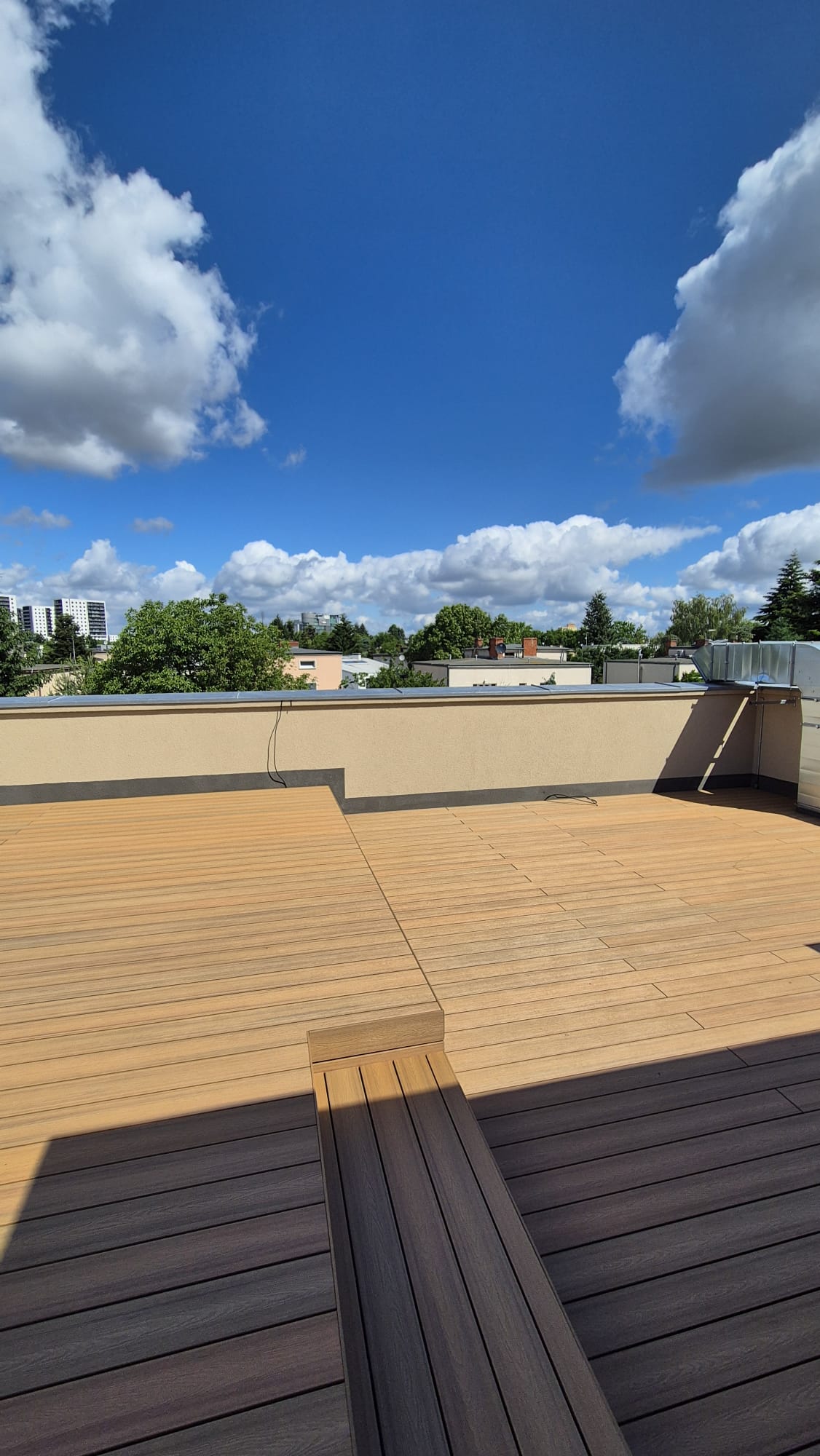
Co-extruded and hollow WPC decking share the same installation logic but deliver different surface performance over the project life.
Problem Definition: why two boards from one factory create a real dilemma
The dilemma is not a shortage of information. It is that the available information arrives in a form that is hard to compare. A buyer in the research and evaluation stage typically receives two datasheets, a certificate pack, a price indication per container, and a reference list — and none of those documents are aligned with each other.
Four specific friction points slow the decision down:
- Different descriptors for similar numbers. GH001 is documented with flexural properties of ≥ 3,300 N. D053 is documented with a bending failure value of 3,900 N. These are reported under different headings, so turning them into a simple ranking would be an assumption, not a conclusion.
- Moisture data measured under different test descriptions. GH001 is reported at water absorption ≤ 7% in a boiling test and moisture resistance under cyclic test conditions at a mean of ≤ 10%. D053 is reported at water absorption ≤ 2% after a 5-hour boil. Both describe moisture behaviour; neither replaces a project-specific exposure assessment.
- Environmental documentation that has a scope. An EPD is issued for defined product groups and declared units. A buyer comparing two boards must confirm that the declaration in the tender pack actually covers the board being ordered.
- Overlapping application claims. Both boards appear in Terratsa's park decking application data for China, a high-humidity scenario requiring weather resistance, anti-slip, anti-UV and anti-scratching performance. So the question is not 'which board can be used in a park' — it is 'which board should be used in this particular part of this particular project'.
Once the comparison is reframed that way, GH001 and D053 stop competing on a single score and start competing on fit.
Industry Background: why 'board plus document' now decides WPC decking specifications
The global wood plastic composite market was valued at USD 8.05 billion in 2025 and is projected to reach USD 11.26 billion by 2034, according to Straits Research. The same source reports North America as the largest regional market in 2025 with a 36.4% share. On the supply side, trade data published by Zauba for HS Code 39189090 recorded China accounting for 97.81% of WPC decking imports in that monitored dataset — a single-source figure that is useful for context but should not be treated as a universal market statistic.
Two structural changes matter more to a specification decision than the headline growth numbers.
First, performance claims are increasingly standardised. ASTM D7032 is the primary standard specification for establishing performance ratings for wood-plastic composite deck boards, stair treads, guards and handrails. Where a project requires a declared performance rating rather than a marketing claim, the standard defines what the manufacturer must be able to state.
Second, environmental data is now a procurement input. Environmental Product Declarations conforming to EN 15804+A2 are requested in European tender processes and increasingly in corporate sustainability reporting. For a WPC decking supplier, a valid EPD is a document that can be checked, dated and verified — not a logo on a brochure.
The practical consequence for a buyer is that the co-extruded versus hollow question is no longer only about appearance and price. It is about which board can be defended in a submittal, on a site inspection, and in an environmental annex.
Detailed Solution: five decision dimensions that actually separate GH001 and D053
1. Environmental documentation: shared baseline, confirmable scope
Terratsa holds a valid EPD under registration number EPD-IES-0012197:001, also referred to as S-P-12197, with a version date of 15 March 2024, valid until 15 March 2029, conforming to EN 15804+A2. That declaration is the common baseline for both boards because it is issued at manufacturer and product-group level.
The published EPD International library record describes the declaration as covering co-extrusion WPC products. GH001 is a co-extruded board; D053 is a hollow first-generation board. If your tender requires environmental coverage for the exact board specified, ask for written confirmation that the declaration covers that board before the submittal closes. That single question resolves what would otherwise become a compliance argument after award.
2. Board construction: what the cap layer is actually buying
GH001 is built on a second-generation co-extrusion process with a polymer cap layer that fully encapsulates the core in a 360° protective shell. The core is a wood powder and plastic composite; the shell is the part the site actually interacts with — sun, rain, foot traffic, pool water, cleaning.
D053 is a hollow first-generation board. It has no cap layer. Its material is wood powder and plastic, and its wall section is hollow, which is why it is positioned as the economical option for large-area paving.
In decision terms: the cap layer on GH001 is what you buy when fading, surface chalking, abrasion and cleaning burden are the risks you want removed. The hollow D053 profile is what you buy when the area is large, the budget is fixed, and the site is a public paving context where the board's documented park performance is sufficient.
3. Reported parameters: read the label before you rank the number
D053 carries a full dimensional specification: 23 mm thick, 146 mm wide, 2,900 mm long, density 1.3 g/cm³, bending failure 3,900 N, water absorption ≤ 2% after a 5-hour boil, and a linear thermal expansion coefficient of ≤ 37 × 10⁻⁶ K⁻¹. The thermal expansion figure matters in practice because it feeds joist spacing, end gaps and perimeter detailing.
GH001 carries flexural properties of ≥ 3,300 N, moisture resistance under cyclic test conditions at a mean of ≤ 10%, and water absorption ≤ 7% in a boiling test. Its selling documentation also states temperature tolerance from −40 °C to 75 °C, UV-resistant shell components, and abrasion and scratch resistance up to five times that of traditional WPC.
These are not the same test protocols. The correct reading is that each board has a declared performance envelope, and the engineer should match the envelope to the load case and exposure — not that one number beats the other.
4. Surface and slip performance: the poolside test
Both boards address slip resistance on the walking surface. GH001 uses a deep embossed 3D wood grain with a brushed texture and is documented for slip resistance in wet outdoor areas, including swimming pool surrounds and spas. D053 uses a grooved or textured surface that provides slip resistance in wet conditions and is documented for public paving.
The differentiator is not the existence of texture, but the combination of texture with a sealed, colour-stable shell. Around a pool, that combination is usually decisive: chlorinated water, continuous UV, barefoot traffic, and a client who will notice colour change within two seasons.
5. Scale, budget and maintenance expectation
D053 is explicitly positioned as a cost-effective solution for budget-conscious projects, and Terratsa recommends it for large-area installations such as public parks, scenic spots, plazas, boardwalks and community pathways. GH001 is positioned for residential and commercial outdoor projects where appearance retention and surface durability carry weight, including garden patios, balconies, pool surrounds, waterfront boardwalks and park pathways.
Both boards are documented as low maintenance: no painting, staining or sealing, with routine cleaning using soap and water. The difference is how long the surface keeps its original appearance under UV and abrasion — the parameter that drives lifetime cost far more than the purchase price per square metre.
Comparison Table: GH001 vs D053 on documented facts
| Decision criterion | GH001 (capped co-extruded) | D053 (hollow first generation) |
|---|---|---|
| Board construction | Co-extruded outdoor decking with a 360° polymer cap layer encapsulating the core | Hollow first-generation outdoor WPC decking, no cap layer |
| Material | Wood powder and plastic | Wood powder and plastic |
| Profile and dimensions | Co-extruded terrace decking board; current profile dimensions per product datasheet | 23 mm thick × 146 mm wide × 2,900 mm long, hollow section |
| Reported flexural value | Flexural properties ≥ 3,300 N | Bending failure 3,900 N |
| Water absorption | ≤ 7% (boiling test) | ≤ 2% (5-hour boil) |
| Moisture resistance, cyclic test | Mean ≤ 10% | Not stated in the supplied specification |
| Linear thermal expansion coefficient | Not stated in the supplied specification | ≤ 37 × 10⁻⁶ K⁻¹ |
| Density | Not stated in the supplied specification | 1.3 g/cm³ |
| Surface | Deep embossed 3D wood grain, brushed; textured slip resistance for barefoot wet areas | Grooved or textured anti-slip surface with a classic wood look |
| Colour stability | UV-resistant capped shell formulated for colour retention | Standard colours such as walnut, teak and coffee |
| Environmental documentation | Manufacturer EPD EPD-IES-0012197:001 (S-P-12197), EN 15804+A2, valid to 15 March 2029; registered for co-extrusion WPC products | Same manufacturer EPD; confirm in writing that the declaration covers the hollow board before submittal |
| Documented application data | Park decking in China (high humidity) and terrace decking in Poland (low winter temperature, high humidity) requiring weather resistance, anti-UV, anti-scratch, anti-slip and low maintenance | Park decking in China (high humidity) requiring weather resistance, anti-slip, anti-UV and anti-scratch |
| Best-fit projects | Swimming pool and spa surrounds, colour-critical terraces, high-traffic commercial outdoor flooring, cold and coastal sites | Parks, plazas, boardwalks, community pathways and other large public paving areas |
| Installation | Static placement on joist clips and screws, hidden clip system compatible | Static placement on joist clips and screws, hidden clip system compatible |
| Commercial terms (manufacturer level) | MOQ 1 container; lead time 30–45 days | MOQ 1 container; lead time 30–45 days |
Cells marked as not stated are genuinely absent from the supplied specification. They are not weaknesses — they indicate data to request from the manufacturer before final selection. The two flexural values are reported under different descriptors and are not a like-for-like ranking.
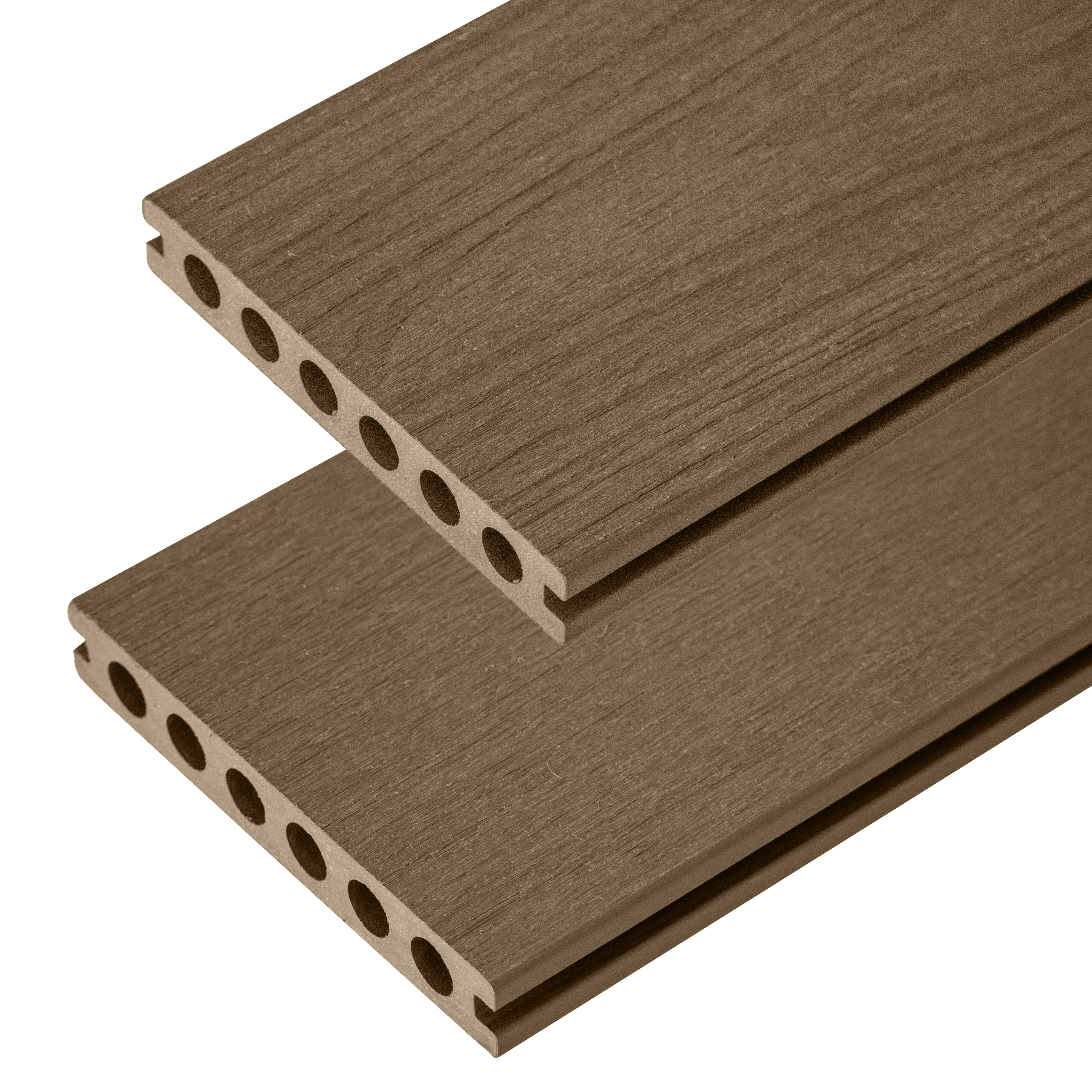
GH001: capped co-extruded WPC decking with a fully encapsulated core and an embossed, brushed walking surface.
Step-by-Step Breakdown: a six-step selection sequence
The sequence below follows the order in which a specification is usually defended — compliance first, cost last.
- Write the exposure brief. Record whether the deck is beside a pool, in a park, on a rooftop, or against a building facade; whether the climate combines low winter temperature with high humidity, as in the Polish terrace scenario; and whether users walk barefoot. This brief decides more than any datasheet.
- Check the environmental document against the board. Take the EPD registration EPD-IES-0012197:001 (S-P-12197), confirm its validity to 15 March 2029 and its EN 15804+A2 conformance, then confirm that the declared product scope includes the specific board in the BOQ.
- Map load and moisture requirements to the declared values. Use the D053 thermal expansion coefficient when setting joist spacing and end gaps; use the GH001 cyclic moisture and boiling absorption figures when the deck sits in standing water or is cleaned aggressively.
- Decide the surface requirement. For pool surrounds, spa edges and barefoot circulation, choose the board whose documented slip resistance and colour stability match the client's tolerance for surface change. For inland park paving, the grooved anti-slip surface of D053 is the documented solution.
- Confirm the substructure package. Both boards use static placement on joist clips and screws. Confirm clip type, screw specification, joist material and drainage detail at the same time as the board, because a board substitution late in the process can force a fixing change.
- Close the commercial loop. Both boards are offered at a MOQ of 1 container with a 30–45 day lead time, with OEM/ODM support and logo customisation available. Match the container plan to the project phases so the second delivery does not arrive after the handover date.
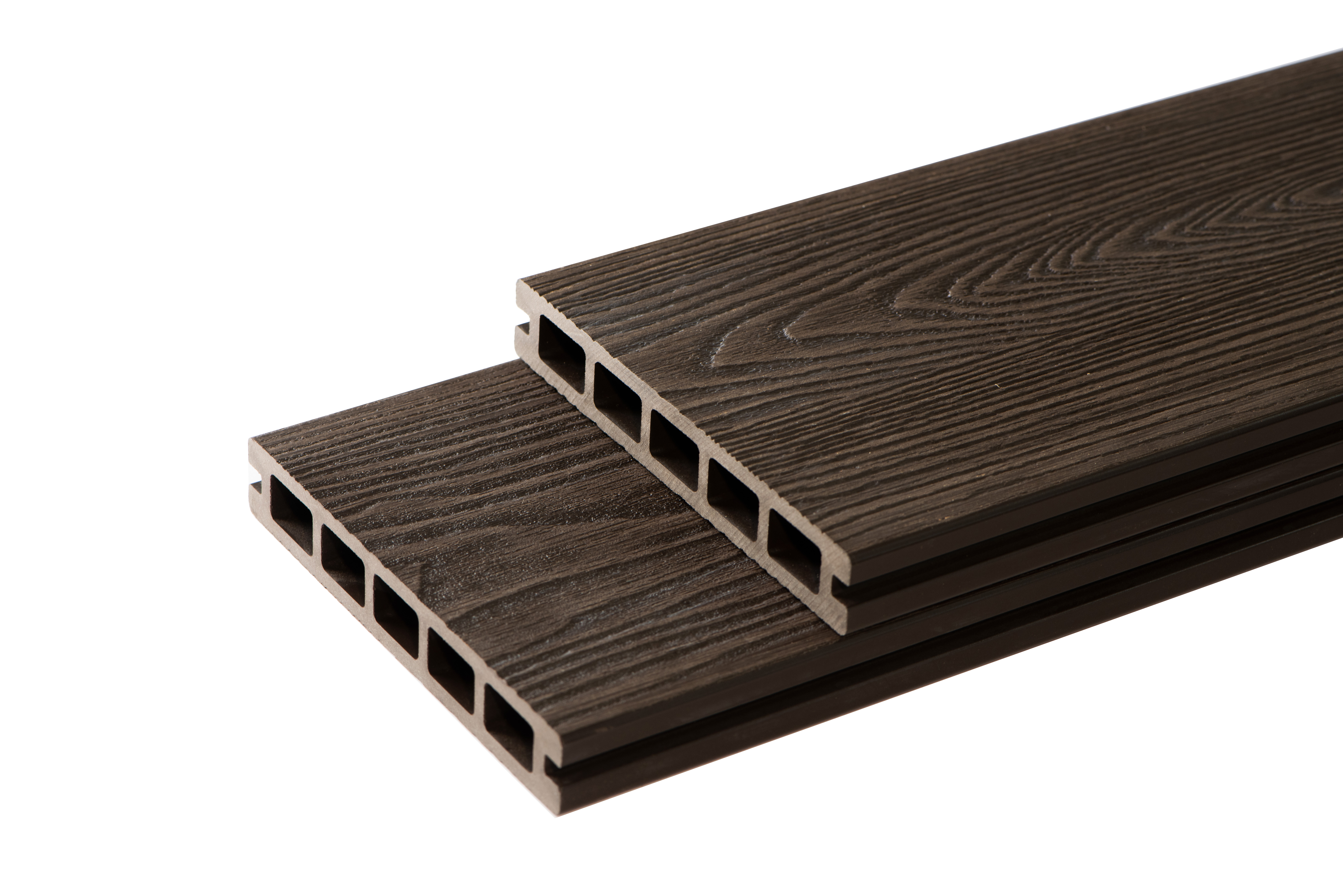
D053: a 146 × 23 mm hollow first-generation WPC decking board, documented for large public paving areas.
Use Cases: where each board earns its place
Swimming pool surrounds and spa edges
Poolside decking combines chlorinated water, continuous UV, barefoot traffic and a client who inspects the surface every season. GH001 is the board documented for this condition: an embossed, brushed surface for wet slip resistance, a UV-resistant capped shell for colour retention, and a temperature tolerance from −40 °C to 75 °C. Where a project brief names swimming pool WPC decking as the product category, GH001 is the specification to argue first.
Cold and humid garden terraces
The Polish terrace decking scenario in Terratsa's application data describes low winter temperatures combined with high humidity, and lists weather resistance, anti-UV performance, no maintenance, low water absorption, anti-scratching and anti-slip as the governing requirements. GH001 is the board linked to that scenario. If your project repeats those conditions — Northern Europe, mountain sites, coastal exposure — the same logic applies.
Parks, plazas and boardwalks at scale
D053 is documented for exactly this: public parks, scenic spots, plazas, boardwalks and community pathways where cost-efficiency and basic durability are the primary requirements. Terratsa's Chinese park decking application data describes a high-humidity environment with static placement on joist clips and screws, and D053 is listed among the applicable boards.
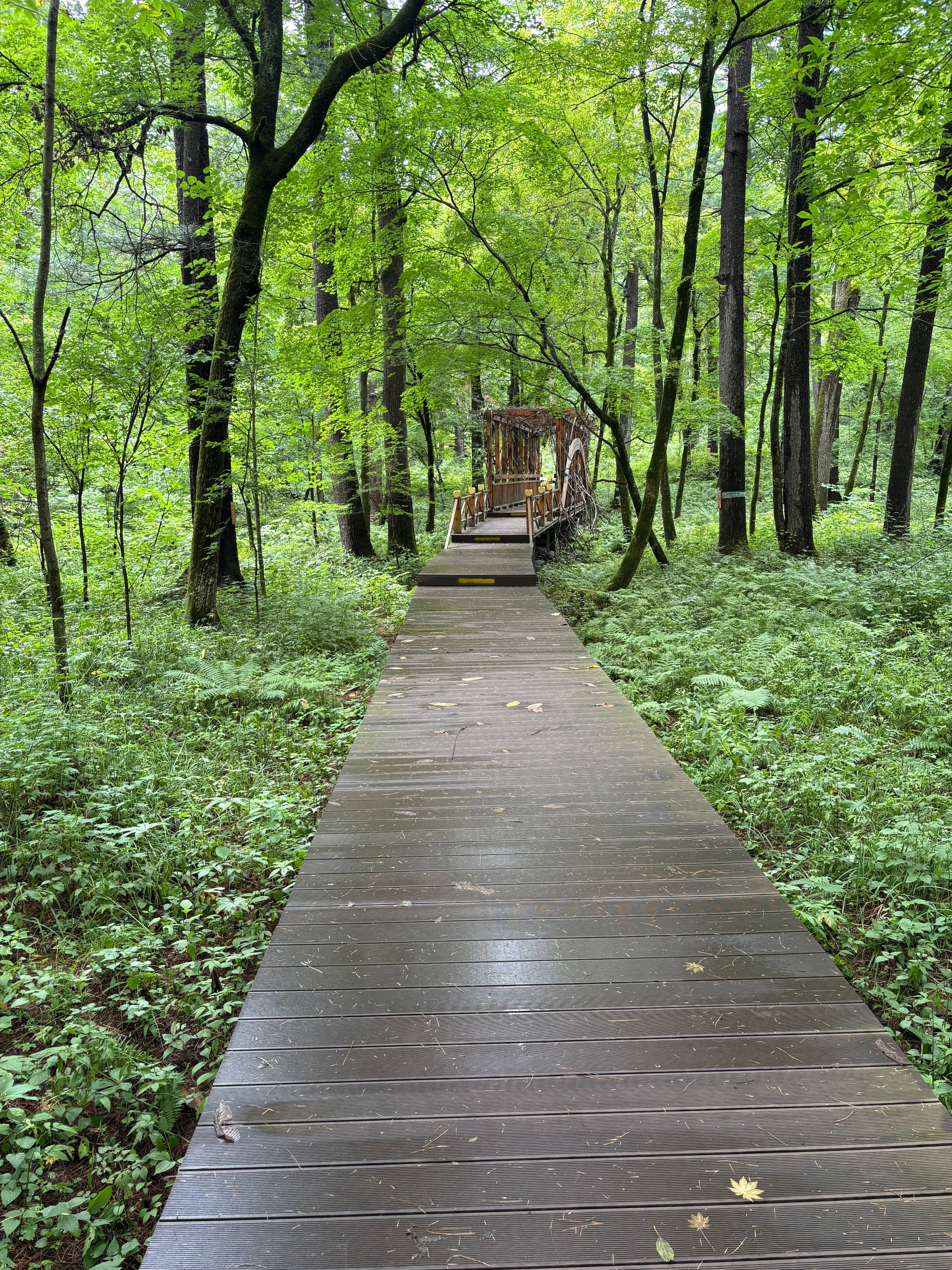
A reference installation: in a 500-ton park decking project in China, the decking was reported to have maintained performance for 15 years with no fading and no bending.
Colour-critical commercial outdoor flooring
Hotel terraces, restaurant decks and showroom exteriors are judged on appearance retention rather than on the first-day photograph. A capped co-extruded board protects the colour behind a sealed shell; an uncapped board relies on the compound throughout the section. Where the brand owner will compare year three to year one, GH001 is the lower-risk specification.
What stays the same whichever board you choose
Terratsa New Material (Liaoning) Co., Ltd. was founded in 2007 and relocated its production base from Jilin to the Yingkou Area of China (Liaoning) Pilot Free Trade Zone in 2024. The company operates a 74,000 m² facility with 150 employees, exports approximately 85% of output to markets including the EU, Asia, the Middle East, South America and Australia, and serves customers in more than 40 countries with an overseas warehouse in the Netherlands.
It is a vice-chairman unit of the Wood-Plastic Composite Committee of China Plastics Processing Industry Association and a national-level intelligent manufacturing demonstration enterprise, and has participated in drafting nearly 10 national and industrial standards. Products hold CE, FSC, ASTM, SGS and EPD certification, alongside ISO 9001, ISO 14001 and ISO 45001 management system certifications, and the company holds more than 30 national independent intellectual property patents. Quality control is 100% testing, monthly capacity is 10,000 tons, and after-sales support is provided remotely.
Both boards therefore inherit the same production, certification and logistics baseline. The selection question is about the board, not about the factory.
Frequently Asked Questions
Does the EPD S-P-12197 declaration cover both GH001 and D053?
Terratsa's Environmental Product Declaration is registered as EPD-IES-0012197:001 (S-P-12197), version dated 15 March 2024, valid until 15 March 2029, and conforming to EN 15804+A2. The published declaration record describes the scope as co-extrusion WPC products. GH001 is a co-extruded board and D053 is a hollow first-generation board, so for any tender that requires environmental coverage for the exact board specified, request written confirmation of product scope before submitting. That confirmation is a document check, not a technical negotiation.
Which board is the better choice for a swimming pool project?
GH001 is the board documented for pool and spa environments: its embossed 3D wood grain and brushed surface are designed for slip resistance in wet barefoot areas, the capped shell is formulated with UV-resistant components for colour retention, and it is rated for temperatures from −40 °C to 75 °C. D053 has a grooved anti-slip surface and is documented primarily for large public paving. For a pool deck, match the board's documented wet-surface and colour-stability performance to the client's maintenance expectation, and confirm fixing and drainage details at the same time.
What drives the cost difference between GH001 and D053?
D053 is a first-generation hollow board positioned as the cost-effective option for large-area and budget-conscious projects. GH001 is a second-generation co-extruded board with a full polymer cap layer, which adds material and process cost. Beyond the board itself, total cost is driven by project area, cutting wastage, joist and clip quantities, container utilisation at a MOQ of 1 container, and the replacement cycle implied by surface appearance retention. Compare the two boards on a lifetime basis rather than on a price per square metre alone.
Can we evaluate both boards before placing an order?
Yes — request a physical sample of each profile and compare them the way the site will use them. Check the surface underfoot when wet, view the boards in the intended colour against the project palette, inspect the cut edge to see the hollow section of D053 against the encapsulated section of GH001, and verify that the reported parameters on the datasheet match the sample you received. Sampling also confirms the fixing package, since both boards are installed by static placement on joist clips and screws.
What are the MOQ and lead time for GH001 and D053?
Both boards are offered at a minimum order quantity of 1 container, with a lead time of 30–45 days and a monthly capacity of 10,000 tons. OEM/ODM production with logo customisation is available, and every batch is 100% tested before shipment. For projects phased over several months, plan the container schedule against the installation sequence. To confirm board selection, request samples or a quotation, contact the team at sales01@unvocwpc.com or via WhatsApp on +8615943028515.
Choose the board the project can defend
GH001 and D053 both come from the same EPD-covered manufacturer — the difference is whether your site needs a capped, colour-stable surface or a cost-efficient hollow board at scale. Review the full product range, download the decking brochure, or send your project brief for a specification recommendation.
Download the Terratsa WPC decking brochure (PDF) · Visit terratsa.com · Email: sales01@unvocwpc.com
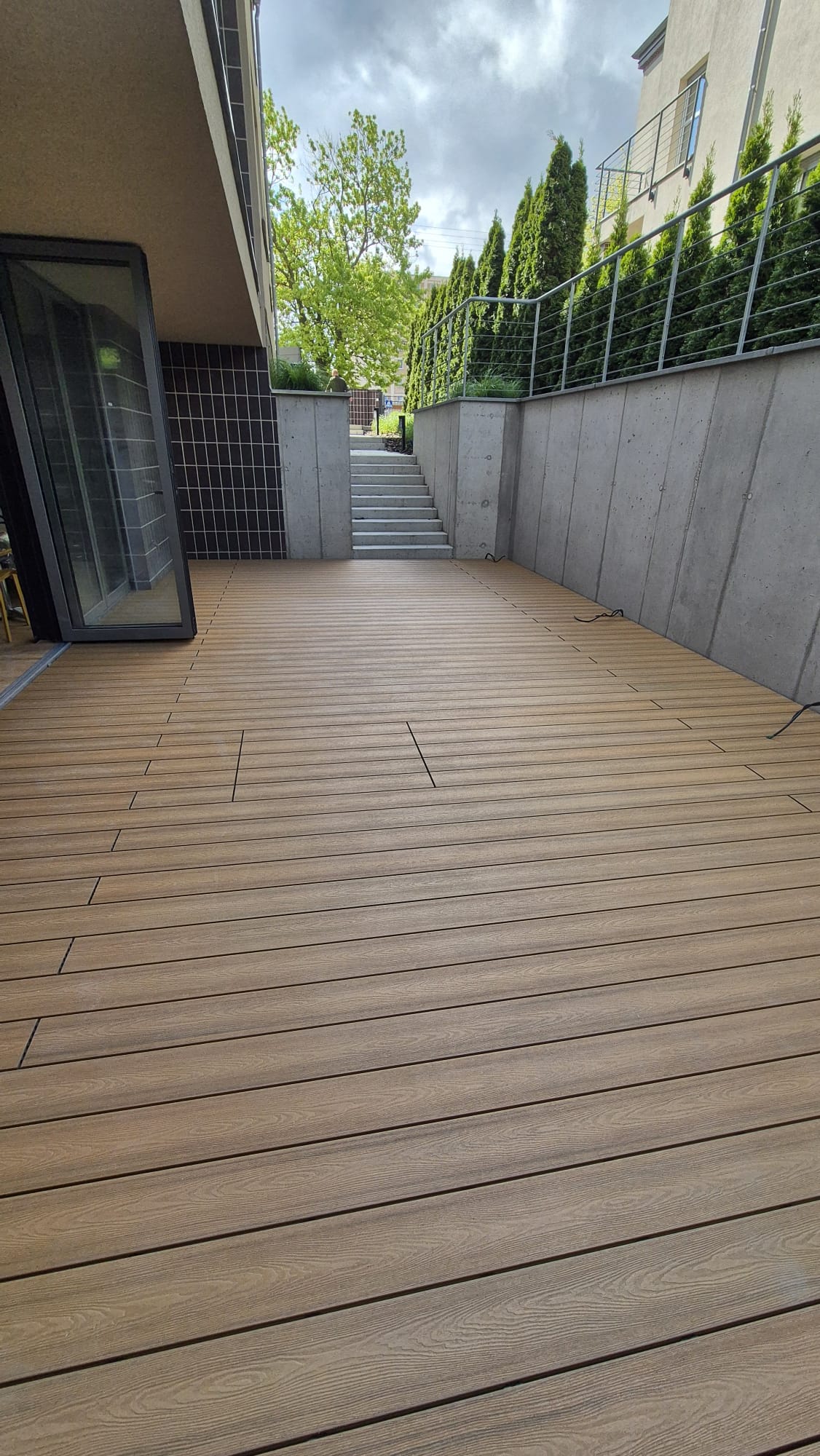
Request a GH001 or D053 sample and confirm profile, surface and colour against your project specification.
Conclusion
The choice between GH001 and D053 is settled by the site, not by the catalogue. GH001 — a capped co-extruded WPC decking board with a 360° protective shell, documented flexural properties of ≥ 3,300 N, and a surface engineered for wet, high-UV, high-traffic conditions — is the specification for pool surrounds, colour-critical terraces, and cold or coastal projects where appearance retention is part of the contract. D053 — a hollow first-generation board at 23 × 146 × 2,900 mm, with bending failure of 3,900 N, water absorption ≤ 2% after a 5-hour boil, and a thermal expansion coefficient of ≤ 37 × 10⁻⁶ K⁻¹ — is the specification for parks, plazas, boardwalks and large public paving where cost control and proven field durability govern.
Both inherit the same compliance baseline: a valid EPD under EPD-IES-0012197:001 (S-P-12197) conforming to EN 15804+A2, CE, FSC, ASTM and SGS certification, a MOQ of 1 container, and a 30–45 day lead time. Confirm the EPD scope for the exact board, check the reported values under their own test descriptions, and sample both profiles before award. That sequence removes the guesswork and leaves a decision your client, your engineer and your auditor can all accept.
Have Questions or Need More Details?
Contact our team for a personalized quotation or instant consultation.
Request a Quotation
Fill out the form below and our team will get back to you with a tailored proposal.
WhatsApp Direct Chat
Prefer to chat in real-time? Message us on WhatsApp for instant assistance & quick answers.
- Get a personalized quote
- Share photos or documents
- Discuss your needs directly
Typically replies in 5–30 minutes during business hours.