
WPC Decking and Cladding Application Guide: Certified Products for Project Scenarios
Certification documents do not choose a board — their scope statements do. The practical question at specification stage is not whether a WPC supplier holds certificates, but which certificate covers which model, under which standard, valid until which date, and for which market. Terratsa New Material (Liaoning) Co., Ltd., a wood-plastic composite manufacturer founded in 2007 and producing in the Yingkou Area of China (Liaoning) Pilot Free Trade Zone, publishes a certification set that can be read exactly this way, and this guide applies it to four models: GH001 co-extruded outdoor decking, D053 outdoor hollow decking, GH010 exterior wall cladding and GH024 outdoor WPC cladding.
Specifiers arriving at the evaluation-to-execution stage usually carry three questions into the file: which certificate satisfies the specification, which board suits the scenario, and what happens between order confirmation and delivery. The sections below answer them in that order — using published certificate numbers, validity dates and product parameters — and close with the commercial terms, acceptance criteria and lead times that turn a specification into a shipment.
The Specification Problem: Certificate Lists Are Not Product Fit
The documentation gap in WPC procurement is rarely about whether certificates exist. It is about whether they are matched to the model actually being purchased. Three mismatches appear repeatedly in project files.
- Scope mismatch. A management system certificate covers a defined activity, not automatically every item in a catalogue. ISO 9001 certificate 03825Q01470R0M is scoped to the production of WPC flooring and is linked to GH001, D053 and GH010; ISO 14001 and ISO 45001 certificates 03825E01471R0M and 03825S01472R0M are linked to GH001, D053, GH010 and GH024. Assuming uniform coverage across an entire range is where specification packages stall at approval stage.
- Standard mismatch. An Environmental Product Declaration built on EN 15804+A2 answers a different question from an FSC chain-of-custody certificate, and both differ from an ISO 14001 system certificate. When a tender names a standard, the certificate that satisfies it must be the one that references that standard — not simply the most recognisable logo in the bundle.
- Generation mismatch. First-generation hollow WPC decking and second-generation co-extruded WPC decking are not interchangeable at equal cost. The generation decision changes the performance expectation, the maintenance plan and the budget line, and it is often postponed until the purchase order is being drafted.
Each of these is a documentation task rather than a manufacturing problem, and each can be resolved before the first container is booked.
Market Context: Why Documentation Now Carries More Weight
Wood-plastic composite has moved from a niche alternative to a mainstream exterior material, and the supplier base has expanded with it. Third-party research published by Straits Research values the global WPC market at USD 8.05 billion in 2025, with a projected value of USD 11.26 billion by 2034; the same source reports North America as the largest regional market in 2025 with a 36.4% share. Trade monitoring of WPC decking imports under HS Code 39189090 recorded China as the origin of 97.81% of that monitored volume — a directional figure from a single trade dataset rather than a global census.
Two consequences follow for specifiers. First, when many suppliers quote similar-looking boards, documentation scope becomes the practical differentiator: an EPD that names its declared markets, or an FSC certificate that states its claim type (FSC 100% or FSC Mix), tells a buyer more than a generic compliance statement. Second, the technical reference point is increasingly standardised. ASTM D7032 is the specification used to establish performance ratings for wood-plastic composite deck boards, stair treads, guards and handrails, which is why project specifications frequently cite a named standard instead of a marketing description.
Market size estimates vary between research houses because of differences in what is counted — some include automotive and interior WPC applications, others cover exterior decking only. Use the numbers for context; use certificate scope for procurement decisions.
Certification as a Project Fit Filter: Four Documents, Four Uses
For a live specification, the four document types below answer four distinct questions: environmental performance of the product, consistency of production, environmental and safety management of the plant, and traceability of the wood content.
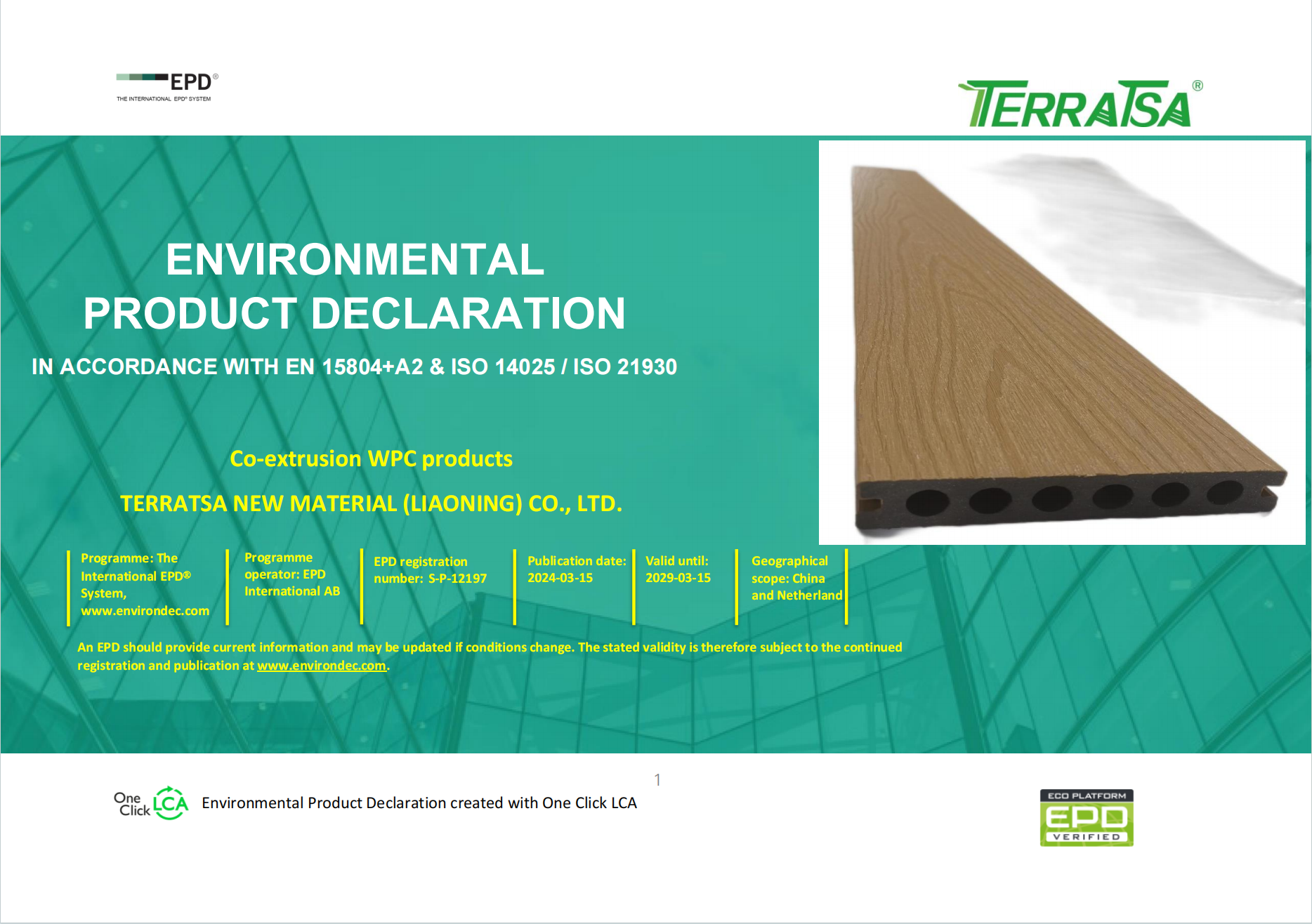
EPD S-P-12197: Environmental Declaration for Co-Extrusion WPC Products
Registration number S-P-12197 (also recorded as EPD-IES-0012197:001) was issued by EPD International AB, conforming to EN 15804+A2 and ISO 14025 / ISO 21930. The declaration version date is 2024-03-15 and it remains valid until 2029-03-15, with China and the Netherlands among the declared markets. The declared product family is co-extrusion WPC products, and the declaration is linked to the models GH001, D053, GH010 and GH024.
Project fit: an EPD is the document type that answers a specification request for verified environmental information on a construction product. Because the Netherlands is one of the declared markets, the declaration is directly relevant to Dutch and wider European procurement routes, where an EPD rather than a self-declared environmental statement is the accepted evidence format.
ISO 9001, ISO 14001 and ISO 45001: Management System Indicators
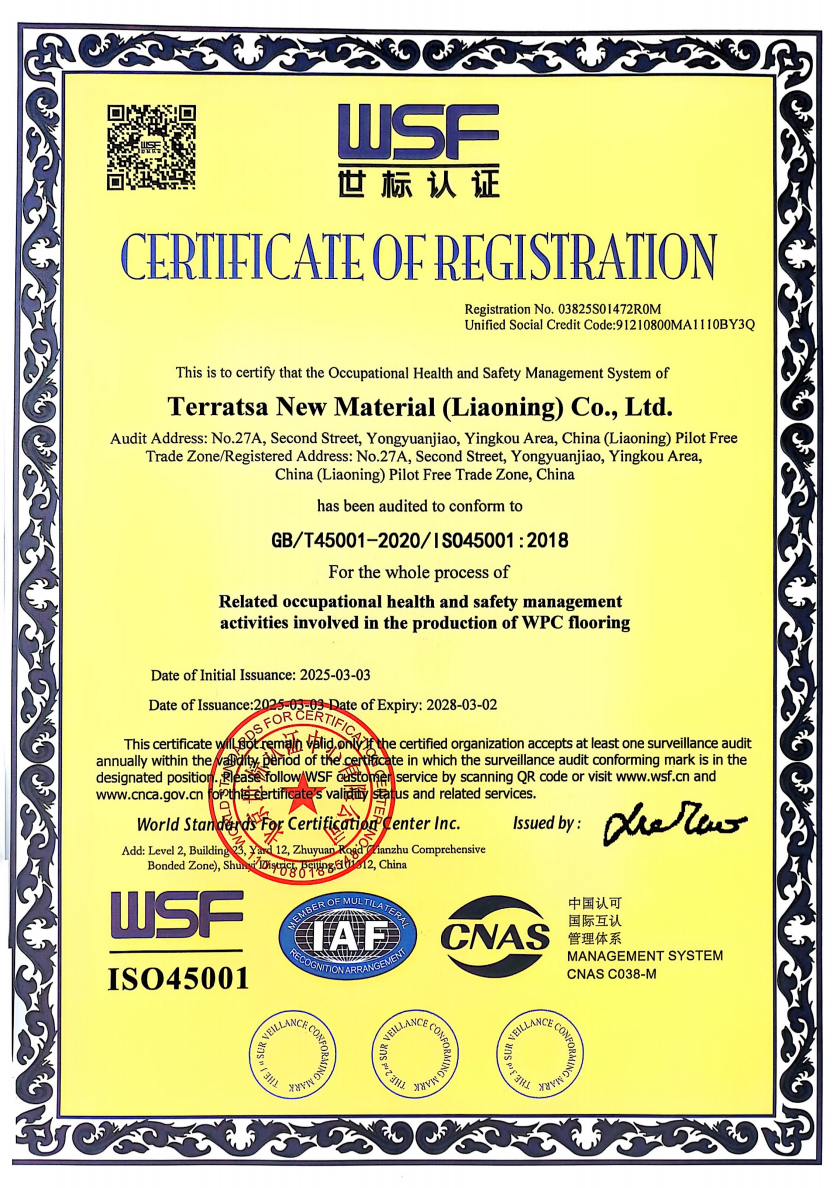
All three certificates were issued on 2025-03-03 by World Standards For Certification Center Inc. and are valid until 2028-03-02:
- ISO 9001, certificate 03825Q01470R0M, to GB/T 19001-2016 / ISO 9001:2015 — scope: production of WPC flooring.
- ISO 14001, certificate 03825E01471R0M, to GB/T 24001-2016 / ISO 14001:2015 — scope: related environmental management activities involved in the production of WPC flooring.
- ISO 45001, certificate 03825S01472R0M, to GB/T 45001-2020 / ISO 45001:2018 — scope: related occupational health and safety management activities involved in the production of WPC flooring.
Project fit: management system certificates surface during supplier pre-qualification, factory audits and EHS review. ISO 9001 addresses how production consistency is controlled; ISO 14001 and ISO 45001 answer the environmental and occupational safety sections of client questionnaires. They are plant-level evidence and do not replace board-level test data.
FSC Chain of Custody: Wood Sourcing Claims
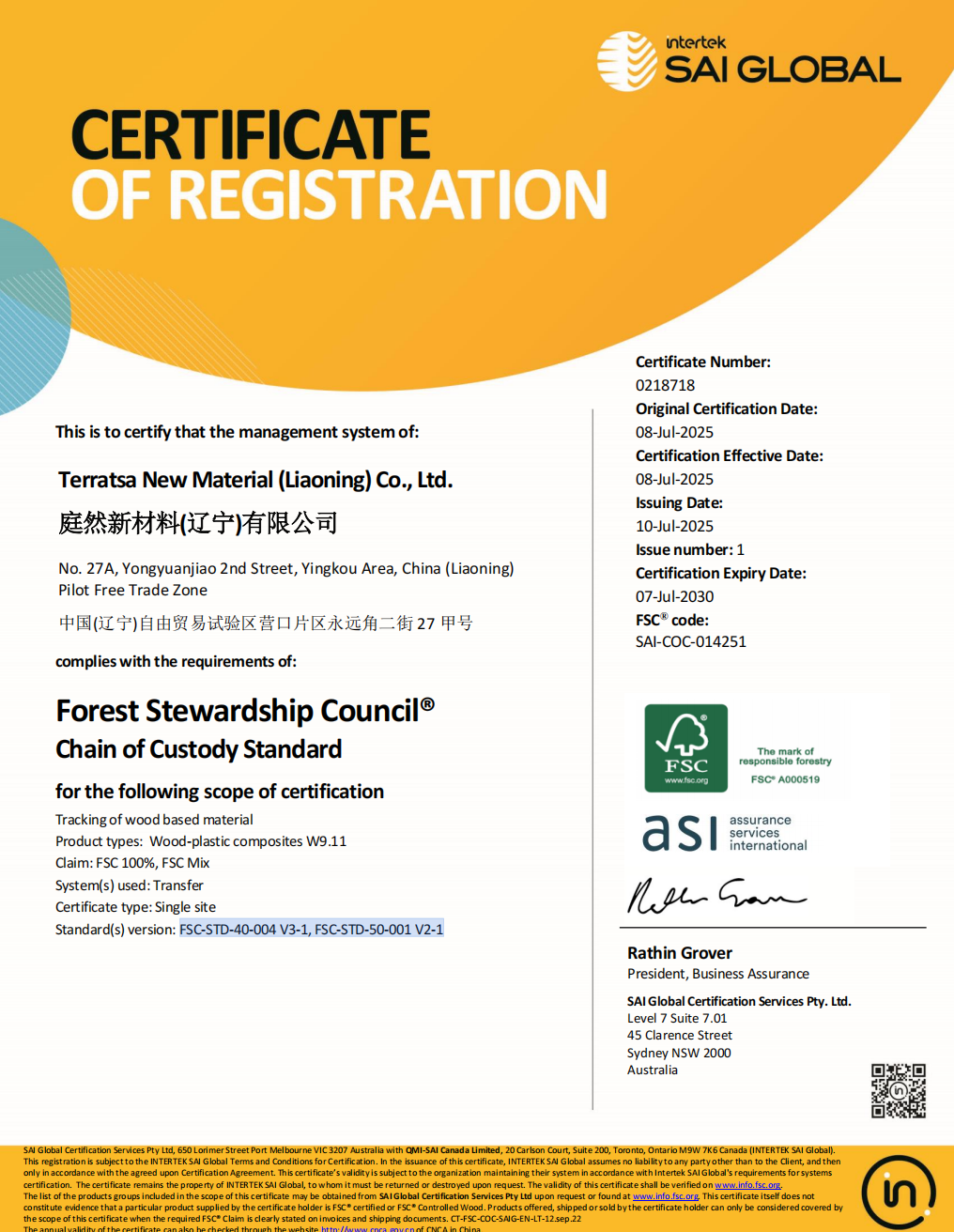
Certificate 0218718 was issued by SAI Global Certification Services Pty. Ltd. under FSC-STD-40-004 V3-1 and FSC-STD-50-001 V2-1, valid from 2025-07-10 to 2030-07-07. Its scope is the tracking of wood-based material — wood-plastic composites W9.11 — with the claims FSC 100% and FSC Mix. In the current documentation the certificate is linked to GH010, GH001 and D053.
Project fit: chain of custody matters when the wood fraction of a composite must be traceable to certified sources, for example in procurement policies that set sourcing conditions, or in documentation packages for green building submissions. Where a specification applies a chain-of-custody requirement to a model that is not listed on the certificate, that requirement must be confirmed separately before it is written into the order.
Product-Level Fit: GH001, D053, GH010 and GH024 by Application
GH001 — co-extruded outdoor decking. Published parameters: flexural properties ≥ 3300 N; moisture resistance under cyclic test conditions, mean ≤ 10%; water absorption (boiling test) ≤ 7%. Material: wood powder and plastic. The model is linked to the EPD, to ISO 9001, ISO 14001 and ISO 45001, and to FSC chain of custody. It fits horizontal outdoor flooring where a co-extruded board is specified and published flexural and water-absorption values are required for submittal.
D053 — first-generation outdoor hollow WPC decking. Published parameters: thickness 23 mm, width 146 mm, length 2900 mm; bending failure 3900 N; density 1.3 g/cm³; water absorption after a 5-hour boil ≤ 2%; linear thermal expansion coefficient ≤ 37 × 10⁻⁶ K⁻¹. The model is linked to the EPD, to the three ISO management system certificates and to FSC chain of custody. It fits large horizontal areas where published water absorption and a defined section are the controlling parameters.
GH010 — exterior wall cladding. Published parameters: thickness 22 mm, width 136 mm, length 2900 mm; flexural properties ≤ 0.79 mm; moisture resistance under cyclic test conditions ≤ 60.7 mm; swelling and water absorption after 28-day immersion ≤ 2%; linear thermal expansion coefficient ≤ 37 × 10⁻⁶ K⁻¹. The model is linked to the EPD, to ISO 9001, ISO 14001 and ISO 45001, and to FSC chain of custody. It fits vertical exterior wall surfaces where a 2900 mm board length and published immersion swelling data are relevant to the design.
GH024 — outdoor WPC cladding. Published parameters: flexural properties ≤ 0.9 mm; moisture resistance under cyclic test conditions ≤ 0.9 mm; swelling and water absorption after 28-day immersion ≤ 4%; boiling test ≤ 3%; linear thermal expansion coefficient ≤ 37 × 10⁻⁶ K⁻¹. The model is linked to the EPD, to ISO 14001 and ISO 45001. It fits exterior cladding specifications that call for both immersion and boiling-test moisture values.
Published values should be read together with their test methods. Where a specification sets a performance threshold, request the corresponding test report rather than relying on a table value alone.
Step-by-Step: Matching a Certified WPC Product to a Project
- Define the exposure and the orientation. Horizontal decking and vertical cladding are loaded and drained differently. Site conditions come first — for example persistently high humidity, or low winter temperatures combined with high humidity — because they determine which published parameters matter: water absorption, cyclic moisture resistance and linear thermal expansion.
- List the certification types named in the specification. Write out exactly what the tender, client or building programme asks for: an EPD to EN 15804+A2, an FSC chain-of-custody claim, or ISO management systems. Each request maps to one document type.
- Check model-level linkage. Confirm that the model being quoted appears in the certificate's product linkage: GH001, D053, GH010 and GH024 for the EPD; GH001, D053 and GH010 for ISO 9001 and for FSC chain of custody; GH001, D053, GH010 and GH024 for ISO 14001 and ISO 45001.
- Compare published parameters on a like-for-like basis. Use flexural properties, water absorption and linear thermal expansion to compare shortlisted models, and note that GH001 reports a force value (≥ 3300 N) while D053 reports bending failure at 3900 N and the two cladding models report deflection values.
- Decide the generation. Published guidance from Terratsa is that second-generation co-extrusion WPC — represented here by GH001 — suits residential and premium commercial projects, while first-generation WPC — represented by D053 — is better suited to large-scale projects with strict budget constraints and a clear short-term usage plan.
- Confirm commercial and acceptance terms before the order. Minimum order quantity 1 container; delivery terms FOB; payment terms 30/70; acceptance based on pre-shipment test procedures. OEM and ODM production services are available, with logo customization, against a monthly production capacity of 10,000 tons and a typical production lead time of 30–45 days.
Application Scenarios in Practice
Public Park and Landscape Decking
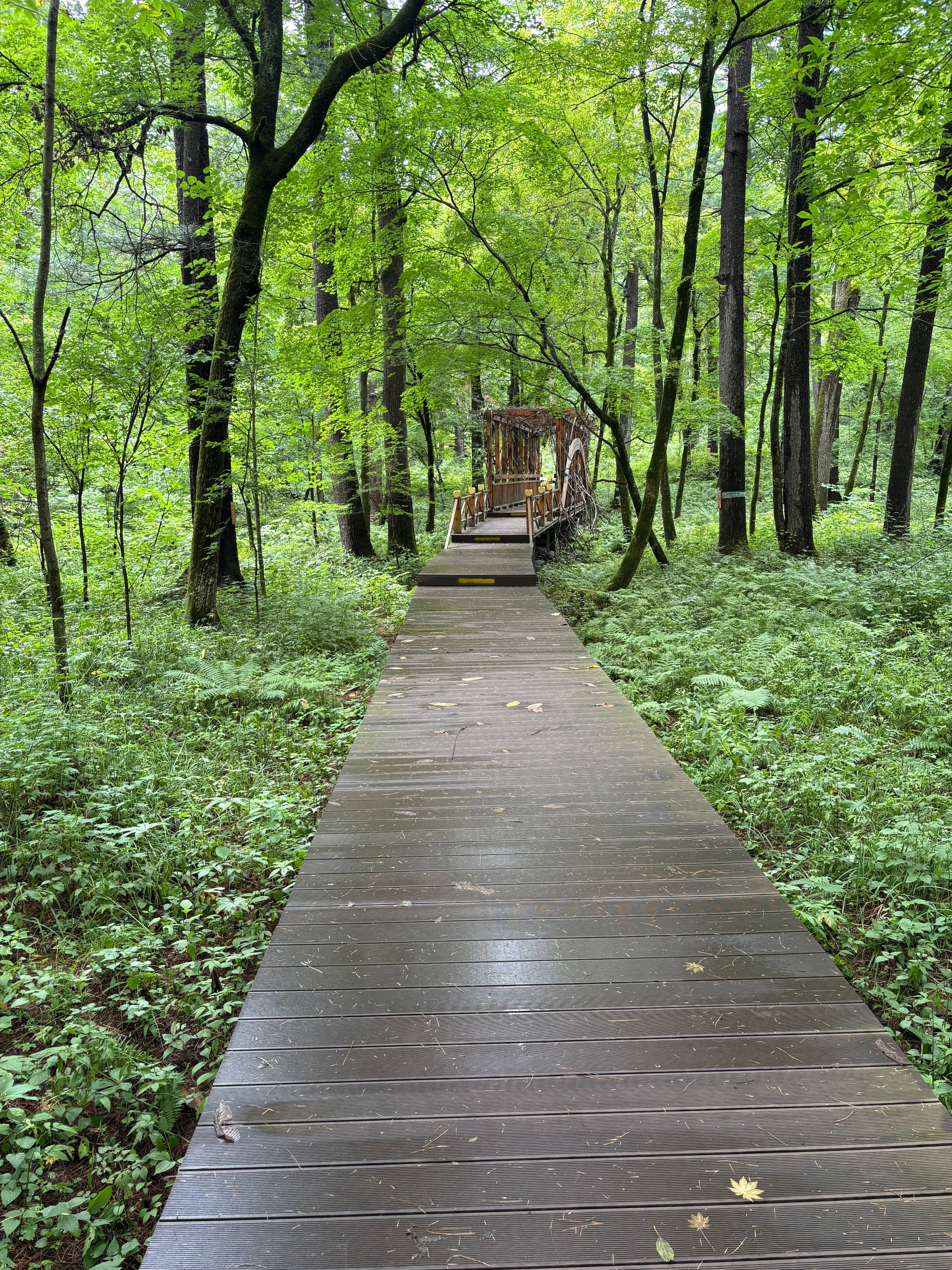
A recorded project case involves a project contractor in China who installed 500 tons of WPC decking in a park, with the installation in place for 15 years and reported as durable, with no fading and no bending. GH001 and D053 are the two models linked to that case. For new landscape projects, the same two boards are the logical starting point where the specification requires published water-absorption data and a defined section.
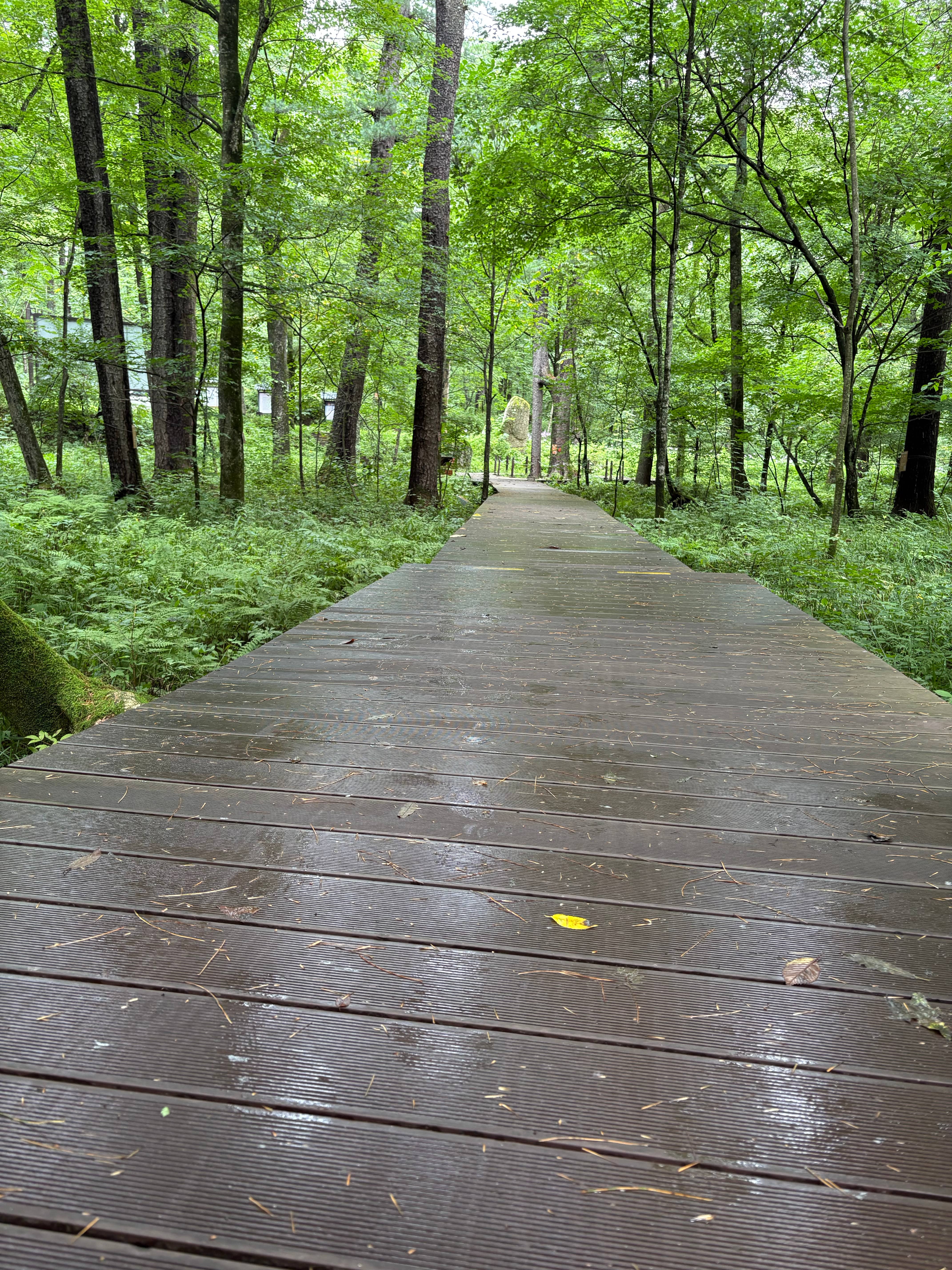
Project outcomes are reported by the installing contractor for that specific site. They describe what happened in one installation and should not be treated as a performance guarantee for a different project with different footfall, substructure or climate exposure.
Terraces and Residential Outdoor Flooring
Terrace work is where the OEM requirement is most common, because terrace projects frequently carry a house brand, a private label or a project-specific packaging format. Terratsa provides OEM and ODM production services with logo customization, a minimum order quantity of 1 container, a typical production lead time of 30–45 days and a monthly production capacity of 10,000 tons.
Decking specifications for cold-winter, high-humidity locations typically list weather resistance, UV resistance, low maintenance, low water absorption, anti-slip and anti-scratch requirements. The published parameters in this guide cover flexural behaviour, moisture and water absorption, and thermal expansion; where a project sets thresholds for UV or slip performance, request the corresponding test evidence rather than assuming it from the material description.
Exterior Wall Cladding and Facade Screening
Cladding selection turns on different evidence than decking. GH010 and GH024 are supplied in 2900 mm lengths, and both publish 28-day immersion swelling and water absorption values plus cyclic moisture resistance, which are the parameters specifiers normally ask for on vertical exterior surfaces. GH010 is additionally linked to ISO 9001 and to FSC chain of custody; GH024 is linked to the EPD, ISO 14001 and ISO 45001. Where a project requires chain-of-custody evidence on the cladding model, GH010 is the model to check first against the FSC certificate scope.
What These Documents Do Not Cover
- The published parameter set for these four models covers flexural behaviour, moisture and water absorption, density and linear thermal expansion. It does not state slip resistance values or fire classification; request dedicated test evidence if a specification requires them.
- Management system certificates describe how a plant is organised. They are not product performance evidence.
- Third-party market figures carry definitional differences between research houses and should not be used as contractual values.
- Certificate validity periods end on fixed dates — the ISO certificates on 2028-03-02 and the EPD on 2029-03-15 — so documentation should be re-confirmed at order date.
Comparison Table: Certified Products at a Glance
The table below summarises the published parameters of the four models covered by this guide.
| Model | Product type | Section (thickness × width) | Length | Flexural / bending | Moisture and water absorption | Linear thermal expansion |
|---|---|---|---|---|---|---|
| GH001 | Co-extruded outdoor decking | Not published | Not published | Flexural properties ≥ 3300 N | Cyclic test mean ≤ 10%; water absorption (boiling test) ≤ 7% | Not published |
| D053 | First-generation outdoor hollow WPC decking | 23 × 146 mm | 2900 mm | Bending failure 3900 N | Water absorption (5-hour boil) ≤ 2% | ≤ 37 × 10⁻⁶ K⁻¹ |
| GH010 | Exterior wall cladding | 22 × 136 mm | 2900 mm | Flexural properties ≤ 0.79 mm | Cyclic test ≤ 60.7 mm; 28-day immersion swelling and absorption ≤ 2% | ≤ 37 × 10⁻⁶ K⁻¹ |
| GH024 | Outdoor WPC cladding | Not published | Not published | Flexural properties ≤ 0.9 mm | Cyclic test ≤ 0.9 mm; 28-day immersion ≤ 4%; boiling test ≤ 3% | ≤ 37 × 10⁻⁶ K⁻¹ |
Certification coverage differs by model, which is the single most useful check before a submittal package is assembled.
| Model | EPD S-P-12197 (valid to 2029-03-15) | ISO 9001 (to 2028-03-02) | ISO 14001 (to 2028-03-02) | ISO 45001 (to 2028-03-02) | FSC Chain of Custody (to 2030-07-07) |
|---|---|---|---|---|---|
| GH001 | Listed | Listed | Listed | Listed | Listed |
| D053 | Listed | Listed | Listed | Listed | Listed |
| GH010 | Listed | Listed | Listed | Listed | Listed |
| GH024 | Listed | Not listed | Listed | Listed | Not listed |
The generation choice sits alongside certification as a decision criterion, and the published guidance is summarised below.
| Decision criterion | First-generation WPC (D053 type) | Second-generation co-extruded WPC (GH001 type) |
|---|---|---|
| Typical project fit | Large-scale projects with strict budget constraints and a clear short-term usage plan | Residential and commercial projects that require premium quality |
| Maintenance expectation | Selected where the usage plan is defined and time-limited | Selected to remove maintenance concern over a long service period |
| Model position in this range | D053 outdoor hollow decking, 23 × 146 × 2900 mm | GH001 co-extruded outdoor decking |
Frequently Asked Questions
Which certifications should a specifier check first for a WPC decking or cladding project?
Match the certificate to what the project names. If verified environmental product information is required, the EPD registered as S-P-12197 with EPD International AB, conforming to EN 15804+A2 and valid until 2029-03-15, covers the declared co-extrusion WPC product family linked to GH001, D053, GH010 and GH024, with China and the Netherlands among the declared markets. If the wood content must be traceable, FSC Chain of Custody certificate 0218718 — valid to 2030-07-07, scope W9.11, claims FSC 100% and FSC Mix — is linked to GH010, GH001 and D053. If pre-qualification or an EHS review requires management systems, ISO 9001 (03825Q01470R0M), ISO 14001 (03825E01471R0M) and ISO 45001 (03825S01472R0M) are all valid until 2028-03-02.
Can Terratsa act as an OEM WPC decking manufacturer for terrace projects?
Yes. OEM and ODM production services are available, and customization includes logo application. Monthly production capacity is 10,000 tons, the minimum order quantity is 1 container, and typical production lead time is 30–45 days. Products undergo 100% test quality control, acceptance is based on pre-shipment test procedures, and remote after-sales support is provided. For terrace projects specifically, GH001 co-extruded outdoor decking and D053 outdoor hollow decking are the two models linked to the EPD.
Should a project choose first-generation or second-generation WPC decking?
Terratsa's published guidance is that second-generation co-extrusion WPC is the direct choice for most residential users and for commercial projects that require premium quality, because it addresses the performance of the board itself and removes maintenance anxiety over a long service period. First-generation WPC is better suited to large-scale projects with strict budget constraints and a clear short-term usage plan. In this product range, D053 is the first-generation outdoor hollow decking and GH001 is the co-extruded outdoor decking.
What purchasing terms and acceptance criteria apply to an order?
Minimum order quantity is 1 container. Delivery terms are FOB. Acceptance criteria are based on pre-shipment test procedures, and payment terms are 30/70. Products undergo 100% test quality control, and remote after-sales support is available after delivery.
What is the typical production lead time for a certified WPC decking order?
Typical production lead time is 30–45 days, supported by a monthly production capacity of 10,000 tons. Lead time should be confirmed at order date together with the current validity of the certification documents the project requires. For a project quotation, sample arrangement or the full product and certification brochure, contact Terratsa directly using the details at the end of this guide.
Next Step: Turn Certification Scope into an Order
Three checks close the loop between specification and delivery. Confirm which certificate type the project actually names — EPD, FSC chain of custody or ISO management systems — and verify that the chosen model appears in that certificate's product linkage. Match the published parameters of GH001, D053, GH010 or GH024 to the exposure and orientation of the surface. Then decide the generation, first or second, before the commercial terms are fixed.
Terratsa New Material (Liaoning) Co., Ltd. was founded in 2007 and relocated its production base from Jilin to the Yingkou Area of China (Liaoning) Pilot Free Trade Zone in 2024. The site covers 74,000 m² with 150 employees, exports account for 85% of output across the EU, Asia, the Middle East, South America and Australia, and the company operates an overseas warehouse in the Netherlands. Products reach more than 40 countries and nearly 100 customers worldwide.
Samples, quotations and the certification pack
Send the specification, quantity, destination port and the certificate type the project requires, and the quotation will include the matching documentation.
Brochure: download the Terratsa WPC decking brochure (PDF)
Email: sales01@unvocwpc.com · WhatsApp: +8615943028515 · Website: www.terratsa.com
Terratsa New Material (Liaoning) Co., Ltd. · No. 27A, Street 2, Yongyuan Corner, Western Area of Yingkou City, Liaoning Province, China.
Have Questions or Need More Details?
Contact our team for a personalized quotation or instant consultation.
Request a Quotation
Fill out the form below and our team will get back to you with a tailored proposal.
WhatsApp Direct Chat
Prefer to chat in real-time? Message us on WhatsApp for instant assistance & quick answers.
- Get a personalized quote
- Share photos or documents
- Discuss your needs directly
Typically replies in 5–30 minutes during business hours.