
WPC Cladding Compliance: Regional Standards vs Test Data
A WPC cladding profile can clear approval in one market and stall in the next without a single change to the panel. What differs is documentation alignment: the same product has to be matched to the standard a market applies, the test values a reviewer accepts, and the certificate scope that actually names the model being ordered. This guide explains how regional requirements diverge, how to read WPC cladding test data so it survives review, and how to build a submittal pack around GH010 exterior wall cladding from Terratsa New Material (Liaoning) Co., Ltd. — a wood-plastic composite manufacturer founded in 2007, working from a 74,000 m² facility, and holding EPD, FSC and ISO 9001, ISO 14001 and ISO 45001 certification.
Why compliance is a data-matching exercise, not a document count
Facade reviews rarely fail because a supplier sent too few certificates. They fail because the certificates sent answer a different question from the one the reviewer asked. A documentation pack for exterior WPC cladding normally contains five distinct families of evidence, and each family establishes something the others cannot:
- Conformity documents such as a CE declaration and its Declaration of Performance, which establish the route a product takes to a market — not how it performs.
- Test reports, which establish measured behaviour for a specific profile under a stated method and condition.
- Environmental declarations such as an EPD, which quantify environmental impact over a declared scope.
- Material-origin certification such as FSC chain of custody, which traces wood-based input through the supply chain.
- Management-system certificates such as ISO 9001, ISO 14001 and ISO 45001, which describe how a factory is run.
The rule that governs all five is simple: every value travels with three companions — the model it belongs to, the method that produced it, and the market where it is accepted. Remove any one of the three and the number stops being evidence. A water absorption figure without its test condition cannot be compared; a certificate without a product scope cannot be applied; a test report without a model number cannot be tied to the panels arriving on site.
This is why a request for “all certificates” produces a folder that looks complete and reviews badly. The productive request is narrower: the certificate or report that covers this profile, for this market, produced by this method, still valid on the delivery date.
How regional requirements actually diverge
The underlying question is identical everywhere — does a documented value, produced by a stated method, meet the requirement written into the project? What changes is who answers that question, in what format, and against which standard vocabulary.
Europe: declaration-led approval
In the European Union, CE marking of construction products sits under the Construction Products Regulation, and the mark is accompanied by a Declaration of Performance. The technical route behind that declaration — a harmonised standard or a European Technical Assessment — depends on the product, so the buyer's check is not whether a CE logo appears on a brochure but which route the declaration for the ordered profile follows. Environmental performance is documented separately: an EPD prepared to EN 15804+A2 is the format typically requested when a project carries green-building or embodied-carbon requirements. Both documents can be legitimate and neither one reports water absorption or flexural behaviour.
North America: locally decided, test-report driven
In North America, compliance is decided locally by the authority having jurisdiction, applying the model code adopted in that area, and submittals are typically built on test reports from recognised laboratories referencing ASTM methods. A European CE declaration does not substitute for that review, and a US test report does not open a European route. For an exporter, this means the same GH010 profile may need two independent evidence tracks — and the buyer should ask which one the project actually requires before the order is placed.
China and Asia-Pacific: GB/T vocabulary
Chinese requirements are written in GB/T standards, and the overlap with international systems is often visible in the certificate text itself: the Terratsa ISO 9001 certificate cites GB/T 19001-2016 / ISO 9001:2015, and the ISO 14001 certificate cites GB/T 24001-2016 / ISO 14001:2015. The same requirement is being expressed twice, in two vocabularies. For projects in the region, a submittal that quotes only the ISO number may be returned with a request for the GB/T reference, so both should appear.
Middle East and consultant-specified markets
Many projects in the Middle East and parts of Asia-Pacific are governed less by a single national mark than by a consultant's specification, which may combine references from more than one system. In that setting the specification document, not the supplier's brochure, defines what counts as acceptable evidence — which is why the parameter list should be extracted from the specification before any documents are requested.
Trade documentation runs alongside technical documentation
Classification is a separate compliance layer. The USITC Harmonized Tariff Schedule lists 3925.90.00 for plastic builders' ware, the heading under which WPC wall panels are classified, while national tariff schedules subdivide further; the importer's broker should confirm the code applied at the destination. The scale of the category is visible in trade data: the Observatory of Economic Complexity reports China's 2024 exports of plastic builders' ware (HS 3925.90) at USD 2.16 billion. None of this says anything about panel performance, but a technically perfect submittal with a mismatched tariff code still stops at the border.
What does not change is the test of a good pack: each document names the product, states its basis, carries a validity date, and matches the market where it will be read.
Reading GH010 test data the way a reviewer does
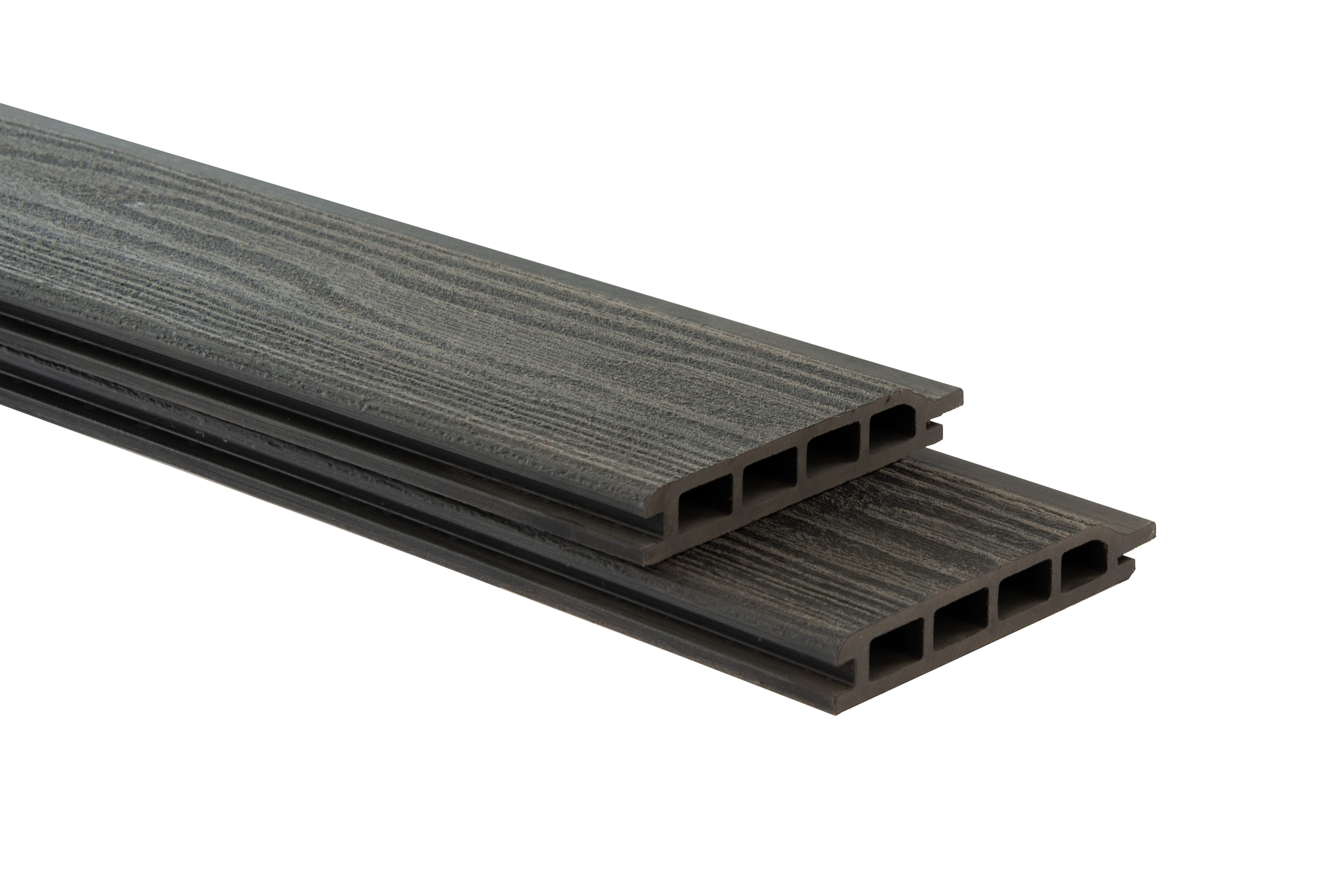
GH010 is an exterior wall cladding profile measuring 136 mm wide, 22 mm thick and 2900 mm long, produced from wood powder and plastic. Its published parameters are thresholds, not marketing claims, and each one only becomes usable in a submittal when it is read together with the condition attached to it.
| Parameter | GH010 documented value | Question it answers | Request this alongside it |
|---|---|---|---|
| Profile dimensions | 136 mm × 22 mm × 2900 mm | Whether the profile fits the facade grid, substrate and fixing design | Dimensional tolerances and available lengths |
| Swelling and water absorption, 28 days immersion | ≤2% | How the panel behaves under prolonged wetting | Report showing method, specimen size and conditioning |
| Moisture resistance, cyclic test | ≤60.7 mm | Behaviour under repeated wet–dry cycles | Cyclic test description, number of cycles, measurement basis |
| Flexural properties | ≤0.79 mm | Bending-related behaviour, recorded as a dimensional limit | The method behind the figure and the property it expresses |
| Linear thermal expansion coefficient | ≤37 × 10⁻⁶ K⁻¹ | Movement to allow for in joints, trims and fixings | Test temperature range and method |
| Material | Wood powder and plastic | What the profile is made from | Recycled-content and FSC claim if the project requires it |
Flexural properties need the most care. The GH010 sheet records flexural properties as ≤0.79 mm — a dimensional limit. It is not a force in newtons and not a stress in megapascals. Datasheets from other suppliers frequently quote flexural strength in MPa or a bending failure load in newtons, and those numbers cannot be dropped into the same comparison column as a millimetre value. The correct action is not to convert the figure but to ask which test method produced it and what property it expresses, then compare like with like or state plainly that the two datasets are not comparable.
Water absorption is inseparable from its condition. The ≤2% figure is defined after 28 days of immersion. A competing claim of 0.4% after a 24-hour soak measures a different exposure and cannot be ranked against it. When the project specification states its own conditioning, the reviewer will compare against that condition, so the report — not the datasheet headline — is the document that decides.
Thermal movement is a design input, not a sales point. A linear thermal expansion coefficient of ≤37 × 10⁻⁶ K⁻¹ describes how much the profile moves per kelvin of temperature change. That value feeds joint width, trim detailing and fixing selection; the cladding is installed with hidden clip systems, and the interaction between panel movement and fixing method belongs in the installation documentation rather than the datasheet.
Two further properties are claimed for the cladding — water and moisture resistance, and UV resistance with anti-fade performance — along with resistance to termites and wood-boring insects and an anti-slip surface. For a high-UV or coastal facade, the useful question is not whether the claim exists but which weathering protocol supports it for the colour and finish actually ordered, since colour performance is normally assessed per finish rather than per product family.
What each Terratsa certificate actually covers
Terratsa reports that its products have obtained CE, FSC, ASTM, SGS and EPD certification alongside its ISO management-system certificates. The table below lists the certificates documented with numbers, issuers, standards and validity dates — the details a reviewer will check first.
| Certificate | Standard / basis | Number | Issuer | Validity | What it establishes |
|---|---|---|---|---|---|
| EPD | EN 15804+A2 & ISO 14025 / ISO 21930 | S-P-12197 | EPD International AB | Issued 2024-03-15, valid to 2029-03-15 | Environmental declaration for co-extrusion WPC products, global market |
| FSC Chain of Custody | FSC-STD-40-004 V3-1; FSC-STD-50-001 V2-1 | 0218718 | SAI Global Certification Services Pty. Ltd. | 2025-07-10 to 2030-07-07 | Chain of custody for wood-based material, WPC W9.11, FSC 100% and FSC Mix claims, global market |
| ISO 9001 | GB/T 19001-2016 / ISO 9001:2015 | 03825Q01470R0M | World Standards For Certification Center Inc. | 2025-03-03 to 2028-03-02 | Quality management system covering WPC production |
| ISO 14001 | GB/T 24001-2016 / ISO 14001:2015 | 03825E01471R0M | World Standards For Certification Center Inc. | 2025-03-03 to 2028-03-02 | Environmental management system |
| ISO 45001 | GB/T 45001-2020 / ISO 45001:2018 | 03825S01472R0M | World Standards For Certification Center Inc. | 2025-03-03 to 2028-03-02 | Occupational health and safety management system |
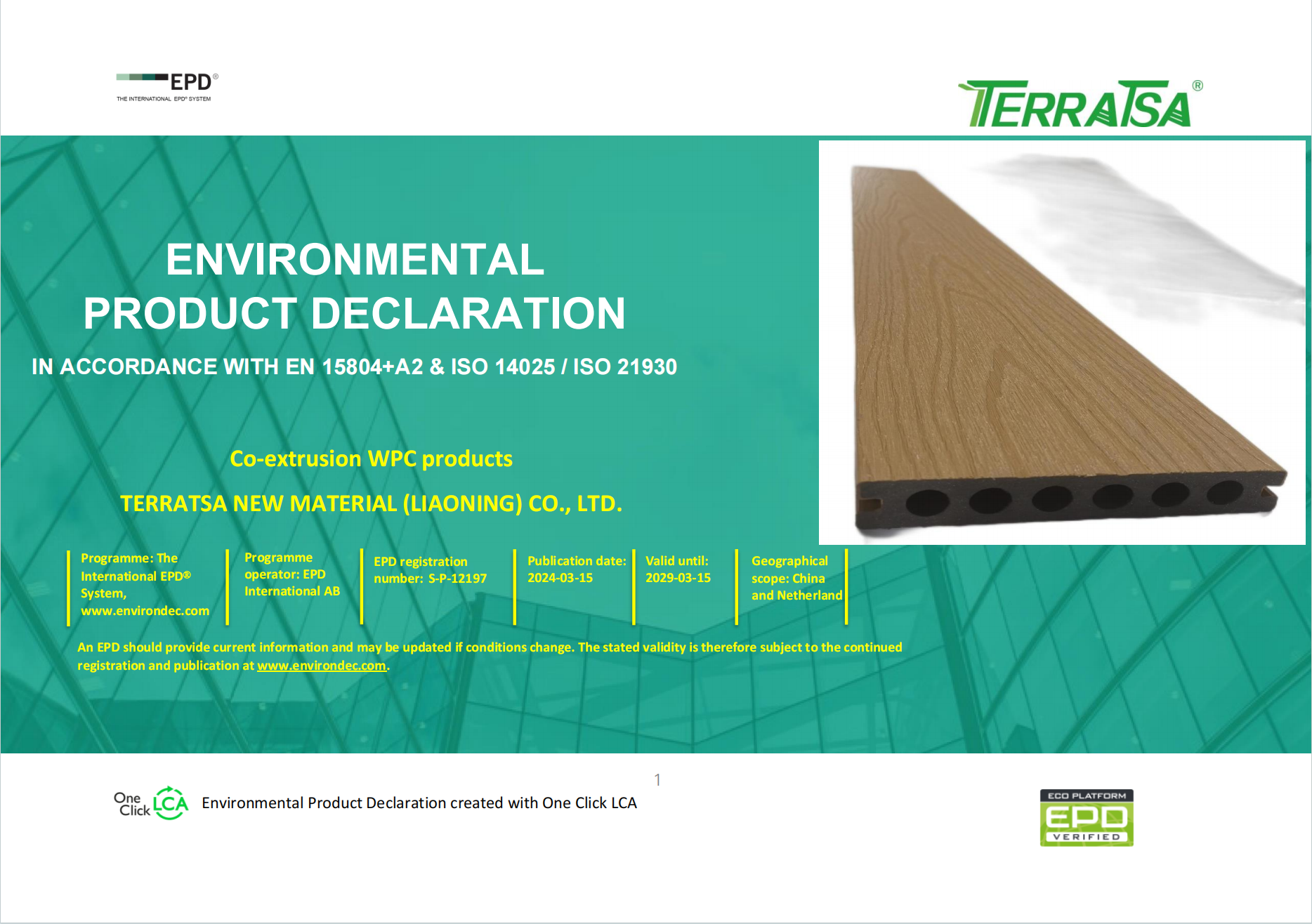
The EPD is the document most often over-read. Registration S-P-12197 was issued by EPD International AB on 15 March 2024 and runs to 15 March 2029, covering co-extrusion WPC products for the global market. It answers questions about environmental performance over a declared scope. It says nothing about water absorption, thermal expansion or flexural behaviour, and presenting it as performance evidence invites a rejection that could have been avoided by sending the test report instead.
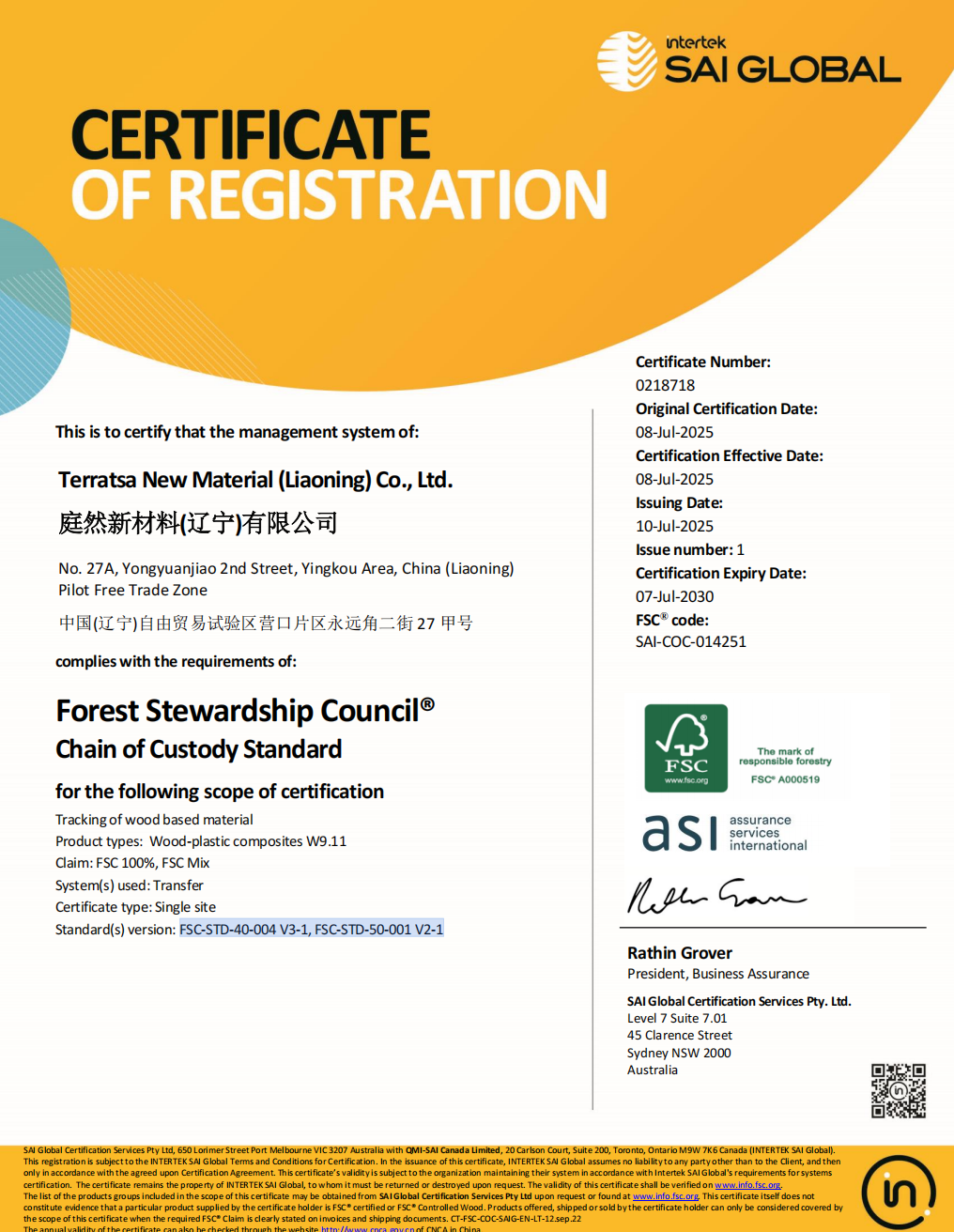
FSC certificate 0218718, issued by SAI Global Certification Services Pty. Ltd. and valid from 10 July 2025 to 7 July 2030, covers tracking of wood-based material under FSC-STD-40-004 V3-1 and FSC-STD-50-001 V2-1, with WPC listed under product code W9.11 and claims of FSC 100% and FSC Mix. GH010 is inside that scope. What it establishes is the origin and custody chain of the woody input; it is not a durability or weathering certificate.
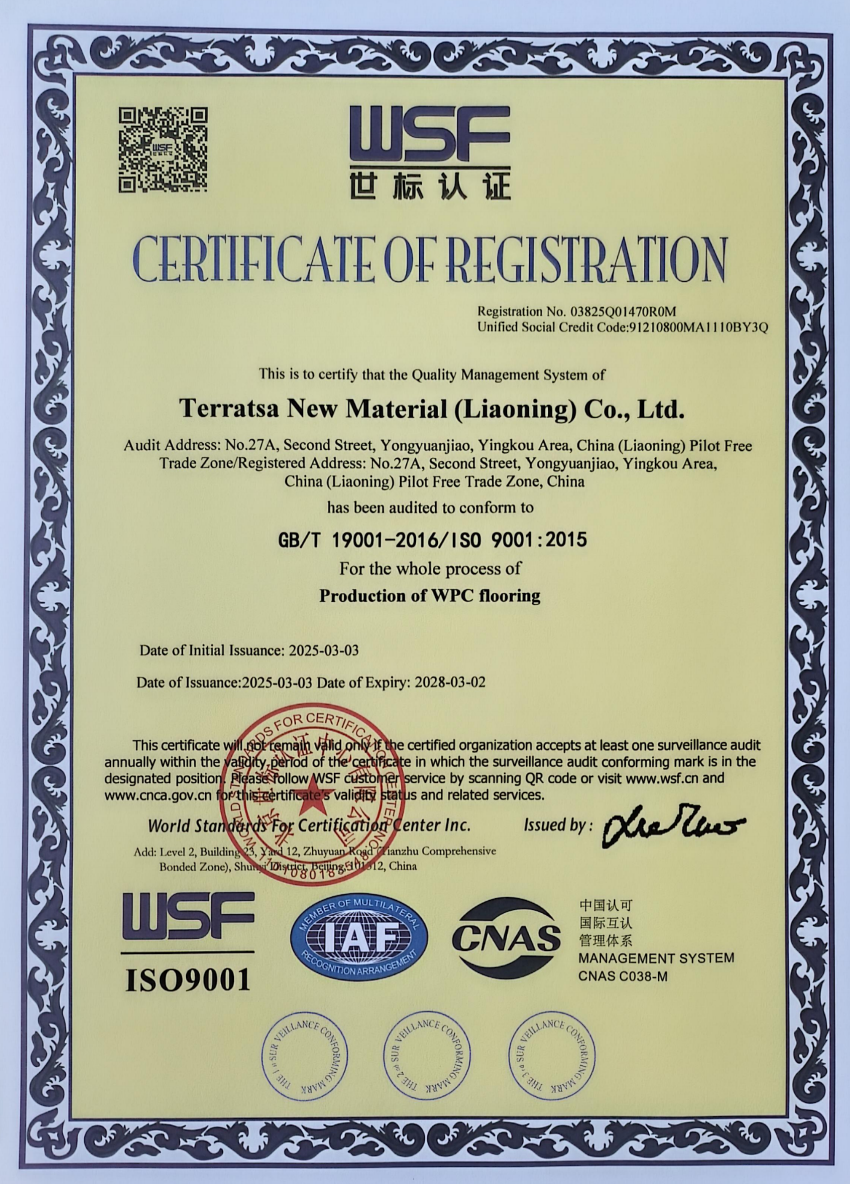
The three ISO certificates were issued by World Standards For Certification Center Inc. on 3 March 2025 and expire on 2 March 2028. They describe how the organisation is managed: quality, environment, and occupational health and safety. Their recorded scope wording refers to WPC production activities, and GH010 is listed among the covered products, but scope statements are worth reading line by line — a buyer ordering a specific profile should ask for written confirmation that the certificate scope covers the cladding profile in the purchase order, rather than assuming a certificate covering one product line covers all of them.
CE sits in a different category again. It is a market-access route, and the document that matters is the declaration covering the ordered profile, with its cited standard or assessment route. A CE reference in a company profile is a starting point; the declaration is the evidence.
Step-by-step: building a submittal pack that survives review
- Fix the market and the decision-maker first. Identify whether approval runs through a notified declaration route, a local code official, a consultant's specification or a combination. Everything downstream depends on this answer, and it is the step buyers most often skip.
- Convert the specification into a parameter list. Write out each required property, its threshold and, where the specification states one, its test method. A parameter list turns a vague document request into a checklist that can be answered yes or no.
- Request model-level data, not family brochures. Ask for the datasheet for GH010 specifically: 136 × 22 × 2900 mm, wood powder and plastic, with the values in the table above. Family brochures merge models and are the origin of most model-drift errors.
- Ask for the test reports behind each value. For every figure, request the method, the laboratory, the test date, the specimen and the conditioning. Confirm what kind of value is recorded — a limit, a mean or a typical figure — because a threshold and an average are read differently by a reviewer.
- Verify each certificate on its own terms. Check the number, the issuer, the standard reference, the issue and expiry dates, the scope and the market. The dates are easy to check and easy to forget: EPD to 15 March 2029, FSC to 7 July 2030, the ISO certificates to 2 March 2028.
- Cross-check the pack for internal consistency. Model numbers, dimensions, certificate dates and product names must agree across the datasheet, the reports and the declarations. One inconsistency is enough to send the whole submission back.
- Agree verification and delivery terms in writing. Terratsa's documented terms include 100% testing, a minimum order of one container, a lead time of 30–45 days, OEM/ODM support including logo customisation, and remote after-sales support. Put the document pack on the same schedule as the goods so the paperwork does not arrive after the container.

Where alignment usually breaks
Four failure modes account for most rejected WPC cladding submittals. Model drift: a certificate or report that covers the product family but not the ordered profile. Method and unit drift: a millimetre value placed beside a megapascal value, or a 24-hour soak compared with a 28-day immersion result. Validity and market drift: an expired certificate, or one issued for a market the project is not in. Scope overreach: using an EPD to argue mechanical performance, an FSC certificate to argue UV stability, or an ISO 9001 certificate to argue a test result. None of these are paperwork shortages; they are mismatches, and they are fixed by reading rather than by collecting more.
Three project conditions and the evidence each one needs
If the facade sits in a European project with green-building reporting, the pack is declaration-led: the CE declaration and its route for GH010, the EPD to EN 15804+A2, the FSC chain-of-custody certificate if wood-origin claims are made, and the test data for whichever mechanical and moisture parameters the specification names. The EPD carries the environmental argument; it does not carry the performance argument.
If approval rests with a North American authority having jurisdiction, expect the review to centre on test reports referencing ASTM methods and on the datasheet for the specific profile. The EPD and ISO certificates support the supplier evaluation but rarely decide the submittal, and the CE route does not transfer.
If the building faces prolonged humidity, salt spray or high UV, the deciding evidence shifts to moisture behaviour — the ≤2% water absorption after 28 days immersion and the cyclic test record — plus documented UV and anti-fade support for the ordered colour, and a fixing design that accounts for a coefficient of ≤37 × 10⁻⁶ K⁻¹. In these conditions the installation documentation matters as much as the certificate folder, because movement and moisture management are resolved at the joint, not in the panel.
Frequently asked questions
Which standards and certificates should be verified for exterior WPC cladding?
Compliance rests on five document families rather than one certificate: conformity documents such as a CE declaration and Declaration of Performance, test reports for the parameters the project specifies, environmental declarations such as an EPD, material-origin certification such as FSC chain of custody, and management-system certificates such as ISO 9001, ISO 14001 and ISO 45001. Which of these a project needs depends on the market and the specification. The buyer's check is that each document names the model being supplied, states its standard, and remains valid on the delivery date.
How should GH010 test data be read in a submittal?
GH010 is documented at 136 × 22 × 2900 mm with swelling and water absorption of ≤2% after 28 days immersion, a linear thermal expansion coefficient of ≤37 × 10⁻⁶ K⁻¹, flexural properties recorded as ≤0.79 mm, and moisture resistance under cyclic test conditions of ≤60.7 mm. Each figure is only comparable when read with its condition and method — the water absorption value belongs to a 28-day immersion, and the flexural figure is a dimensional limit, not a force. Keep GH024 values, which are recorded differently, out of a GH010 submittal.
Does an EPD or an ISO certificate prove cladding performance?
No. EPD registration S-P-12197 covers co-extrusion WPC products under EN 15804+A2 & ISO 14025 / ISO 21930 and addresses environmental performance; the ISO 9001, ISO 14001 and ISO 45001 certificates address management systems. Questions about water absorption, thermal movement or flexural behaviour are answered by test data for the specific profile under a stated method. Sending an EPD in place of a moisture test report is a scope error, not a stronger submission.
CE-certified WPC cladding manufacturers for exterior projects
CE certification is a market-access document, not a performance rating. Terratsa reports that its products have obtained CE certification alongside FSC, ASTM, SGS and EPD certification, and the documented certificate numbers for the EPD, FSC and three ISO systems are listed in this guide. For a specific exterior project, ask any CE-certified manufacturer for the declaration covering the exact profile ordered, check which standard or assessment route it cites, and pair it with model-specific test data. A CE reference in a brochure is not evidence for GH010 until the declaration names it.
What drives cost in a compliant WPC cladding order?
Published industry evidence puts raw materials at 50% to 70% of WPC wall panel manufacturing cost, so material grade and formulation move price more than paperwork does. Certification and testing charges are quoted per project and are not publicly listed, and freight economics depend on order size — Terratsa's documented minimum order is one container. A lower quote that omits model-specific test reports does not remove the testing requirement; it moves that cost and risk to the buyer after the order is placed.
How long do documentation and delivery take?
Terratsa's documented lead time is 30–45 days with a minimum order of one container, OEM/ODM support including logo customisation, 100% testing and remote after-sales support. Certificate validity should be confirmed at the time of ordering: the EPD runs to 15 March 2029, the FSC certificate to 7 July 2030 and the ISO certificates to 2 March 2028. Where a project needs a document pack before production starts, request it with the model number so the pack is assembled against GH010 rather than against a generic product family.
Conclusion: align the evidence, then buy
Regional WPC cladding compliance is not a search for a stronger certificate; it is the discipline of matching one profile's documented values to one market's requirements and one project's specification. GH010 gives a buyer something concrete to work with: 136 × 22 × 2900 mm, water absorption of ≤2% after 28 days immersion, thermal expansion of ≤37 × 10⁻⁶ K⁻¹, flexural properties of ≤0.79 mm, an EPD registered as S-P-12197 valid to 2029, FSC chain of custody 0218718 valid to 2030, and ISO 9001, ISO 14001 and ISO 45001 certificates valid to 2028 — all issued against standards and certificate numbers that can be checked independently.
Terratsa New Material (Liaoning) Co., Ltd. has participated in the drafting of nearly 10 national and industrial standards, holds more than 30 national independent intellectual property patents, works with a 25-engineer R&D team, and exports to more than 40 countries with an overseas warehouse in the Netherlands. None of that replaces a submittal pack, but it explains why the documents are available in the form a reviewer can use. The next practical step is to take the parameter list from your specification, request the matching reports and declarations for the profile you intend to order, and confirm the certificate scope in writing before production begins.
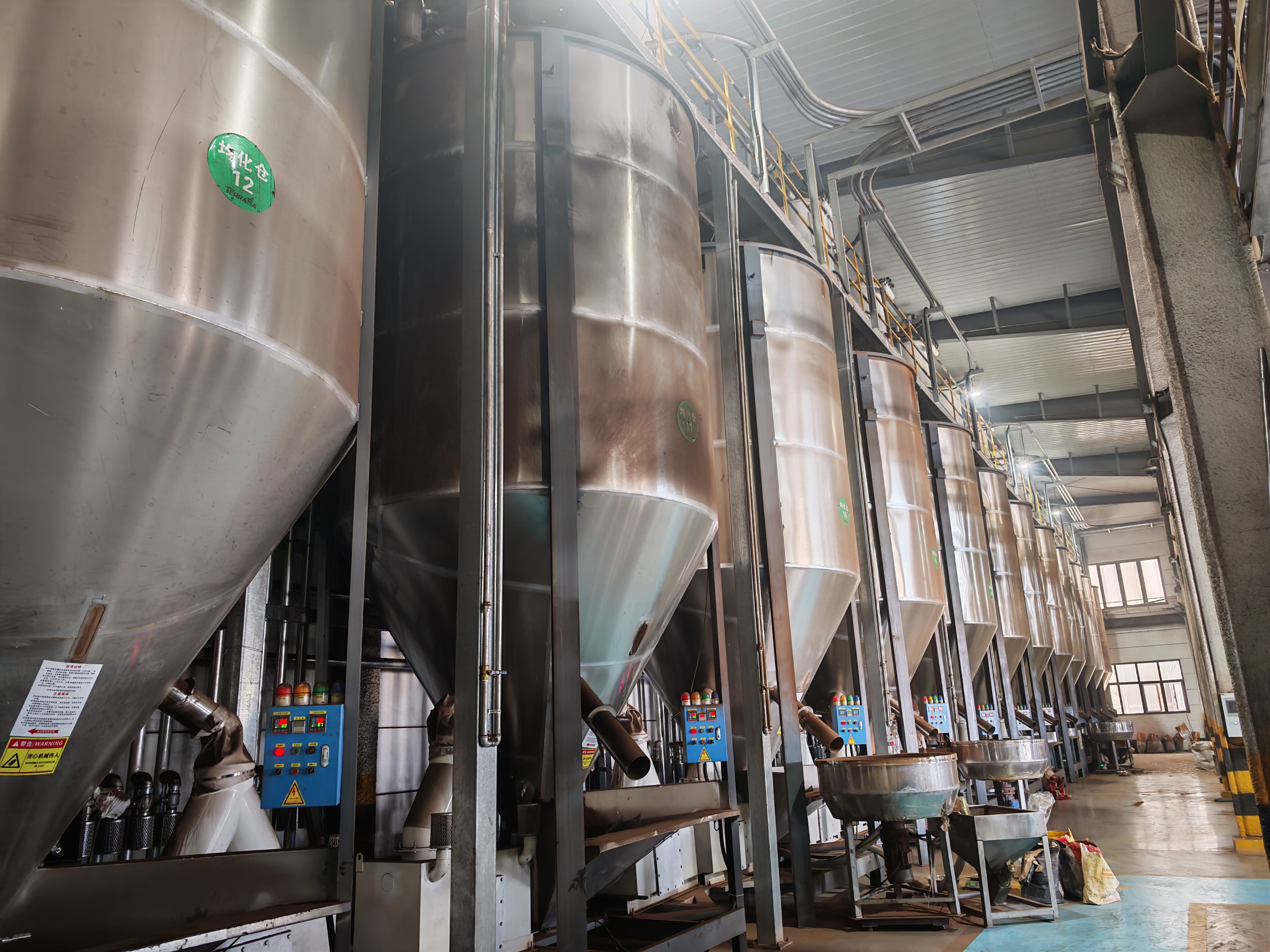
For profile data, dimensions and the cladding range, the Terratsa product brochure is available to download, and the technical team can confirm certificate scope and test documentation for a named profile when a project specification is ready to review.
Have Questions or Need More Details?
Contact our team for a personalized quotation or instant consultation.
Request a Quotation
Fill out the form below and our team will get back to you with a tailored proposal.
WhatsApp Direct Chat
Prefer to chat in real-time? Message us on WhatsApp for instant assistance & quick answers.
- Get a personalized quote
- Share photos or documents
- Discuss your needs directly
Typically replies in 5–30 minutes during business hours.