
WPC Cladding and Decking for Poolside, Boardwalk & Balcony Projects: A Wet-Zone Application Guide
WPC Cladding and Decking for Poolside, Boardwalk & Balcony Projects: A Wet-Zone Application Guide
Poolside surrounds, waterfront boardwalks and exposed balconies push wood-plastic composite (WPC) into a harder environment than a garden patio ever does. Water reaches the assembly from three directions at once — humidity from below, splash from the side, sun-driven evaporation from above — and it reaches two different planes: the vertical surface people look at, and the horizontal surface people walk on.
Terratsa New Material (Liaoning) Co., Ltd. is a wood-plastic composite manufacturer founded in 2007 and based in the Yingkou Area of China (Liaoning) Pilot Free Trade Zone. The company produces outdoor WPC decking, outdoor WPC fencing and outdoor WPC cladding, and exports to markets across the EU, Asia, the Middle East, South America and Australia. Its catalogue separates the two planes deliberately: exterior wall cladding such as GH010 (22 mm × 136 mm × 2900 mm) is built for facades, screens and parapets, while decking such as D053 (23 mm × 146 mm × 2900 mm) and the co-extruded GH001 is built for walking surfaces.
This guide explains where each product belongs in a wet zone, what the measured performance figures actually mean at the waterline, and how to accept the material when it arrives on site.
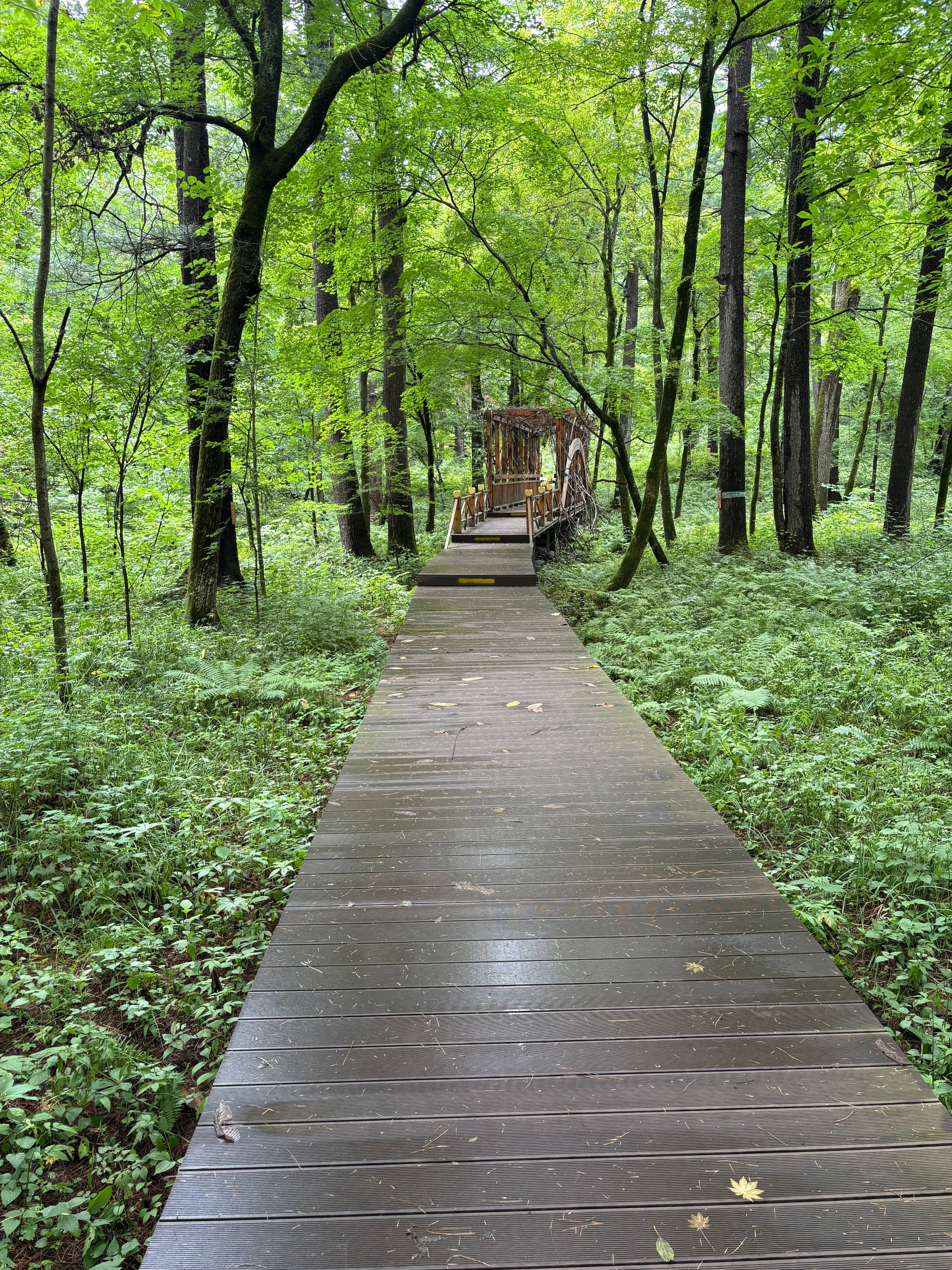
Problem Definition: Why Wet Zones Break Normal Cladding and Decking Logic
A standard exterior specification assumes rain: water lands, runs off, and the surface dries. A pool surround or a boardwalk breaks that assumption in four specific ways, and each one maps to a different product property.
1. Continuous humidity instead of intermittent rain. Splash runs down the face of a pool wall and sits in the deck joint for hours. The material property that governs this is water absorption under immersion and swelling after long immersion, not colour fastness.
2. Two planes with different mechanical loads. A cladding panel has to resist wind load, impact and its own thermal movement while sitting flat against a substrate. A decking board has to carry point loads from footfall and furniture across a span. A single profile cannot be optimal for both.
3. UV plus water plus cleaning chemistry. Sun and water alternate daily in a wet zone. Chlorinated or salt-laden splash water, plus routine cleaning, wear the walking surface faster than a covered balcony ever would.
4. Slip risk on horizontal surfaces. A wet pool deck is a safety surface first and a design element second.
Failure in WPC usually starts as a dimensional problem rather than a structural one. Moisture uptake swells the profile, swollen boards close the drainage gaps, trapped water keeps the joint wet, and repeated wet-dry cycles amplify movement. That is why the numbers that matter in a wet zone are water absorption, immersion swelling, cyclic moisture performance and thermal expansion — and why a specifier should ask for those figures before asking about colour.
Industry Background: A Category Growing Fastest in Leisure and Coastal Construction
The global wood plastic composite market was estimated at USD 8.89 billion in 2025, with North America holding a 51.3% revenue share in the same year (Grand View Research). Future Market Insights projects the category reaching USD 20.3 billion by 2035 at a CAGR of 10.3%, based on a 2025 base of USD 7.6 billion. The two research houses use different base-year values for 2025, so the direction of growth is more consistent across sources than the absolute base figure.
On the supply side, trade data shows how internationally sourced this category is. China was the leading exporter of plastic builders' ware under HS 3925.90 in 2024, with exports valued at USD 2.16 billion (OEC). WPC wall panels sit under HS code 3925.90.00 in the Harmonized Tariff Schedule. Industry product data indicates that exterior WPC cladding generally consists of roughly 60% wood fibre, 30% plastic polymer and 10% additives, and that raw material costs typically account for 50% to 70% of the total manufacturing cost of a WPC wall panel.
The practical consequence for a poolside or boardwalk project is straightforward: because the material is usually sourced internationally, documentation quality — not price alone — determines whether the right product actually lands on site.
Detailed Solution: Matching Product to Plane and Exposure
Vertical Surfaces: GH010 Exterior WPC Wall Cladding
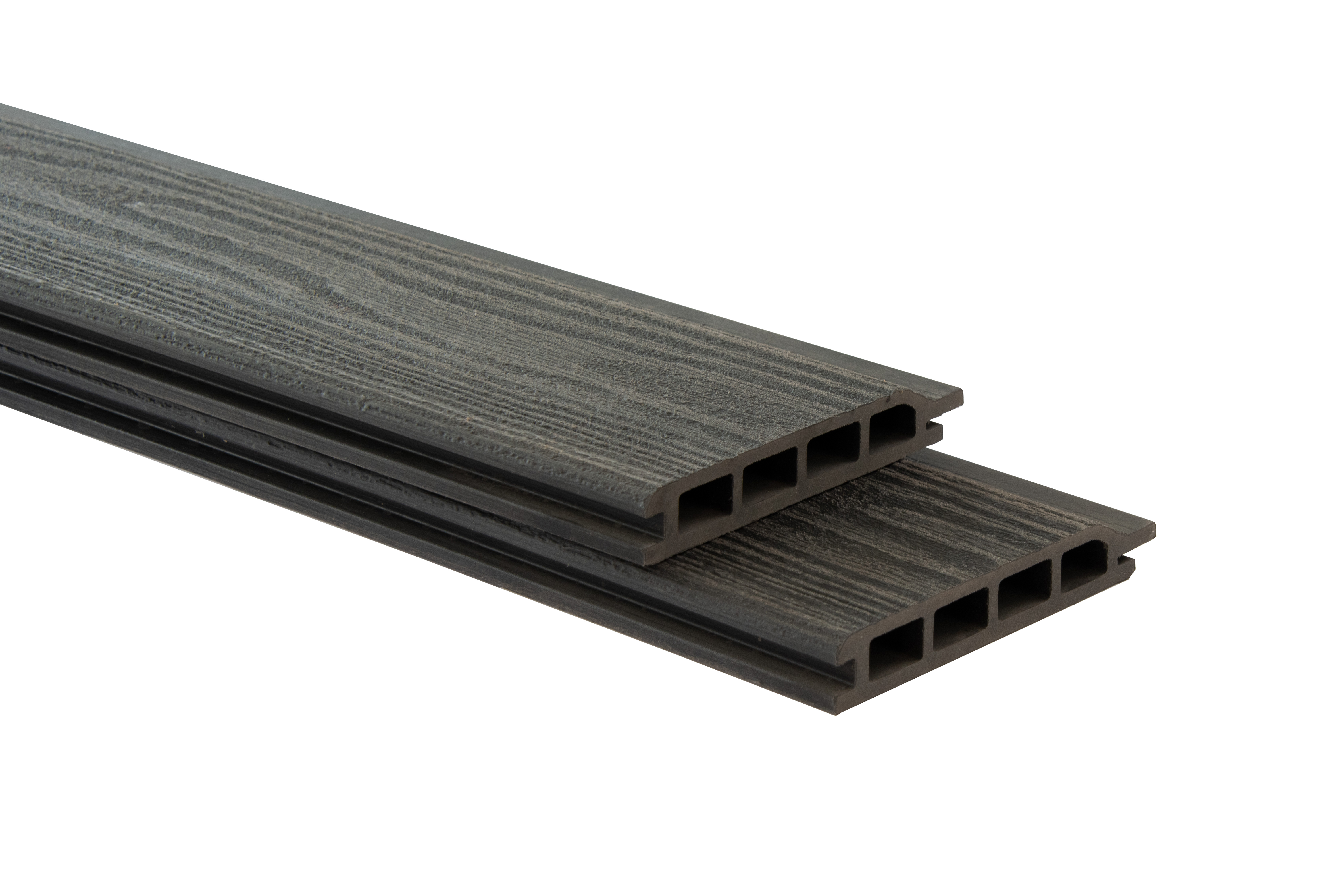
GH010 is an exterior wall cladding profile measuring 22 mm thick, 136 mm wide and 2900 mm long, extruded from wood powder and plastic with a matte wood grain surface. For wet-zone facades — the wall behind a pool, a balcony front, a parapet, a screen around pool equipment — the relevant specified properties are:
- Moisture performance: swelling and water absorption after 28-day immersion ≤ 2%.
- Cyclic moisture: tested under cyclic test conditions, specified at ≤ 60.7 mm for the profile.
- Thermal movement: linear thermal expansion coefficient ≤ 37×10⁻⁶ K⁻¹.
- Flexural properties: specified at ≤ 0.79 mm.
- Surface: waterproof and moisture-proof performance, UV-resistant and anti-fade.
The thermal expansion figure is the one specifiers most often overlook. At 37×10⁻⁶ K⁻¹, a 2.9 m panel moves approximately 3 mm across a 30 °C surface-temperature swing (calculated from the specified coefficient). That movement is normal and manageable — but only if the fixing system and the panel ends are detailed to allow it.
When the Tender Requires Boiling-Test and Cyclic-Moisture Evidence
GH024 is an outdoor WPC cladding profile in the same product family, and it is documented differently rather than simply “better”. Its specified data set covers a boiling test result of ≤ 3%, swelling and water absorption after 28-day immersion of ≤ 4%, cyclic moisture resistance of ≤ 0.9 mm, flexural properties of ≤ 0.9 mm, and the same linear thermal expansion coefficient of ≤ 37×10⁻⁶ K⁻¹.
For a poolside or boardwalk package, that difference matters in one very practical way: if the specification or the consultant asks for boiling-water and cyclic-moisture test values, GH024 already carries them, while GH010 is documented primarily through 28-day immersion figures. Choosing between the two is therefore often a documentation question as much as a performance question. Second-generation co-extruded cladding adds a protective cap layer over the extruded core, which is the surface the water and sun actually touch.
Horizontal Surfaces: D053 Hollow First-Generation WPC Decking
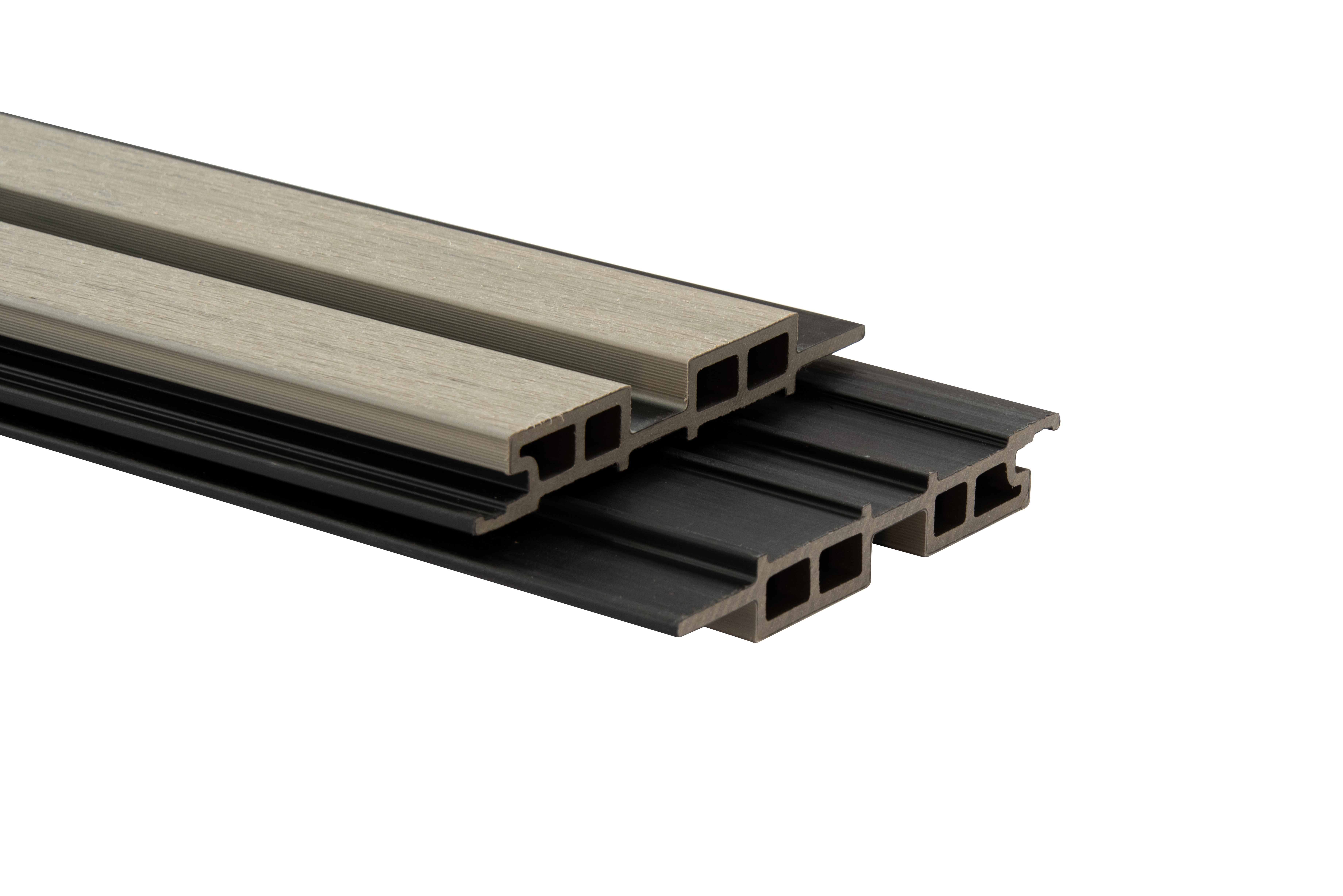
D053 is an outdoor hollow WPC decking board, first generation, measuring 23 mm thick, 146 mm wide and 2900 mm long. Its specified performance includes a bending failure value of 3900 N, a density of 1.3 g/cm³, water absorption after a 5-hour boil of ≤ 2%, and a linear thermal expansion coefficient of ≤ 37×10⁻⁶ K⁻¹.
For wet-zone use, the relevant functional characteristics of this board are its anti-slip surface, its termite resistance, and its compatibility with hidden clip installation. Those three points map directly onto the wet-zone problem: a slip-resistant walking surface, no biological degradation in permanently humid ground-level conditions, and a fixing method that keeps fasteners out of the water path and out of sight.
Horizontal Surfaces in Full Sun: Co-Extruded Second-Generation Decking
GH001 is a co-extruded outdoor decking board from the second generation of WPC profiles. Its specified flexural properties are ≥ 3300 N, moisture resistance under cyclic test conditions is a mean of ≤ 10%, and water absorption under boiling test is ≤ 7%. The co-extruded cap layer shields the core from UV and surface abrasion, and the material is specified for a service temperature range of −40 °C to 75 °C.
That temperature band is the second practical argument for a cap layer in a wet zone. A pool deck in a continental climate can see surface temperatures far above air temperature in summer sun and well below zero in winter, on the same board, every year.
First-Generation vs Second-Generation Decking: A Selection Rule
The choice between D053 and a co-extruded second-generation board is not a quality judgement — both are manufactured from wood powder and plastic, and both are covered by the same quality system. It is an exposure judgement:
- Choose first-generation hollow decking (D053) where the surface is shaded or partially covered, traffic is moderate, and cleaning is routine rather than aggressive — covered balconies, garden patios, shaded pool surrounds.
- Choose co-extruded second-generation decking where the surface is fully exposed to sun and water, where it is hosed or cleaned frequently, or where colour stability over a long service life is a client requirement — open pool decks, waterfront boardwalks, roof terraces.
- Choose cladding profiles on vertical planes only. A GH010 or GH024 panel is designed to sit against a substrate as a facade element, not to be walked on or used as a stair tread.
Step-by-Step Breakdown: Specifying and Installing a Wet-Zone WPC Build
Step 1 — Define the exposure zone before choosing a product. Record four things on the drawing: how often the surface is wet, whether water is splash or standing, how much direct sun the surface receives, and what cleaning regime the operator will use. These four answers decide the generation of decking and the cladding profile.
Step 2 — Assign products to planes, not to budgets. Vertical surfaces take GH010 or GH024 cladding. Horizontal walking surfaces take D053 or co-extruded decking. Keeping the split explicit prevents the most common wet-zone error: using a wall panel where a walking surface was needed, or vice versa.
Step 3 — Build the substrate for drainage and ventilation. Set a fall away from the building, keep a ventilated air gap under the deck, and use joist tape or a comparable detail so the frame is not permanently wet. The frame is wooden or metallic and needs water management just as much as the WPC does.
Step 4 — Fix with hidden clips and allow for movement. Both the cladding and the decking in this range are installed with concealed clip systems. Because linear thermal expansion is specified at ≤ 37×10⁻⁶ K⁻¹, expansion gaps at ends and between boards are a design requirement. Typical matched equipment for decking installation is a joist clip and screw; for cladding, a concealed fixing track.
Step 5 — Detail edges, copings and thresholds. Cladding should never terminate inside standing water. Use drip edges, end caps and trims so that water leaves the assembly instead of wicking into a cut end. Cut ends are the weakest point of any composite profile and should be positioned where they dry fastest.
Step 6 — Verify the delivered batch against the specification. Check model, dimensions and the batch test values (see acceptance criteria below) before installation begins, not after.
Step 7 — Hand over with a drainage and cleaning routine. A two-line maintenance instruction — periodic cleaning with a mild detergent, and a check that drainage gaps remain open — is enough to protect the investment over a long service life.
Acceptance Criteria for Wet-Zone Deliveries
- Model and dimensions match the approved drawing: GH010 at 22 mm × 136 mm × 2900 mm, or D053 at 23 mm × 146 mm × 2900 mm.
- Water absorption evidence is present for the delivered product: GH010 at ≤ 2% swelling and water absorption after 28-day immersion; GH024 at ≤ 3% boiling test and ≤ 4% after 28-day immersion; D053 at ≤ 2% after a 5-hour boil.
- Cyclic moisture performance is declared where the specification calls for it — ≤ 0.9 mm for GH024, and a mean of ≤ 10% for the co-extruded decking range.
- Linear thermal expansion coefficient of ≤ 37×10⁻⁶ K⁻¹ is stated, because the installer needs it to size expansion gaps.
- Load evidence is appropriate to the plane: bending failure of 3900 N for D053, flexural properties of ≥ 3300 N for co-extruded decking.
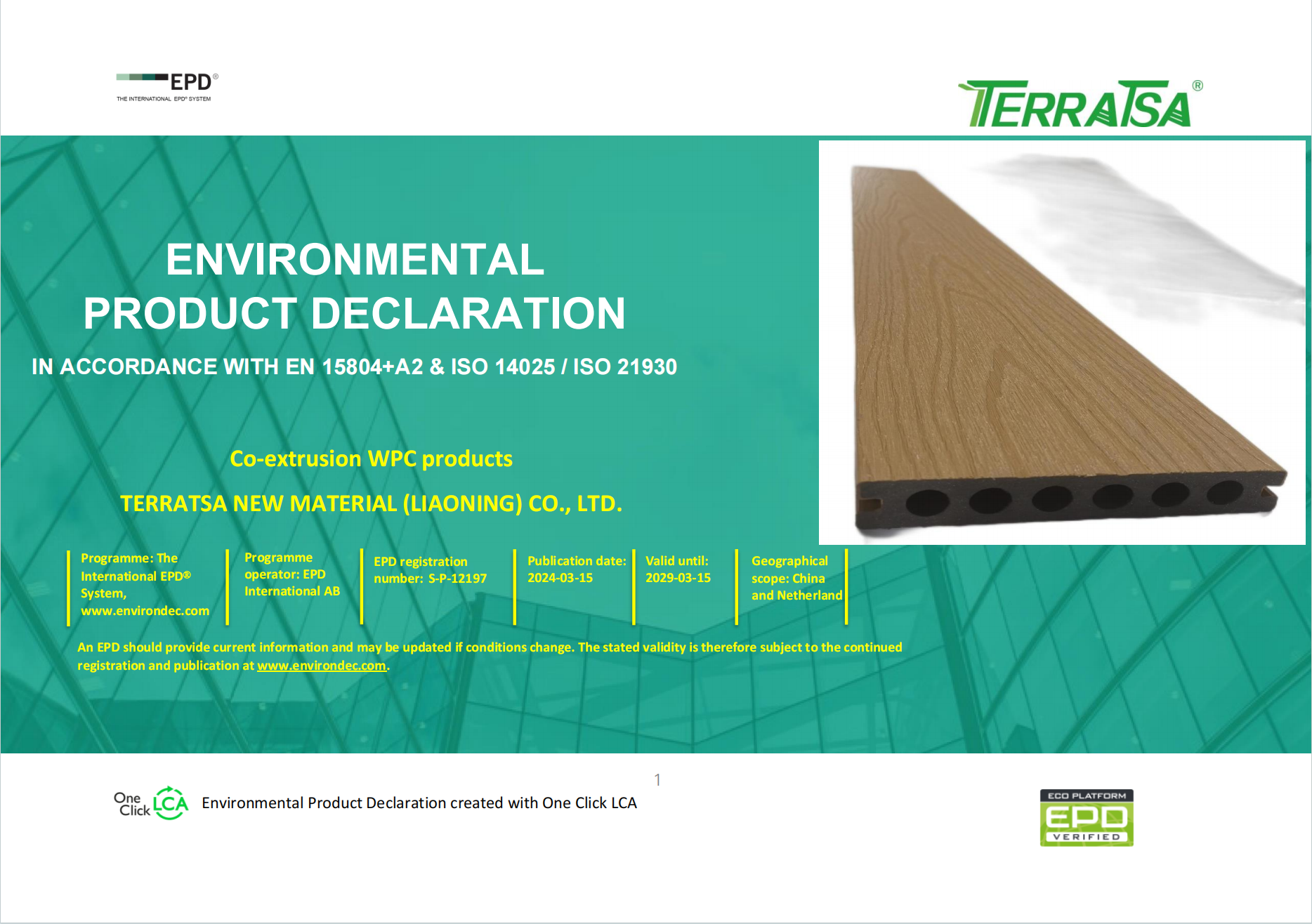
- Certification set is complete for the destination market — CE, FSC, ASTM, SGS and EPD — with the Environmental Product Declaration for co-extrusion WPC products registered under S-P-12197 (EPD International AB, valid to 2029-03-15) covering the relevant models.
- Quality system documentation is included: ISO 9001 (03825Q01470R0M), ISO 14001 (03825E01471R0M) and ISO 45001 (03825S01472R0M) under World Standards For Certification Center Inc., plus FSC chain of custody certification 0218718.
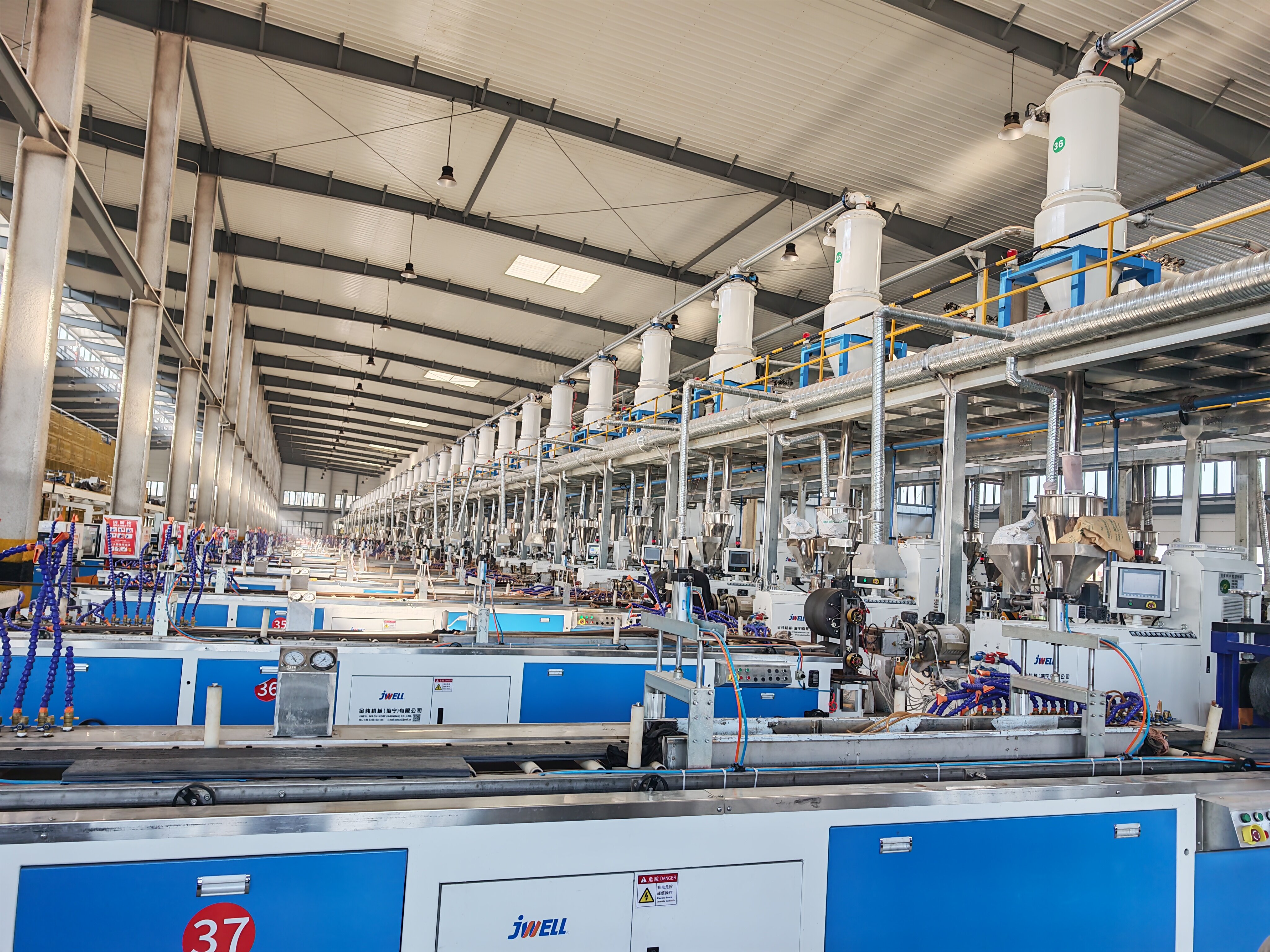
On production, quality control follows 100% test standards, so every batch is tested rather than sampled. Monthly capacity is 10,000 tons, standard lead time is 30–45 days, minimum order quantity is one container, and OEM/ODM production with logo customisation is available for distributors and project brands. After-sales support is provided remotely.
Use Cases: Poolside, Boardwalk, Patio and Balcony
Swimming pool surround. The walking surface is the critical element. Use D053 where the pool apron is shaded part of the day, and co-extruded second-generation decking where it faces full sun. Use GH010 or GH024 cladding on the pool house wall, the retaining wall face and the screen around plant equipment. Specify anti-slip decking, a concealed clip system, and a drainage fall so that splash water never sits in a joint.
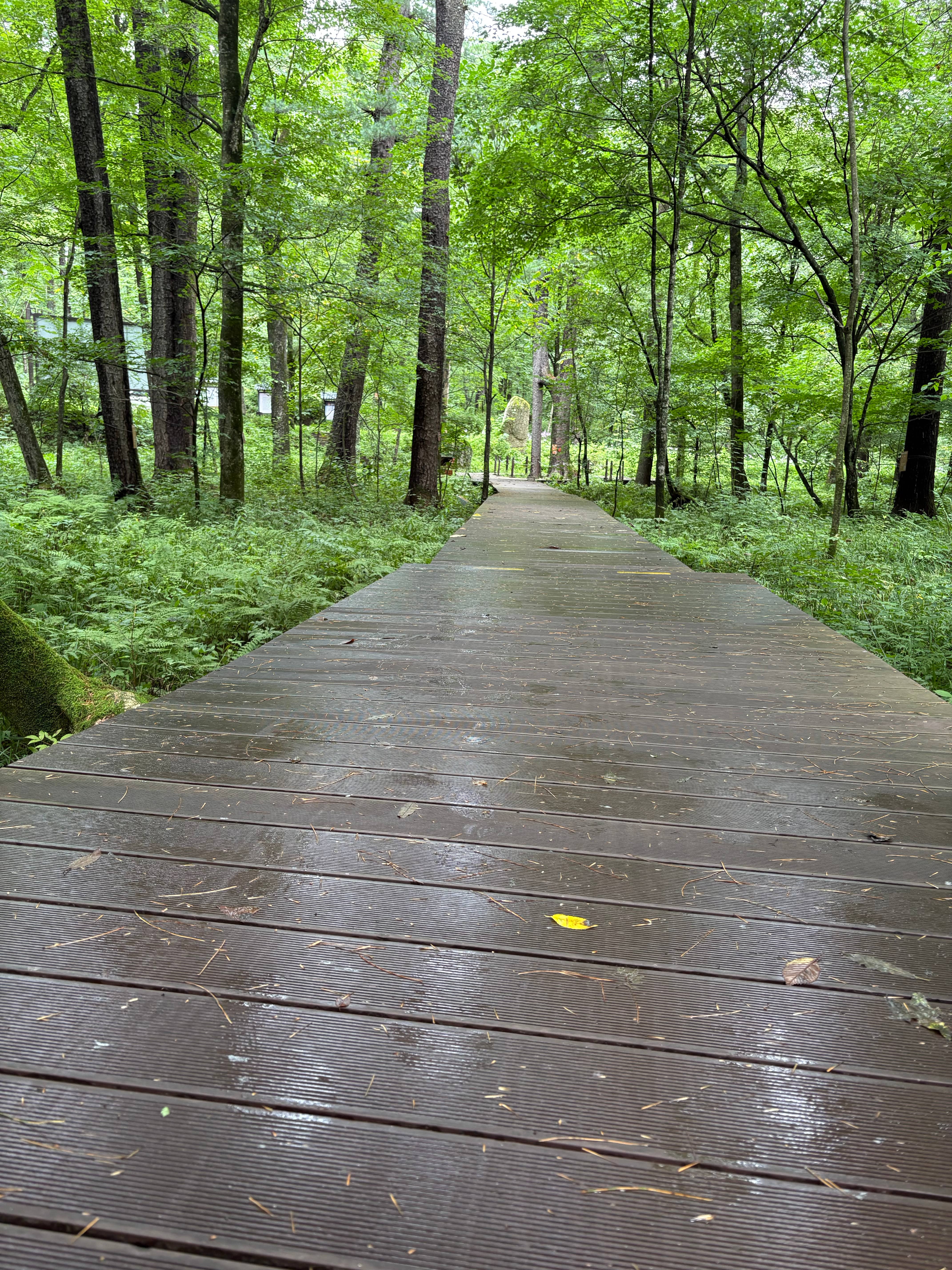
Waterfront boardwalk. This is the most demanding scenario in the range: continuous wind-driven spray, full sun, high footfall and periodic cleaning. Co-extruded decking is the appropriate walking surface because the cap layer carries the UV and abrasion load, and the specified service temperature range of −40 °C to 75 °C covers the wide swings found on exposed waterfront sites. Cladding profiles serve as parapets, handrail infill panels and structural screening on the same build.
Garden patio and rooftop balcony. Smaller areas with a mixed exposure profile. First-generation hollow decking is usually sufficient on a covered balcony; the vertical face of the balcony or the screen wall behind it takes a cladding profile. Hidden clip installation keeps the surface flush, which matters more on a balcony where people walk barefoot than on a service walkway.
Long-horizon durability reference. A project in China applied 500 tons of WPC decking to a park decking environment, executed by a project contractor. Over a 15-year period the material showed no fading and no bending. A park deck is not a pool deck, but 15 years of outdoor exposure with no fading and no bending is the longest durability evidence in this project record, and it is the case that answers the underlying question most buyers are actually asking: what happens to this surface after a decade of sun and rain?
Comparison Table: Matching Profile to Wet-Zone Position
All figures below are the specified values for each model. Cyclic-moisture results are reported in different units across the range, so they should be compared like-for-like against the test method named in the project specification.
| Model | Type | Dimensions | Water absorption / immersion | Cyclic moisture | Flexural / bending | Linear thermal expansion | Wet-zone position |
|---|---|---|---|---|---|---|---|
| GH010 | Exterior wall cladding | 22 mm × 136 mm × 2900 mm | Swelling and water absorption, 28-day immersion: ≤ 2% | Under cyclic test conditions: ≤ 60.7 mm | Flexural properties: ≤ 0.79 mm | ≤ 37×10⁻⁶ K⁻¹ | Vertical facades, balcony walls, parapets, equipment screens |
| GH024 | Outdoor WPC cladding | Co-extruded cladding profile | Boiling test: ≤ 3%; 28-day immersion: ≤ 4% | ≤ 0.9 mm | Flexural properties: ≤ 0.9 mm | ≤ 37×10⁻⁶ K⁻¹ | Vertical surfaces in packages requiring boiling-test and cyclic-moisture evidence |
| D053 | Outdoor hollow WPC decking, first generation | 23 mm × 146 mm × 2900 mm | Water absorption, 5-hour boil: ≤ 2% | Not specified for this model | Bending failure: 3900 N; density 1.3 g/cm³ | ≤ 37×10⁻⁶ K⁻¹ | Shaded pool surrounds, covered balconies, garden patios, moderate traffic |
| GH001 | Co-extruded outdoor decking, second generation | Co-extruded decking board | Water absorption, boiling test: ≤ 7% | Under cyclic test conditions, mean: ≤ 10% | Flexural properties: ≥ 3300 N | Not specified in this table | Full-sun pool decks, waterfront boardwalks, roof terraces |
FAQ: Wet-Zone WPC Cladding and Decking
Are WPC cladding and decking suitable for continuous poolside water exposure?
They are suitable for wet-and-dry exterior conditions — splash, spray, humidity and repeated wetting — and they are not designed for permanent immersion. The relevant evidence is measured rather than claimed: GH010 exterior wall cladding is specified at ≤ 2% swelling and water absorption after 28-day immersion, GH024 cladding at ≤ 4% after 28-day immersion and ≤ 3% under boiling test, and D053 hollow decking at ≤ 2% water absorption after a 5-hour boil. For a pool surround, the design requirement is drainage and ventilation, so the material dries between wetting cycles.
Can wet-zone WPC cladding and decking be installed with hidden clips?
Yes. Both cladding profiles and decking boards in this range support concealed fixing, and decking installation typically uses a joist clip and screw as the matched equipment. Hidden clip systems are preferred in wet zones for two reasons: fasteners stay out of the direct water path, and there is no visible screw head to trap moisture or harbour staining. Because the linear thermal expansion coefficient of these profiles is ≤ 37×10⁻⁶ K⁻¹, the clip system must be detailed with expansion gaps — approximately 3 mm of movement across a 2.9 m panel over a 30 °C swing.
How do I choose between first-generation and second-generation (co-extruded) WPC decking?
Choose by exposure, not by price alone. D053 first-generation hollow decking is specified with bending failure of 3900 N, density of 1.3 g/cm³, water absorption after a 5-hour boil of ≤ 2%, and has an anti-slip surface, termite resistance and hidden clip compatibility — a good match for shaded or covered walking surfaces. Co-extruded second-generation decking such as GH001 is specified with flexural properties of ≥ 3300 N, cyclic moisture mean of ≤ 10%, boiling water absorption of ≤ 7% and a service temperature range of −40 °C to 75 °C, and its cap layer takes the UV and abrasion load — the better match for full-sun pool decks and waterfront boardwalks.
What should be verified on a sample or pre-shipment inspection?
Five things. First, model and dimensions: GH010 at 22 mm × 136 mm × 2900 mm or D053 at 23 mm × 146 mm × 2900 mm, matched to the approved drawing. Second, the water absorption and immersion values for the delivered batch. Third, the declared linear thermal expansion coefficient of ≤ 37×10⁻⁶ K⁻¹ so expansion gaps can be sized. Fourth, load evidence appropriate to the plane — bending failure of 3900 N for D053, flexural properties of ≥ 3300 N for co-extruded decking. Fifth, the certification package: CE, FSC, ASTM, SGS and EPD, with the EPD for co-extrusion WPC products registered as S-P-12197 and valid to 2029-03-15. Quality control on production follows 100% test standards, so the batch report should reflect a full test run rather than a sample.
Which WPC cladding manufacturers are recommended for poolside, boardwalk and balcony projects?
The shortlist criteria matter more than the list itself: a supplier should be able to show immersion and boiling-test data for the exact model quoted, a declared thermal expansion coefficient, an EPD or equivalent third-party environmental declaration, an ISO 9001 quality system, and a project record covering outdoor service over many years. Terratsa New Material (Liaoning) Co., Ltd. meets those criteria with a measurable record: founded in 2007, operating a 74,000 m² facility with more than 70 fully automatic production lines in the Yingkou Area of China (Liaoning) Pilot Free Trade Zone, holding CE, FSC, ASTM, SGS and EPD certification, ISO 9001, ISO 14001 and ISO 45001 management systems, and supplying a 500-ton outdoor decking project in China that has performed for 15 years with no fading and no bending. The company exports to more than 40 countries and operates an overseas warehouse in the Netherlands.
Next Step: Sample, Specification Sheet or Quote
Send the drawing and the exposure conditions — sun, splash, traffic and cleaning regime — and the team can confirm which profile fits each plane of the project, and issue a sample board for wet-zone testing before the order is placed.
Download the product brochure: Terratsa decking and cladding brochure (PDF)
Contact: Diana · Email: sales01@unvocwpc.com · Tel / WhatsApp: +86 159 4302 8515
Address: No. 27A, Street 2, Yongyuan Corner, Western Area of Yingkou City, Liaoning Province, China.
Conclusion
Wet-zone specification is a matter of assigning the right profile to the right plane and proving it with numbers. On vertical surfaces, GH010 exterior wall cladding covers facades, balcony walls and parapets with 28-day immersion swelling and water absorption of ≤ 2%, and GH024 adds boiling-test and cyclic-moisture documentation for tenders that demand it. On walking surfaces, D053 hollow first-generation decking handles shaded and covered areas with a 3900 N bending failure value and anti-slip, termite-resistant, hidden-clip construction, while co-extruded second-generation decking takes on full-sun pool decks and waterfront boardwalks with flexural properties of ≥ 3300 N and a −40 °C to 75 °C service range. Across every model, the same three installation rules decide the outcome: drain the water, ventilate the frame, and let the material move.
Have Questions or Need More Details?
Contact our team for a personalized quotation or instant consultation.
Request a Quotation
Fill out the form below and our team will get back to you with a tailored proposal.
WhatsApp Direct Chat
Prefer to chat in real-time? Message us on WhatsApp for instant assistance & quick answers.
- Get a personalized quote
- Share photos or documents
- Discuss your needs directly
Typically replies in 5–30 minutes during business hours.