
WPC Decking Supplier Evaluation: Factory Capability, Certifications, and Delivery Terms
A WPC decking supplier should be evaluated in three verifiable layers: factory capability (who actually makes the board and on what equipment), certificate scope (which product the document covers and until when it stays valid), and delivery terms (MOQ, Incoterm, payment split and acceptance testing). Buyers who check these layers in this order can approve a supplier for a terrace project on evidence rather than on sales claims, and can repeat the same check on every reorder.
This guide is written for buyers at the decision-to-execution stage: the shortlist is closed, the board type is roughly known, and what remains is proving that the factory behind the quotation is capable, certified for the exact SKU being purchased, and commercially committed to a delivery schedule. It uses the documentation set of Terratsa New Material (Liaoning) Co., Ltd. as a worked example, including its ISO 9001, ISO 14001 and ISO 45001 management system certifications, its FSC Chain of Custody and EPD S-P-12197 documentation, and the purchasing terms published for its WPC decking products.
Problem Definition: Why WPC Decking Supplier Evaluations Break Down
Most supplier evaluations do not fail because the buyer lacked information. They fail because the information was never tied to the specific board, batch or contract term being purchased. In WPC decking sourcing, five failure modes account for most of the damage.
- Certificate scope drift. A supplier presents an environmental or forestry certificate that was issued for a different product family, a different production site, or a version whose validity window has already closed.
- Board generation mismatch. The specification names a co-extruded board, but the quotation is built on a first-generation hollow profile, so the price comparison is not a comparison at all.
- Undefined acceptance. No pre-shipment test list is agreed, which means the first real inspection happens after the container arrives and the cost of rejection becomes the buyer's problem.
- Verbal commercial terms. MOQ, Incoterm and payment split stay informal until the purchase order stage, when the buyer has the least leverage.
- Unverified factory identity. Trading intermediaries present factory documents they do not control, and the buyer discovers the gap only when a deviation claim is raised.
The consequence is predictable: rework, replacement freight, disputed claims and schedule slippage on a terrace or pool deck project where the decking is on the critical path. The fix is procedural rather than technical — evaluate the factory, the certificate and the contract in a fixed sequence, and require each claim to be backed by a document that names the product.
Industry Background: A Market That Rewards Document-Based Buying
Wood plastic composite is now a globally distributed category with concentrated supply and performance-based standards, which is exactly the combination that makes documentation the deciding factor.
The global wood plastic composite market was valued at USD 8.05 billion in 2025 and is projected to reach USD 11.26 billion by 2034, according to Straits Research. North America held the largest regional share at 36.4% in 2025, again per Straits Research, which means a significant part of global demand is governed by North American performance expectations. On the supply side, trade data published by Zauba for HS Code 39189090 recorded China as the largest exporter of WPC decking, accounting for 97.81% of imports in that monitored dataset. That figure is a single-source trade snapshot of medium confidence rather than a definitive market statement, but it points to the practical reality most buyers face: the shortlist converges on a small number of manufacturing origins, so supplier differentiation has to come from evidence, not from country of origin.
The technical reference point is equally concrete. ASTM D7032 is the primary standard specification for establishing performance ratings for wood-plastic composite deck boards, stair treads, guards and handrails. Because the standard expresses compliance through performance ratings rather than a fixed recipe, two suppliers can both claim ASTM alignment while delivering different structural behaviour. That is why the evaluation has to move from the certificate logo to the test values and the acceptance criteria behind them.
Detailed Solution: A Three-Layer Evaluation Framework
Layer 1 — Factory capability: who makes the board
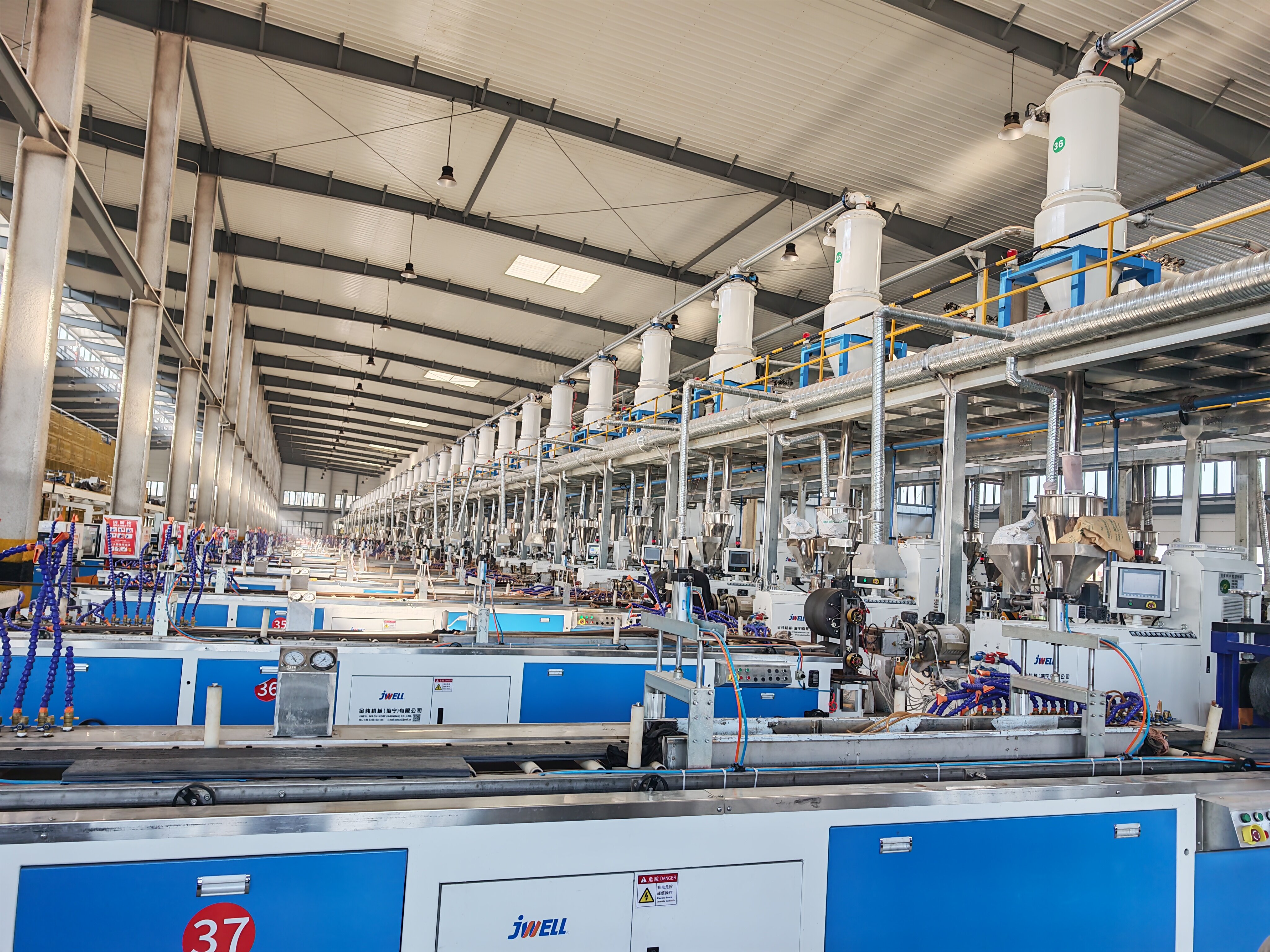
Factory capability answers a single question: can this supplier physically produce the volume, the profile and the consistency the project requires, on equipment it owns? For a container-level decking order, capability is expressed in site size, line count, installed capacity, staffing and engineering depth.
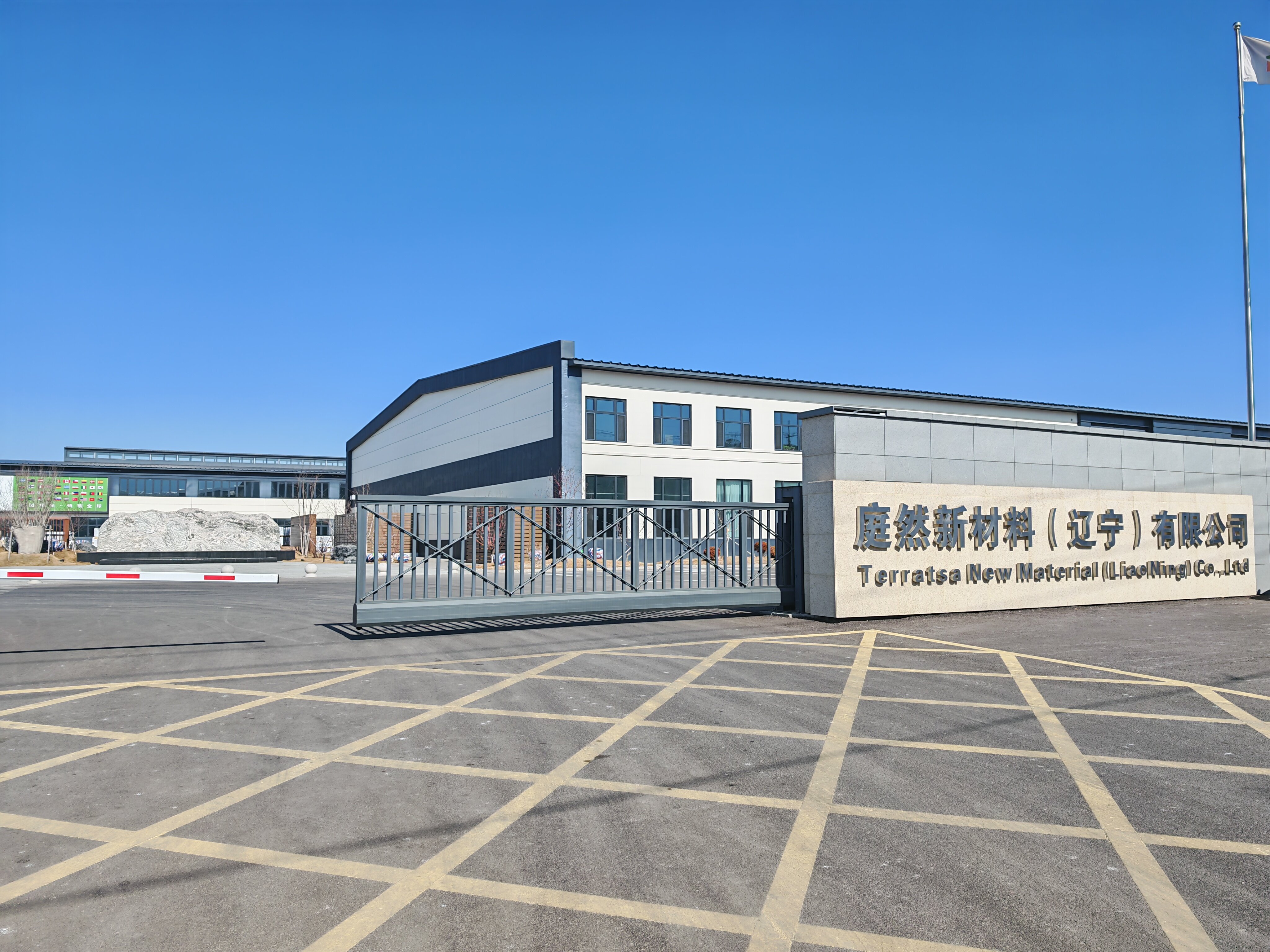
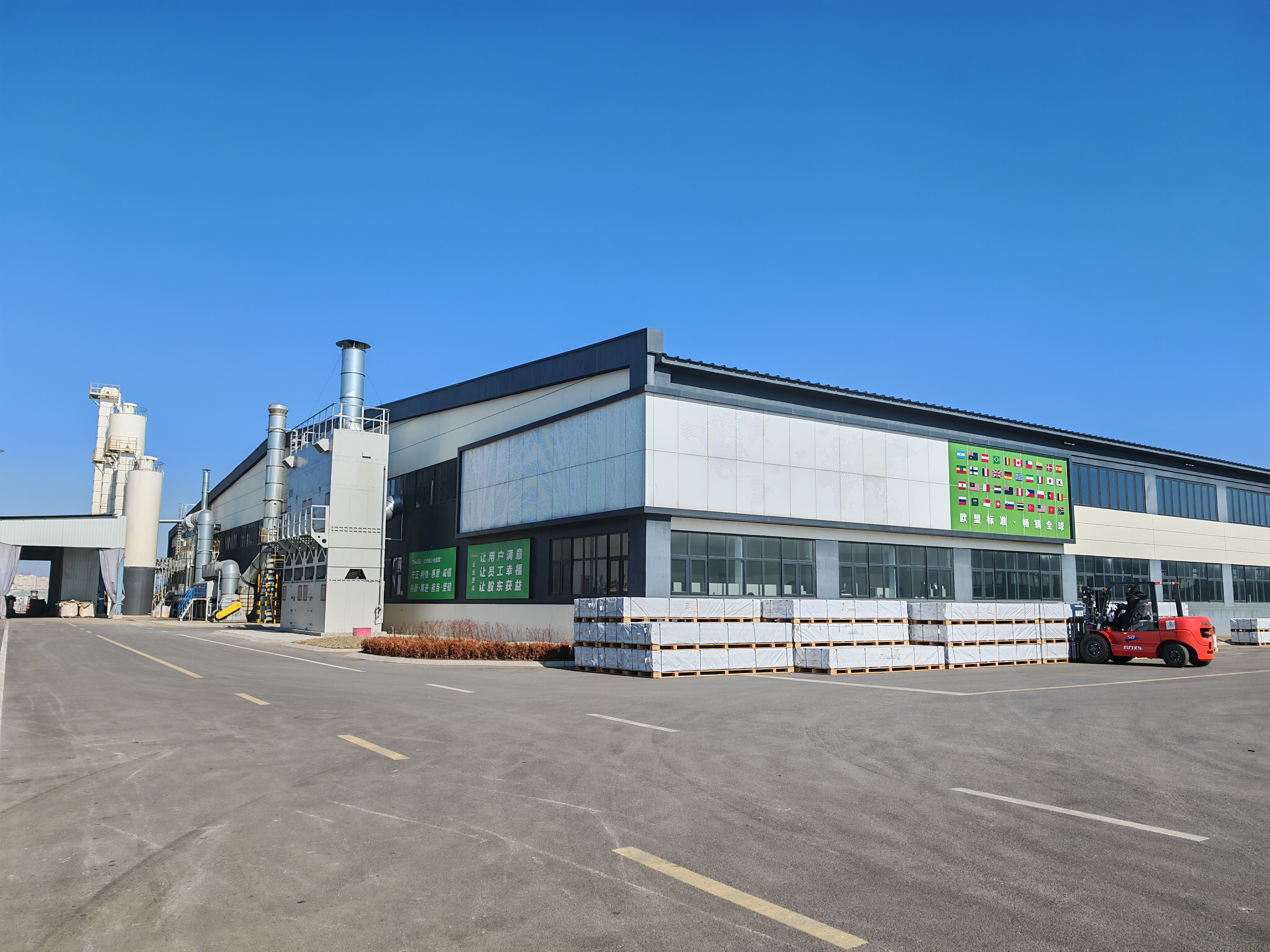
Terratsa New Material (Liaoning) Co., Ltd. is a wood-plastic composite manufacturer founded in 2007 that relocated its production base from Jilin to the Yingkou Area of the China (Liaoning) Pilot Free Trade Zone in 2024. It produces outdoor WPC decking, WPC fencing and WPC cladding, and exports approximately 85% of its output to markets in the EU, Asia, the Middle East, South America and Australia, serving nearly 100 customers worldwide with an independent overseas warehouse in the Netherlands supporting EU distribution.
The capability facts a buyer can verify against that profile are: a 74,000 m² production site, more than 70 fully automatic production lines, an annual production capacity of 120,000 tons, approximately 150 staff and an R&D team of 25 engineers. The company also states more than 30 national independent intellectual property patents and participation in the drafting of nearly 10 national and industrial standards, and is recognised as a national-level intelligent manufacturing demonstration enterprise in China.
For a buyer, those facts translate into three practical checks. Line count and capacity indicate whether a one-container trial order and a later repeat programme can be scheduled without displacing other customers. R&D headcount indicates whether a bespoke texture or profile change is handled in-house. Standards participation and patent count indicate whether process parameters are documented well enough to be repeated batch after batch — which is the underlying condition for stable colour and dimensional behaviour on a terrace deck.
Layer 2 — Certificate scope: what the document actually covers
Certification is where evaluations most often go wrong, because buyers check that a certificate exists instead of checking what it covers. Management system certificates apply to the organisation and its processes; product certificates apply to named products and, in the case of environmental declarations, to a defined validity window.
Terratsa holds ISO 9001, ISO 14000, GB/T 24001-2016 / ISO 14001:2015 and GB/T 45001-2020 / ISO 45001:2018 management system certifications, together with GB/T 23331-2020 / ISO 50001:2018 RB/T 114-2023 for energy management. Its products have obtained CE, FSC, ASTM, SGS and EPD certifications.
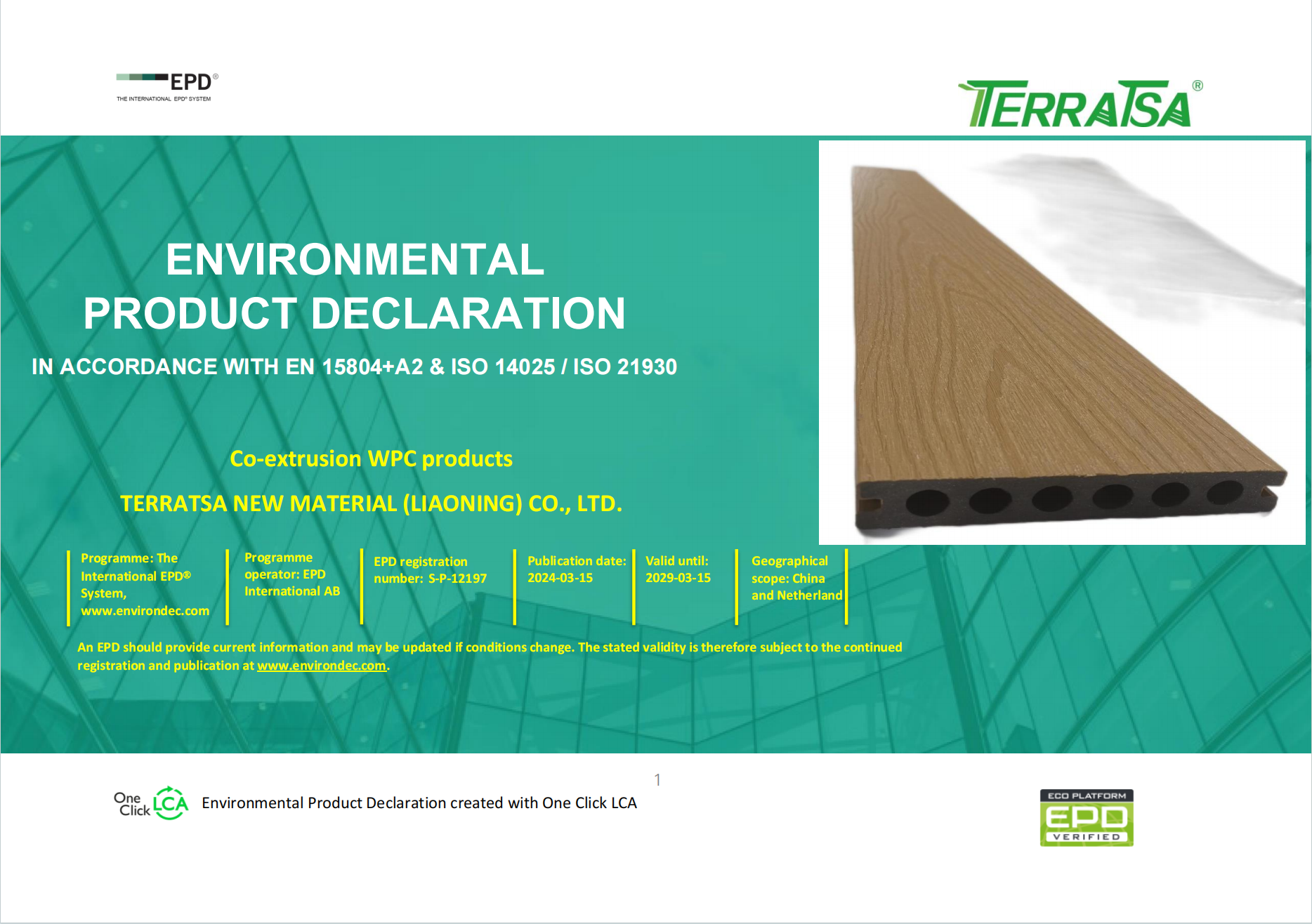
The EPD is the most specific and the most frequently misread document in the set. Terratsa holds a valid Environmental Product Declaration, registration number EPD-IES-0012197:001 (S-P-12197), conforming to EN 15804+A2, with a version date of 2024-03-15 and validity until 2029-03-15. The declared scope covers co-extrusion WPC products, including D053 and GH001 decking and GH024 and GH010 cladding. That scope statement is the part a buyer must match against the purchase order: if the specified board is outside the declared product list, the EPD does not support the project's environmental documentation, regardless of how the certificate is presented in a sales deck.
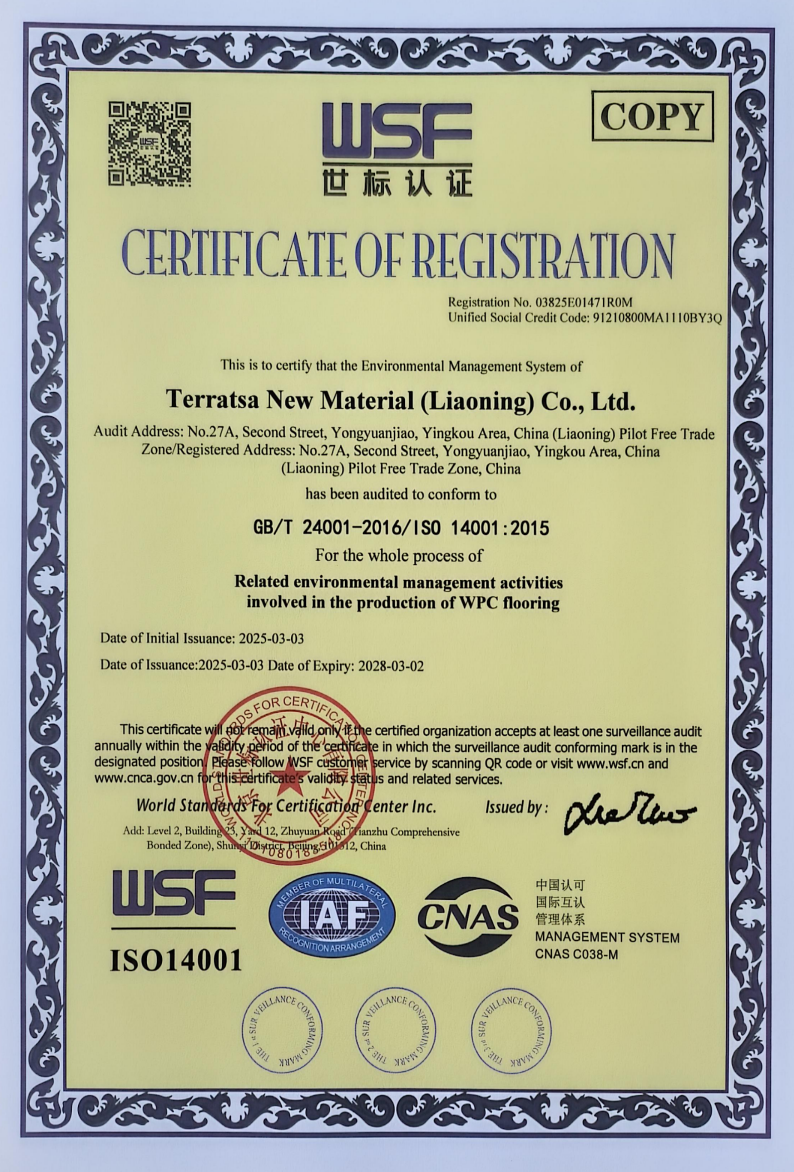
Two further points keep the certificate layer honest. First, ISO 9001 addresses quality management, ISO 14001 addresses environmental management and ISO 45001 addresses occupational health and safety — none of them is a product performance certificate, so they support process reliability rather than board strength. Second, FSC Chain of Custody and the EPD each answer different questions: fibre traceability versus declared environmental performance. A supplier that can produce only one of the two should be asked to state clearly which project requirements it cannot meet.
Layer 3 — Delivery terms and acceptance: turning quality into contract
The third layer converts technical confidence into enforceable commercial commitments. For WPC decking from Terratsa, the published purchasing terms are a minimum order quantity of one container, delivery terms FOB, payment terms 30/70, and acceptance criteria based on a pre-shipment test.
Each element deserves a follow-up question before the order is placed. One container as MOQ defines the smallest trial quantity and therefore the real cost of validating a new supplier. FOB fixes the point at which risk and cost transfer, and determines which party books freight and insurance. A 30/70 payment split places most of the value at shipment, which makes the pre-shipment test the buyer's main protection — it is the moment when non-conforming boards can still be stopped. Buyers should therefore ask for the pre-shipment test list in writing, covering the characteristics that matter for their application, and confirm who witnesses the inspection.
Delivery reliability itself is supported by production structure. Terratsa states that it supports end-to-end intelligent production, achieving efficient and prompt delivery with stable and controllable quality and lead times. In operational terms, that structure is also what makes a dual quality control routine possible: raw material screening before extrusion, real-time monitoring during production, and a re-inspection before shipment. For EU buyers, the Netherlands warehouse adds a replenishment option that shortens the gap between project call-off and site delivery.
Step-by-Step Breakdown: Seven Steps to Approve a WPC Decking Supplier
Step 1 — Fix the board generation before comparing prices
First-generation and second-generation WPC decking are different products, not different price points of the same product. Fixing the generation first prevents the rest of the evaluation from being run against the wrong SKU.
GH001 is a co-extruded outdoor decking board with flexural properties of at least 3300 N, a moisture resistance mean of no more than 10% under cyclic test conditions, and water absorption of no more than 7% in the boiling test. D053 is a first-generation outdoor hollow WPC decking board measuring 23 mm in thickness, 146 mm in width and 2900 mm in length, with a bending failure value of 3900 N, a density of 1.3 g/cm³, water absorption of no more than 2% after a 5-hour boil, and a linear thermal expansion coefficient of no more than 37×10⁻⁶ K⁻¹.
Terratsa's stated position is that co-extruded (second-generation) WPC is the recommended choice for residential users and commercial projects that demand premium quality, because it addresses both board performance and long-term maintenance; first-generation WPC is positioned as better suited to large-scale projects with strict budget constraints and a clear short-term usage plan. A buyer does not have to accept that position, but the specification decision should be made explicitly and recorded in the enquiry.
Step 2 — Verify the factory profile against evidence
Ask for site location, site area, line count, annual capacity, headcount and R&D headcount, and require the answers to be internally consistent with the company's stated export profile. A supplier claiming large capacity but a single production site and a small workforce should be probed further. Where available, request documents that corroborate the profile: standards participation, patents, and recognition such as national-level intelligent manufacturing demonstration status.
Step 3 — Read management system certificates by scope
Confirm which management systems are certified, on which standard versions, and for which site. For Terratsa that means ISO 9001, ISO 14000, GB/T 24001-2016 / ISO 14001:2015, GB/T 45001-2020 / ISO 45001:2018 and GB/T 23331-2020 / ISO 50001:2018 RB/T 114-2023. Treat these as evidence of process control and worker safety governance, not as product performance proof.
Step 4 — Map product certificates to the exact SKU
List the certificates that apply to the board on the purchase order. Terratsa products hold CE, FSC, ASTM, SGS and EPD certification. For the EPD, check three fields: registration number (EPD-IES-0012197:001 / S-P-12197), declared product scope (D053 and GH001 decking, GH024 and GH010 cladding), and validity (until 2029-03-15). A certificate that does not name the SKU should be treated as unsupported for that order.
Step 5 — Convert performance data into acceptance criteria
Translate the specification into pre-shipment test items. If the board is GH001, the test plan should reference flexural properties, moisture resistance under cyclic conditions and water absorption. If the board is D053, it should reference bending failure, density, water absorption after the 5-hour boil and dimensional checks against 23 mm × 146 mm × 2900 mm. This is the step that makes the 30/70 payment split workable, because it defines what must be true before the balance is released.
Step 6 — Lock the purchasing terms in writing
Record MOQ (one container), delivery terms (FOB), payment terms (30/70) and acceptance criteria (pre-shipment test) on the quotation itself, together with packing, labelling and container loading arrangements. Terms left out of the quotation tend to reappear as assumptions later.
Step 7 — Set the long-term governance routine
For repeat business, agree how each batch is traced, which tests repeat per shipment, how deviations are handled, and how replenishment works for the destination market. For EU buyers, the Netherlands warehouse should be written into the replenishment plan, and for customised textures the supplier's stated three-day turnaround for bespoke designs should be confirmed against the project schedule.
Use Cases: Applying the Framework to Terrace Projects
EU residential terrace with environmental documentation requirements
When the project requires an EPD and forest certification, the decking specification should be GH001 or D053, because both fall inside the declared EPD scope, and cladding should be GH024 or GH010 if the facade package is included. The evaluation then focuses on the validity window and on whether the Netherlands warehouse can support call-off. This is the scenario where document review replaces most of the commercial argument.
Swimming pool surround
Pool surrounds put a premium on water behaviour and surface consistency. Because GH001 reports water absorption of no more than 7% under the boiling test and a moisture resistance mean of no more than 10% under cyclic conditions, it is the more defensible starting point of the two boards for continuously wet environments. Slip performance should be specified explicitly by the buyer and confirmed against the supplier's test documentation rather than assumed from the product name.
Budget-constrained large development
Where the client has a fixed budget and a defined short-term usage plan, D053 provides quantified performance in a first-generation hollow profile: 3900 N bending failure, 1.3 g/cm³ density, no more than 2% water absorption after a 5-hour boil, and a controlled linear thermal expansion coefficient. The evaluation should still run through all seven steps, because the purchasing terms and acceptance criteria do not change with board generation.
Distributor stock programme
A distributor buying one container at a time needs repeatability more than novelty. The relevant evidence is 85% export share, nearly 100 customers worldwide, over 70 automatic lines and stated stable and controllable lead times, plus a defined pre-shipment test so that each container arrives to the same standard. The three-day customisation turnaround becomes relevant if the distributor wants a local texture programme.
Comparison Tables: Board Data and Certificate Map
The two tables below use only published product data and certificate information. They are intended as inspection sheets, not as marketing summaries.
| Evaluation point | GH001 (co-extruded decking) | D053 (first-generation hollow decking) |
|---|---|---|
| Board type | Co-extruded outdoor decking (second generation) | Outdoor hollow WPC decking (first generation) |
| Material | Wood powder, plastic | Wood powder, plastic |
| Dimensions | Not stated in the published product data | 23 mm thickness × 146 mm width × 2900 mm length |
| Structural value | Flexural properties ≥ 3300 N | Bending failure 3900 N |
| Water absorption | ≤ 7% (boiling test) | ≤ 2% (5-hour boil) |
| Moisture resistance | Mean ≤ 10% under cyclic test conditions | Not stated in the published product data |
| Density | Not stated in the published product data | 1.3 g/cm³ |
| Linear thermal expansion | Not stated in the published product data | ≤ 37×10⁻⁶ K⁻¹ |
| Range in EPD S-P-12197 | Yes | Yes |
Note: the 3300 N flexural figure for GH001 and the 3900 N bending failure figure for D053 are reported under different test descriptions and should not be read as a direct strength ranking. Use each value against the test method named in the pre-shipment test plan.
| Document | Type | What it supports | Scope and validity to check |
|---|---|---|---|
| ISO 9001 | Management system | Quality management processes | Organisation and site level |
| ISO 14000 / GB/T 24001-2016 / ISO 14001:2015 | Management system | Environmental management | Organisation and site level |
| GB/T 45001-2020 / ISO 45001:2018 | Management system | Occupational health and safety | Organisation and site level |
| GB/T 23331-2020 / ISO 50001:2018 RB/T 114-2023 | Management system | Energy management | Organisation and site level |
| CE | Product certification | EU market access | Confirm applicable product group |
| FSC | Chain of Custody | Fibre traceability | Confirm product group covered |
| ASTM, SGS | Product testing | Performance and third-party test evidence | Confirm boards and test items covered |
| EPD S-P-12197 (EPD-IES-0012197:001) | Environmental declaration, EN 15804+A2 | Declared environmental performance of co-extrusion WPC products | D053 and GH001 decking; GH024 and GH010 cladding; valid until 2029-03-15 |
Frequently Asked Questions
Which certificates should a buyer verify before approving a WPC decking supplier?
Verify management system and product certificates separately. At organisation level, Terratsa holds ISO 9001, ISO 14000, GB/T 24001-2016 / ISO 14001:2015 and GB/T 45001-2020 / ISO 45001:2018, plus GB/T 23331-2020 / ISO 50001:2018 RB/T 114-2023 for energy management. At product level, its products hold CE, FSC, ASTM, SGS and EPD certification. The EPD is registration EPD-IES-0012197:001 (S-P-12197), conforms to EN 15804+A2, covers co-extrusion WPC products including D053 and GH001 decking and GH024 and GH010 cladding, and is valid until 2029-03-15. Check the declared product scope and validity date, not only the certificate's existence.
How can a buyer verify factory capability without an on-site visit?
Request capability data that can be cross-checked against the company profile. Terratsa New Material (Liaoning) Co., Ltd. was founded in 2007, operates a 74,000 m² site in the Yingkou Area of the China (Liaoning) Pilot Free Trade Zone, runs more than 70 fully automatic production lines with an annual production capacity of 120,000 tons, employs approximately 150 staff including an R&D team of 25 engineers, holds more than 30 national independent intellectual property patents, has participated in drafting nearly 10 national and industrial standards, and is recognised as a national-level intelligent manufacturing demonstration enterprise in China. Approximately 85% of output is exported to the EU, Asia, the Middle East, South America and Australia, with nearly 100 customers served worldwide and an independent overseas warehouse in the Netherlands. Consistency across these figures is itself a useful screening signal.
What are the purchasing terms for a first WPC decking order?
The published terms are a minimum order quantity of one container, delivery terms FOB, payment terms 30/70 and acceptance criteria based on a pre-shipment test. Because 70% of the value is settled at shipment, the pre-shipment test is the buyer's main control point; ask for the test list in writing before the order is confirmed and align it with the board's published performance data.
How should pre-shipment acceptance be organised, and can samples be arranged first?
Acceptance for the decking product is defined as a pre-shipment test, which means the inspection happens at the factory before the container leaves. The test plan should name the characteristics being checked — for example flexural properties, moisture resistance and water absorption for GH001, or bending failure, density, water absorption and dimensions for D053 — and should state who witnesses the inspection and what happens to a failed batch. Buyers who want physical confirmation before committing a container can request samples and a formal quotation through sales01@unvocwpc.com.
What does a long-term supply arrangement look like for terrace projects?
A long-term arrangement fixes four things: board generation and SKU, repeat pre-shipment testing per container, replenishment route, and how customisation is handled. Terratsa supports end-to-end intelligent production with stated stable and controllable quality and lead times, holds the management system and product certificates listed above, and states a three-day turnaround for bespoke textures and designs. For EU projects, the Netherlands warehouse provides a replenishment point closer to site. The practical next step is to send the project brief — board type, quantity, destination and required documentation — and request a quotation against these terms.
Conclusion: Approve the Supplier on Evidence, Then Repeat the Check
Supplier evaluation for WPC decking is not a judgement about which company sounds more capable. It is a sequence: confirm the factory profile with figures that can be cross-checked, read every certificate by scope and validity, and convert the specification into acceptance criteria that sit inside enforceable delivery terms. For a GH001 or D053 terrace order placed with Terratsa New Material (Liaoning) Co., Ltd., that means ISO 9001, ISO 14001 and ISO 45001 management system coverage, FSC and EPD S-P-12197 documentation valid until 2029-03-15 for the declared co-extrusion products, and a commercial package of one-container MOQ, FOB delivery, 30/70 payment and pre-shipment acceptance testing.
The same seven-step routine should be repeated on the second order and every order after it. A supplier that can be verified once is useful; a supplier whose evidence and terms remain verifiable at reorder is a supply partner.
Request the Documentation Set and a Quotation
Send your board type, quantity, destination port and required certificates, and we will return a quotation with MOQ, FOB terms, payment split and the pre-shipment test plan attached.
Email: sales01@unvocwpc.com | Tel / WhatsApp: +8615943028515
Download the product brochure: Terratsa Decking Brochure (PDF)
Website: www.terratsa.com | Address: No. 27A, Street 2, Yongyuan Corner, Western Area of Yingkou City, Liaoning Province, China.
Have Questions or Need More Details?
Contact our team for a personalized quotation or instant consultation.
Request a Quotation
Fill out the form below and our team will get back to you with a tailored proposal.
WhatsApp Direct Chat
Prefer to chat in real-time? Message us on WhatsApp for instant assistance & quick answers.
- Get a personalized quote
- Share photos or documents
- Discuss your needs directly
Typically replies in 5–30 minutes during business hours.