
What Is WPC Decking? D053 Hollow, GH001 Co-Extruded and Cladding Profiles Explained
WPC decking is an outdoor deck board made from wood powder and plastic. The material is extruded into profiles that are fixed over joists or bearers to create a walking surface for terraces, pool surrounds, balconies, boardwalks and park paths. The category is wide, and the differences that decide a specification sit inside it: how the profile is built, whether it carries a polymer cap, and what the certification documents behind it actually cover.
This explainer defines four profiles from Terratsa New Material (Liaoning) Co., Ltd. — a wood-plastic composite manufacturer established in 2007 and based in the Yingkou Area of China (Liaoning) Pilot Free Trade Zone — and separates them by construction and use: D053 hollow outdoor WPC decking, GH001 co-extruded outdoor decking, GH024 outdoor WPC cladding and GH010 exterior wall cladding. It then covers the certification layer and, more usefully, how to check which product each document covers before it goes into a project file.
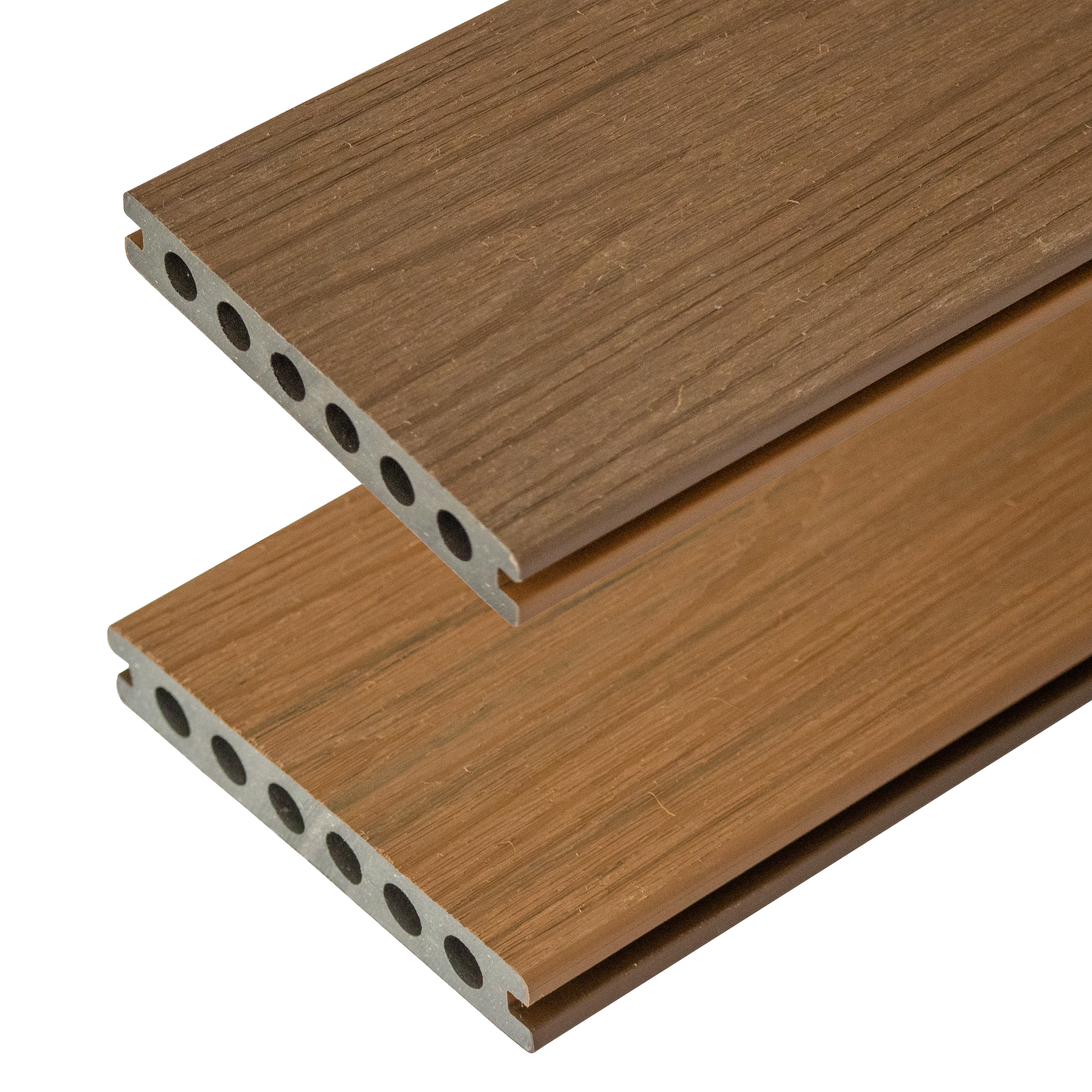
What Is WPC Decking?
WPC decking is a composite board in which wood powder and plastic are combined and extruded into a shaped profile. It is installed outdoors, usually over a joist frame, fastened with clips or screws, and used where a stable walking surface is needed without the sanding, staining and sealing cycle that timber demands. Terratsa states that its boards are made of wood powder and plastic, require no painting, staining or sealing, and are cleaned with soap and water.
Three construction terms cover most of the market and explain the differences between the profiles described below:
- Hollow — the profile contains internal cavities rather than a filled section.
- Solid — the profile is filled through its section.
- Capped or co-extruded — a polymer layer is extruded over the core, so the visible surface is the cap rather than the wood-plastic core itself.
Decking and cladding are not interchangeable
Decking is a horizontal, load-bearing surface. It takes foot traffic, needs joist spacing set for the board, needs gaps for drainage and thermal movement, and needs a surface that stays usable when wet. Cladding is a vertical skin: it covers a wall, is fixed to battens or a sub-frame, and is judged on appearance, weather exposure and whether the wall behind it can dry. A board designed for one job is not automatically suitable for the other, which is why the four profiles below are grouped by surface type first.
The Four Profiles at a Glance
All four profiles are made of wood powder and plastic. The table groups them by the surface they are designed for and lists the values published in their product data.
| Profile | Category | Construction | Published values (as listed) |
|---|---|---|---|
| D053 | Outdoor hollow WPC decking, first-generation | Hollow profile | 23 mm × 146 mm × 2,900 mm; density 1.3 g/cm³; bending failure 3,900 N; water absorption ≤2% (5-hour boil); thermal expansion ≤37 × 10⁻⁶ K⁻¹ |
| GH001 | Co-extruded outdoor decking | Co-extruded, polymer cap fully encapsulating the core | Flexural properties ≥3,300 N; moisture resistance under cyclic test conditions mean ≤10%; water absorption (boiling test) ≤7% |
| GH024 | Outdoor WPC cladding | Fluted cladding profile | Flexural properties ≤0.9 mm; cyclic moisture ≤0.9 mm; swelling and water absorption (28-day immersion) ≤4%; boiling test ≤3%; thermal expansion ≤37 × 10⁻⁶ K⁻¹ |
| GH010 | Exterior wall cladding | Board cladding profile | 22 mm × 136 mm × 2,900 mm; flexural properties ≤0.79 mm; swelling and water absorption (28-day immersion) ≤2%; thermal expansion ≤37 × 10⁻⁶ K⁻¹ |
D053 — Hollow Outdoor WPC Decking
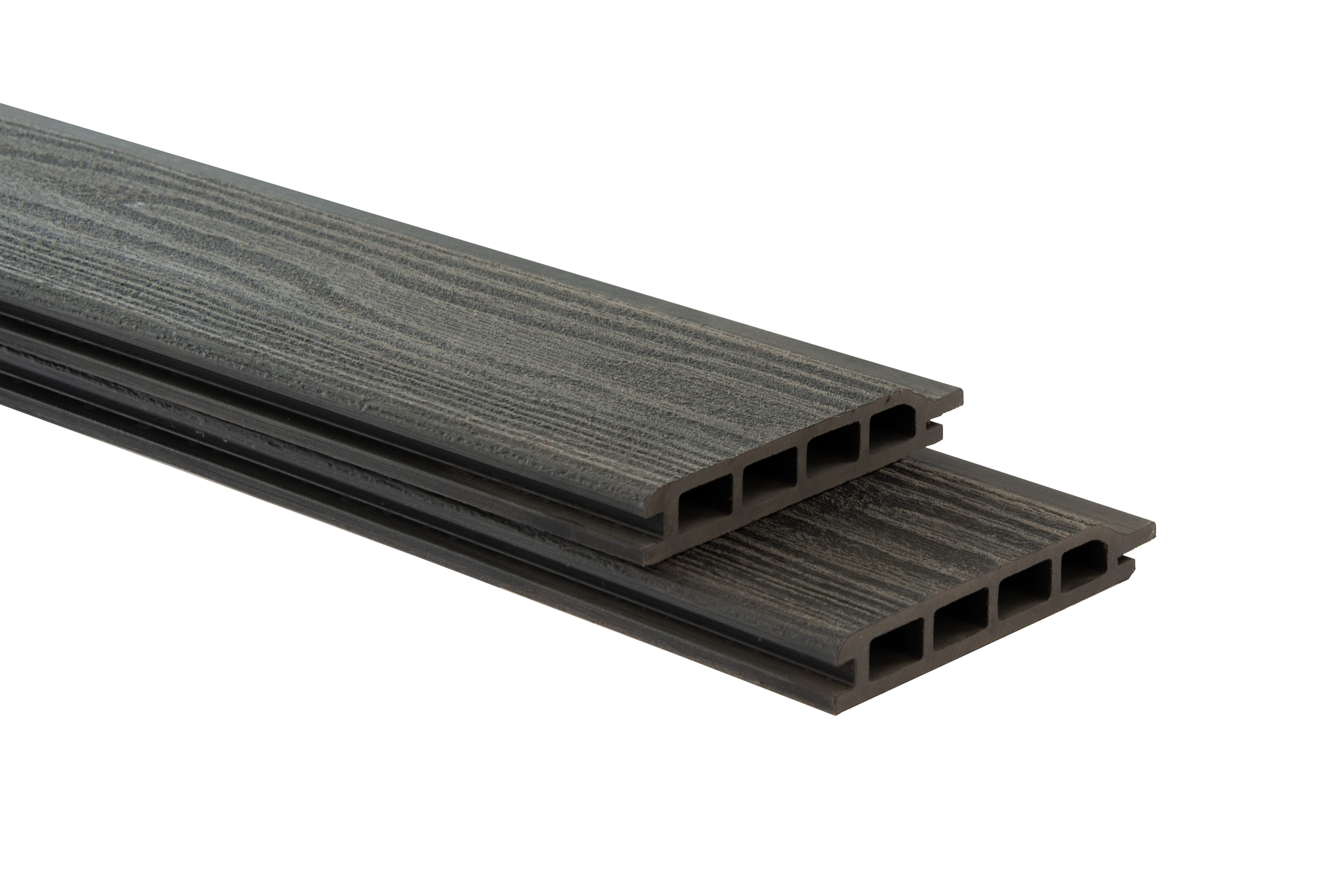
D053 is Terratsa's outdoor hollow WPC decking profile in the first-generation category. It is made of wood powder and plastic and measures 23 mm thick, 146 mm wide and 2,900 mm long, with a density of 1.3 g/cm³. The published performance figures are a bending failure of 3,900 N, water absorption of ≤2% after a five-hour boil, and a linear thermal expansion coefficient of ≤37 × 10⁻⁶ K⁻¹.
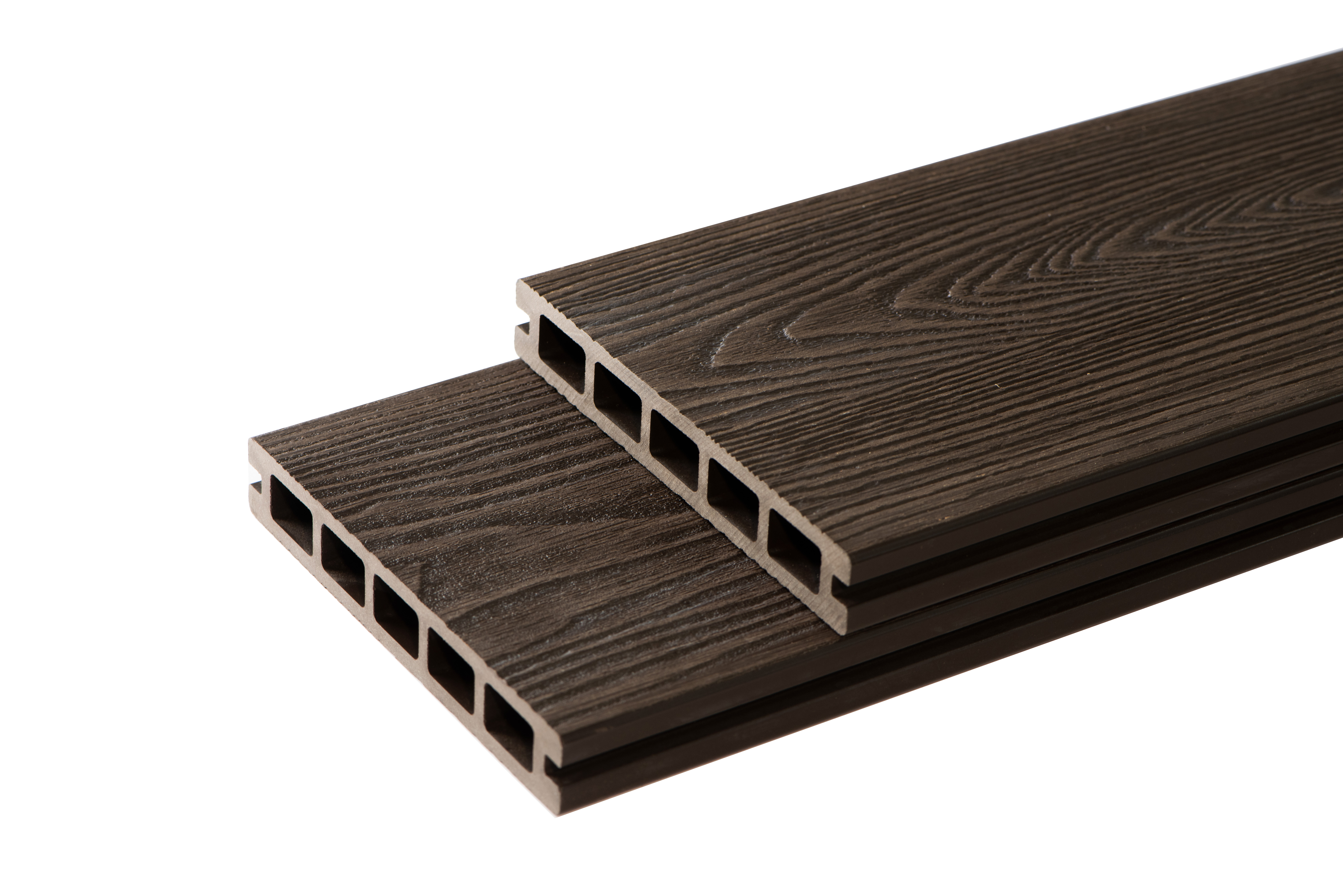
The recorded surface is grooved or textured to provide slip resistance, and standard colours include walnut, teak and coffee. Terratsa positions the board for cost-sensitive, large-area work such as public parks, scenic areas, plazas, boardwalks and community pathways, where a consistent surface at scale matters more than a decorative cap layer.
Hollow construction carries practical consequences at installation. Because the profile is not filled, fixing and edge treatment follow the board section: clips locate in the side groove, cut ends are normally closed with an end cap, and the deck is detailed so water does not collect in open ends or between board and joist. Those are installation rules rather than product claims, and they should be taken from the supplier's installation guide for the specific profile.
GH001 — Co-Extruded Outdoor WPC Decking
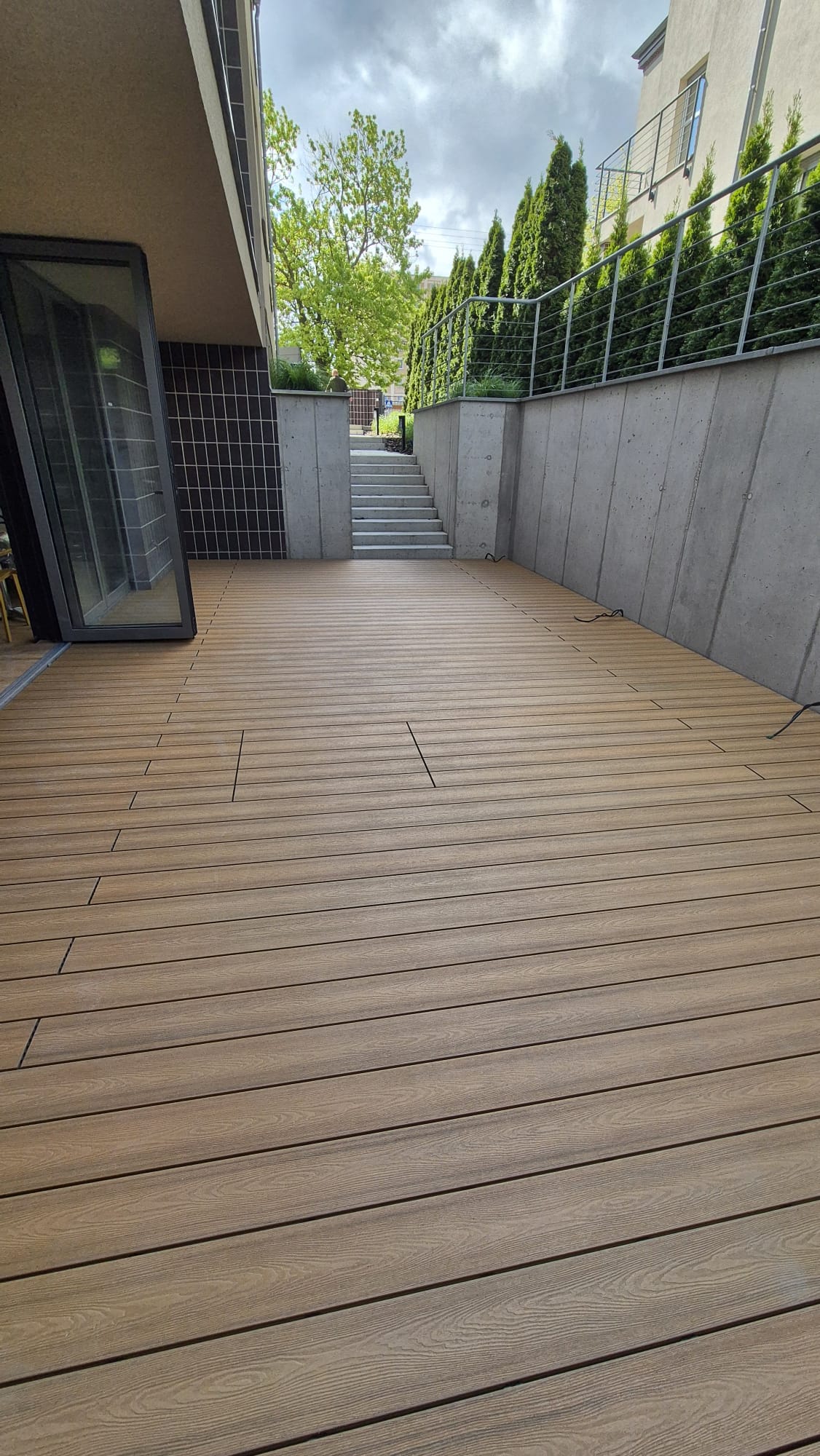
GH001 is a co-extruded outdoor WPC decking profile made of wood powder and plastic. Co-extrusion means the core is formed and then encapsulated: Terratsa describes a second-generation co-extruded polymer cap layer that fully encapsulates the core, so the surface facing sun, rain and foot traffic is the cap rather than the wood-plastic core.
The published values read differently from a hollow board: flexural properties of ≥3,300 N, a mean of ≤10% moisture resistance under cyclic test conditions, and ≤7% water absorption in a boiling test. Terratsa describes GH001 as engineered to withstand temperatures from -40°C to 75°C, with UV-resistant components in the outer shell, a textured slip-resistant surface and deep embossed 3D wood grain patterns. Boards are available in a range of standard colours and custom finishes, and the material is stated to be free from formaldehyde, benzene and toxic chemicals and to be 100% recyclable.
Two cautions apply when comparing figures across the range. First, the absorption values for D053 (≤2%, five-hour boil) and GH001 (≤7%, boiling test with the duration not stated in the supplied data) are not a like-for-like pair, because the stated test descriptions differ; treating the lower number as the better board is a conclusion the data does not support. Second, the useful question for a capped board is not only whether a cap exists but how it is specified for the exposure — pool splash zones, salt air and high UV load the surface layer differently, and the technical data sheet, not a marketing summary, is where suitability is confirmed.
GH024 — Outdoor WPC Cladding
GH024 is outdoor WPC cladding made of wood powder and plastic. It is a wall profile rather than a deck board, and its published values describe that different duty: flexural properties ≤0.9 mm, moisture resistance under cyclic test conditions ≤0.9 mm, swelling and water absorption after 28-day immersion ≤4%, boiling test ≤3%, and a linear thermal expansion coefficient of ≤37 × 10⁻⁶ K⁻¹.
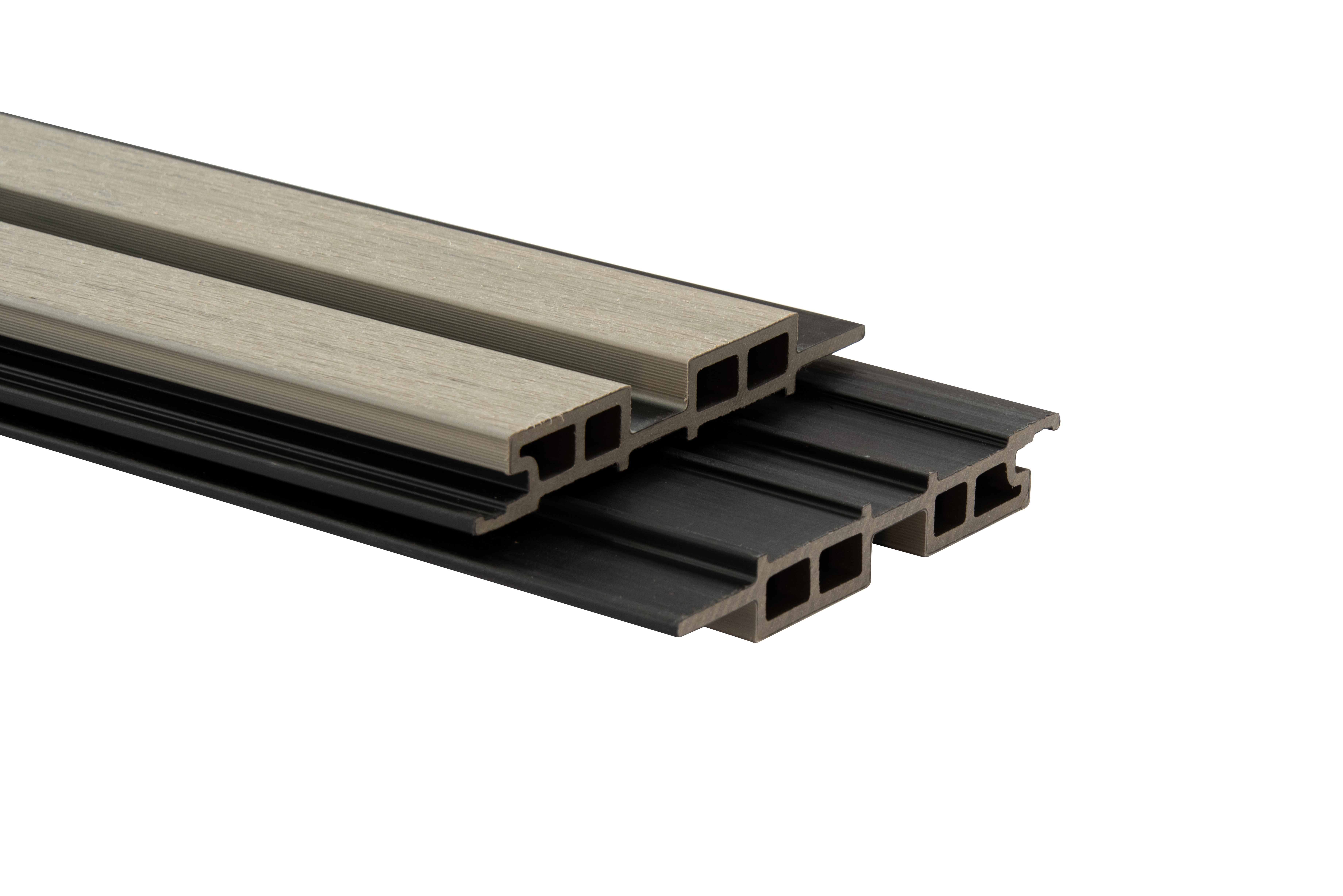
The design point is the fluted, 3D-textured face, which gives a wall depth instead of a flat panel, combined with an interlocking joint that Terratsa describes as quick to install over an existing wall. The company also states that the profile is waterproof and anti-mould, free from formaldehyde, resistant to termites and fading, and cleanable with soap and water. GH024 is listed for exterior facades, garden feature walls, balcony privacy screens, fence cladding and outdoor kitchen surrounds — situations where a decorative vertical skin is wanted and the wall behind it can be detailed correctly.
GH010 — Exterior Wall Cladding
GH010 is exterior wall cladding measuring 22 mm thick, 136 mm wide and 2,900 mm long, with a 28-day immersion swelling and water absorption value of ≤2%, flexural properties of ≤0.79 mm and a linear thermal expansion coefficient of ≤37 × 10⁻⁶ K⁻¹.
Visually it is the board-cladding option of the pair. Terratsa describes realistic 3D wood grain embossing, matching trims, corners and hidden fasteners for a continuous facade, UV inhibitors intended to limit fading and chalking, and installation either horizontally or vertically on compatible sub-frame systems. It is listed for residential homes, commercial buildings, hotels and villas, and for garden walls, balcony screens, fence cladding and outdoor kitchen surrounds.
The difference between GH024 and GH010 is therefore largely a design and detailing decision — fluted profile against board profile, and the trim set that goes with each — rather than a claim that one outperforms the other. Both are wall products, and neither substitutes for a deck board.
Decking or Cladding: A Four-Question Decision Rule
Four questions sort the range before any paperwork is compared.
- Is the surface horizontal or vertical? Horizontal, load-bearing and walked on points to D053 or GH001. Vertical, decorative and weather-facing points to GH024 or GH010.
- What does the surface have to survive? A pool surround or waterfront boardwalk puts splash, chlorine or salt and strong UV on the surface layer, which favours a capped board. A plaza or park path where area and budget dominate favours the hollow profile.
- Which look is being specified? A grooved or brushed deck surface in standard colours, a fluted 3D cladding, or a board cladding with a trim set.
- Which document has to be filed? If the project requires an EPD, the declared product group should be checked first, because that check can decide the profile before aesthetics do.
How Decking and Cladding Fit Under Recognized Standards
Certification problems in WPC procurement are usually scope problems rather than forgery: a valid certificate is attached to a product it does not cover, or a management system certificate is read as a product performance rating. The four documents below need to be read differently.
Environmental Product Declaration
Terratsa holds an Environmental Product Declaration registered as EPD-IES-0012197:001, also shown as S-P-12197, conforming to EN 15804+A2. It is listed as valid, with a version date of 2024-03-15 and validity to 2029-03-15, and it covers the company's co-extrusion WPC products. Among the four profiles in this article, GH001 is the co-extruded decking product; D053 is a hollow first-generation board, and GH024 and GH010 are cladding profiles.
Before the EPD is filed for those profiles, the declared product group should be checked against the profile actually being supplied. An EPD declares environmental information under a defined set of rules; it is not a fitness-for-use, span or slip certificate, and a valid registration date does not extend its scope to other products.
ISO 9001, ISO 14001 and ISO 45001
Terratsa's management system certifications are listed with their Chinese standard equivalents: ISO 9001 for quality, GB/T 24001-2016 / ISO 14001:2015 for environmental management, GB/T 45001-2020 / ISO 45001:2018 for occupational health and safety, and GB/T 23331-2020 / ISO 50001:2018 with RB/T 114-2023 for energy management. These certificates describe how the organisation is run — process control, environmental management, workplace safety and energy performance. They are relevant when a buyer audits a supplier, and they are not evidence that a given board meets a given load, slip or fire requirement.
FSC certification and chain of custody
Terratsa lists FSC among its product certifications, alongside CE, ASTM, SGS and EPD. FSC chain of custody is the traceability mechanism that links certified or recycled input material to the finished product, and it is what allows an FSC claim to appear on an invoice. For a specific order, the claim type — FSC 100%, FSC Mix or FSC Recycled — and the certificate or licence code should be confirmed on the transaction documents, because the claim type is what a green-building submission can actually use.
CE, ASTM and test reports
CE marking is listed for the products, and the declaration and standard cited for the specific profile should be confirmed. ASTM D7032 is the standard specification used to establish performance ratings for wood-plastic composite deck boards, stair treads, guards and handrails, and Terratsa lists ASTM among its certifications. Because D7032 establishes ratings rather than a single pass mark, the question to ask is which ratings have been determined for the profile offered. SGS is a testing and inspection organisation; where SGS appears in a certificate list, the report number and the test scope it covers should be requested.
| Document | What it addresses | What to verify before use |
|---|---|---|
| EPD-IES-0012197:001 (S-P-12197) | Declared environmental information to EN 15804+A2 | Declared product group, validity dates, match to the offered profile |
| ISO 9001 | Quality management system | Scope, site and certification body named on the certificate |
| ISO 14001 / ISO 45001 | Environmental and occupational health and safety management | Scope and manufacturing site covered |
| FSC certification | Chain of custody for wood fibre | Claim type and certificate or licence code on the order documents |
| ASTM D7032 | Deck board performance ratings | Which ratings apply to the specific profile |
| CE marking | Market access declaration | Declaration and standard cited for the profile |
From Surface to Specification: A Six-Step Check
- Fix the surface and the exposure. Decide whether the project needs a horizontal walking surface or a vertical wall skin, then describe the exposure: pool splash, coastal salt, frost, high UV or heavy public footfall.
- Match the profile family. D053 or GH001 for decking, GH024 or GH010 for cladding. Construction and face design follow from that choice.
- Read the published values against the duty. Bending failure and flexural values describe behaviour under load; absorption and swelling values describe water uptake; thermal expansion sets the movement allowance. Numbers recorded under different test descriptions should not be ranked against each other.
- Check the scope of each document. Confirm the EPD product group, the FSC claim type, the ASTM ratings and the site named on the management system certificates.
- Detail the substructure and movement. Joist spacing, ventilation, drainage falls, expansion gaps and fastener type are set per profile and per site, and come from the installation guide rather than the data sheet.
- Confirm order terms in writing. Colour, finish, packing, sample arrangements and delivery terms are commercial items agreed per order, and the certificate set should be attached to the same order.
Where These Profiles Are Used
Terratsa's application data records two outdoor decking scenarios that show how exposure drives selection. In Poland, a decking application is described with low winter temperatures and high humidity, matched to GH001, with requirements covering weather resistance, UV resistance, no maintenance, low water absorption, anti-scratching and anti-slip. In China, a park decking scenario is described with high humidity, matched to D053 and GH001, with requirements covering weather resistance, anti-slip, UV resistance and scratch resistance.
Those entries describe application conditions and matched products rather than completed project results. For cladding, the listed applications are exterior facades of residential homes, commercial buildings, hotels and villas, together with garden feature walls, balcony privacy screens, fence cladding and outdoor kitchen surrounds. In practice the same building often uses both product families: decking for the terrace and pool edge, cladding for the facade and privacy screens, specified from the same material system.
FAQ
Does the EPD cover every WPC decking and cladding profile Terratsa makes?
No blanket answer applies. The EPD registered as EPD-IES-0012197:001, also shown as S-P-12197, covers Terratsa co-extrusion WPC products and conforms to EN 15804+A2, with a version date of 2024-03-15 and validity to 2029-03-15. GH001 is the co-extruded decking profile described in this article. For D053 hollow decking and the GH024 and GH010 cladding profiles, the declared product group should be checked against the profile being supplied before the EPD is used in a project file.
What is the difference between hollow and co-extruded WPC decking?
A hollow board such as D053 is a wood-powder-and-plastic profile with internal cavities; it measures 23 mm × 146 mm × 2,900 mm, with a density of 1.3 g/cm³, a bending failure of 3,900 N and water absorption of ≤2% after a five-hour boil. A co-extruded board such as GH001 adds a polymer cap layer that fully encapsulates the core; its published values are flexural properties ≥3,300 N, a cyclic moisture mean of ≤10% and boiling water absorption of ≤7%. The cap changes what the visible surface is made of; it does not make the two sets of test figures directly comparable.
What drives the price of WPC decking and cladding?
This article does not publish prices, and a per-square-metre figure quoted without a profile, finish and order size is not a useful comparison. The variables that move a WPC quotation are the profile and construction (hollow or capped), the colour and surface finish, the quantity and packing, the certification documents required with the order, the fixing and trim set, and the delivery terms to destination. A quotation that names the model, colour, quantity and included documents can be compared line by line.
How should I compare WPC decking manufacturers?
Compare on verifiable items rather than on claims. Check whether the manufacturer publishes the model, material and performance values for the profile you are buying; whether its certification list shows scope documents (EPD product group, FSC claim type, ASTM ratings) rather than certificate names alone; whether management system certificates name the manufacturing site; and whether the certificate set can be attached to your specific order. Terratsa, established in 2007, operates a 74,000 m² facility in the Yingkou Area of China (Liaoning) Pilot Free Trade Zone with more than 70 fully automatic production lines and a stated annual production capacity of 120,000 tons, holds more than 30 national independent intellectual property patents, has participated in drafting nearly 10 national and industrial standards, and exports about 85% of its products to more than 40 countries and regions. These are capability facts to verify against documents, not a ranking.
Can I check a sample before placing a full order?
Request a sample of the exact model and colour, then check it against the data sheet: profile dimensions, surface texture, colour, and whether the sample comes from the production type you intend to order. Sample quantities and terms are commercial items agreed per order, so they should be confirmed in writing. A sample confirms appearance and workability; it does not replace the profile's published test values or the certificate scope check.
What to Take Away
The useful definition of WPC decking is structural rather than promotional: a wood-powder-and-plastic board, built as a hollow or capped profile, installed over a substructure for a specific outdoor surface. Within the Terratsa range, D053 covers hollow decking, GH001 covers co-extruded decking, GH024 covers fluted outdoor cladding and GH010 covers exterior wall cladding.
The certification layer does not change that map; it adds a scope question. The EPD EPD-IES-0012197:001 declares co-extrusion WPC products to EN 15804+A2 and is valid to 2029-03-15; the ISO 9001, ISO 14001 and ISO 45001 certificates describe management systems; the FSC entry needs its claim type confirmed per order. Match the document to the profile, and the profile to the surface, before either goes into a specification.
Next step. The full product range, dimensions and finishes are collected in the Terratsa decking brochure (PDF). For profile data sheets, certificate copies or a quotation covering D053, GH001, GH024 or GH010, contact the company through terratsa.com or write to sales01@unvocwpc.com.
Have Questions or Need More Details?
Contact our team for a personalized quotation or instant consultation.
Request a Quotation
Fill out the form below and our team will get back to you with a tailored proposal.
WhatsApp Direct Chat
Prefer to chat in real-time? Message us on WhatsApp for instant assistance & quick answers.
- Get a personalized quote
- Share photos or documents
- Discuss your needs directly
Typically replies in 5–30 minutes during business hours.