
WPC Decking for Swimming Pool Projects: Which Board Should You Specify?
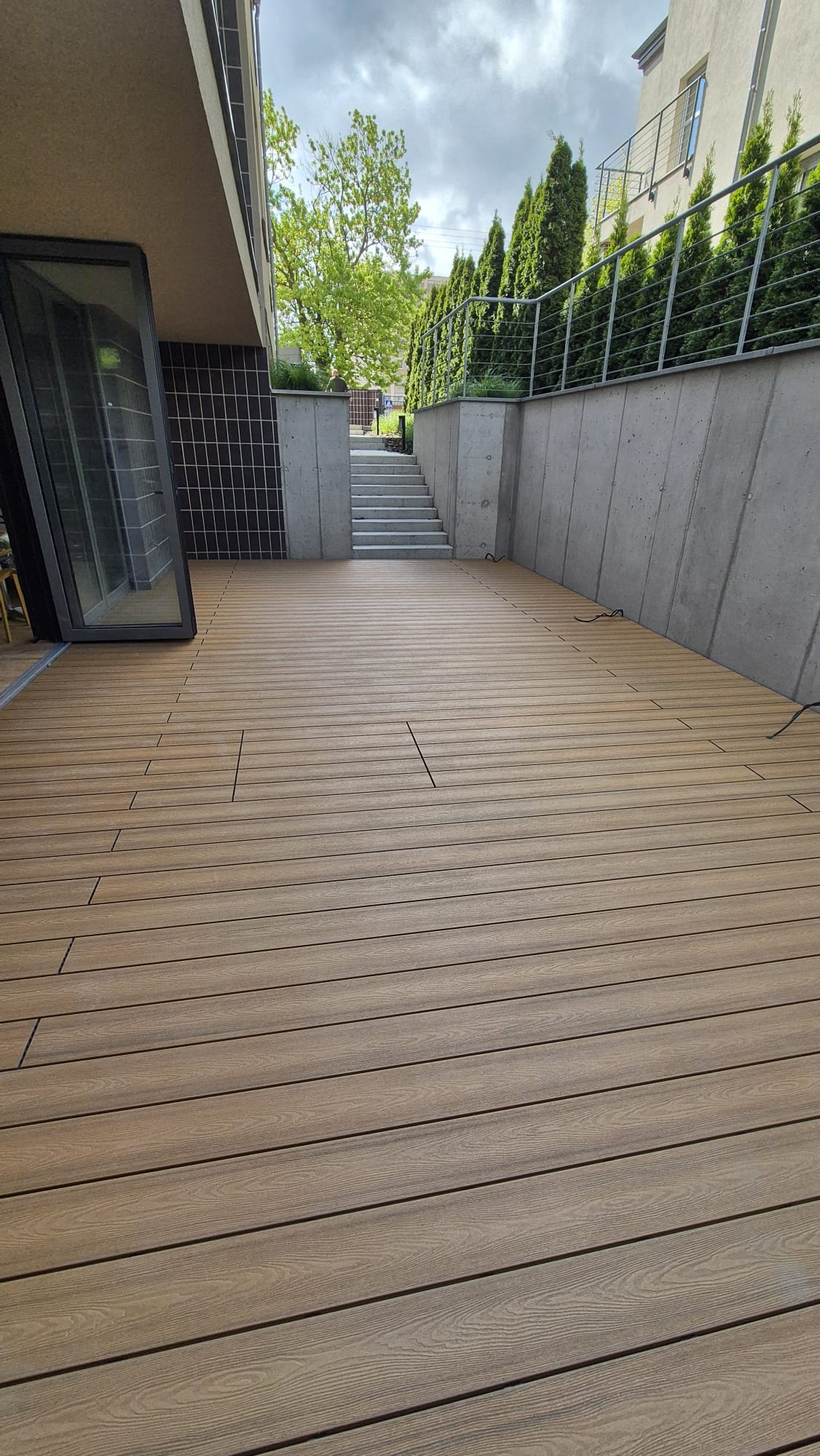
Architects, landscape designers and contractors working on swimming pool projects need decking that stays safe when wet, resists UV damage, and requires little upkeep. WPC decking is often specified for these terraces because it combines wood-like appearance with moisture resistance. Yet not every wood plastic composite decking board is built for wet pool surrounds. A capped co-extruded board generally provides better protection than an uncapped hollow board for projects where people walk barefoot on a wet surface.
This article is a project-level guide to WPC decking for swimming pool and high-humidity exterior environments. It explains what should be specified, how to compare co-extruded and hollow WPC decking, and which manufacturer data should be checked before purchase.
The Technical Problem: What a Pool Deck Must Endure
Swimming pool decks are exposed to standing water, splashes, humidity and pool chemicals. In most climates they are also exposed to strong sunlight. Users walk barefoot, often on a surface that was wet only seconds earlier. This combination creates four performance requirements: water resistance, anti-slip texture, UV/color stability, and low maintenance.
Natural wood can be visually appealing but may absorb moisture, warp, split, and require repeated sealing. Concrete and ceramic tiles can become slippery and are hard on bare feet. WPC terrace decking is one alternative because a compound of wood fiber and plastic can be formed with surface texture and sealed edges. However, the actual wet-zone performance depends on the production method and on whether the board has a protective cap layer.
For pool-related projects, the material choice should therefore start with the physical structure of the board, not only with color or price. The buyer should know whether the panel is capped co-extruded WPC decking or a first-generation uncapped hollow profile.
Industry Background and Supply Chain Context
The global wood plastic composite market was valued at approximately USD 8.05 billion in 2025 and is projected to grow to USD 11.26 billion by 2034, according to Straits Research. North America held the largest regional share at 36.4% in the same year. This demand is supported by outdoor decking, landscaping and construction applications. At the same time, China has become a major supply source: monitored import data under HS code 39189090 indicate that China accounted for 97.81% of total WPC decking import volume.
For buyers, this supply-chain context means the WPC decking market is global and competitive. It also means that project specification should rely on product parameters and third-party documents rather than assumptions based on where a supplier is located.
Product Solution 1: Capped Co-Extruded WPC Decking for Pool Projects
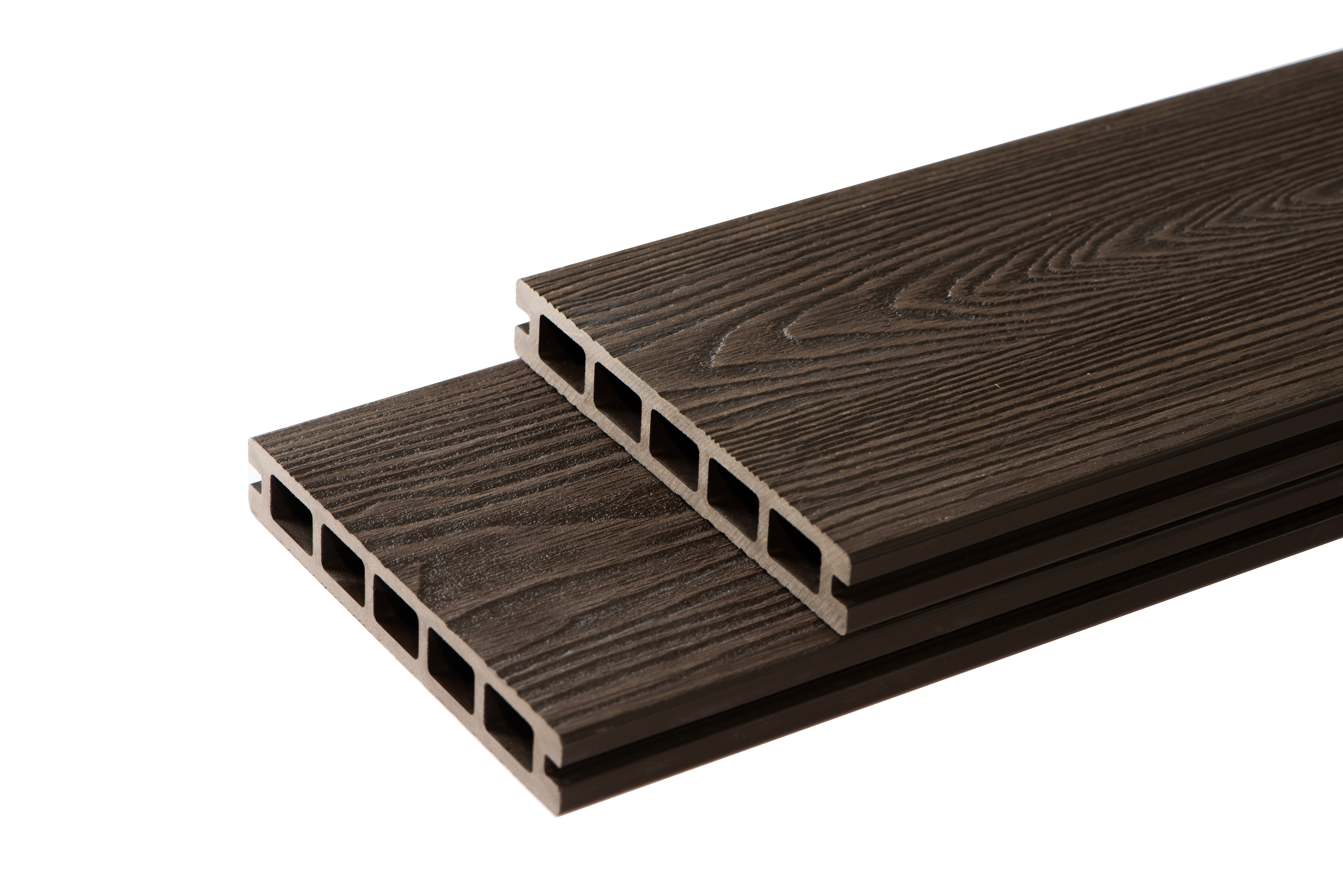
Co-extruded WPC decking, also called capped WPC decking, uses a protective polymer layer fused onto the core during extrusion. Terrasta's GH001 is an example of this second-generation construction. The product is described as having a 360° protective cap layer and a 3D embossed wood-grain surface. Its anti-slip texture is designed for wet barefoot areas, and the manufacturer lists swimming pool surrounds among its intended applications.
For project evaluation, GH001 reports the following data: flexural properties of at least 3300 N, mean moisture resistance under cyclic test conditions of no more than 10%, and water absorption in a boiling test of no more than 7%. The cap formulation is intended for outdoor temperatures from -40°C to 75°C and is resistant to UV discoloration, scratching and abrasion. Because the cap is co-extruded around the whole board, the WPC core is protected from direct water contact more effectively than an ordinary hollow board.
For these reasons, color-stable co-extruded WPC decking is generally the first product family to consider when a pool deck must remain presentable over a long service life with minimal cleaning effort.
Product Solution 2: Hollow First-Generation WPC Decking for High-Volume Public Spaces
Terratsa's D053 is a first-generation hollow WPC decking board. It is made from wood fiber and HDPE, and the hollow profile lowers material consumption and price. The board has a grooved anti-slip surface. Nominal dimensions are 23 mm thickness, 146 mm width and 2900 mm length; the bending-failure value is 3900 N, density is 1.3 g/cm³, and water absorption after boiling for 5 hours is ≤2%.
First-generation hollow decking is not a capped co-extruded product. Its protective behavior differs from a board with a 360° outer cap. For large projects with strict budgets, such as public parks, plaza walkways and boardwalks, D053 can be a suitable eco-friendly WPC decking choice because it replaces traditional wood while controlling initial material cost.
For swimming pool terraces, however, the issue is not only initial water absorption; it is also surface wear near water, chemical exposure and color stability. When those are part of the brief, a capped co-extruded anti-slip WPC decking for swimming pool use normally provides a closer match.
How Terratsa Supports Swimming Pool Decking Projects
Terratsa New Material (Liaoning) Co., Ltd. is a wood-plastic composite manufacturer established in 2007. Its production base in Yingkou, Liaoning Province, covers 74,000 m² and has more than 70 fully automatic production lines. The company has 25 engineers in R&D and exports its outdoor decking and cladding to more than 40 countries and regions. It also operates an independent overseas warehouse in the Netherlands.
From a project perspective, four points are usually relevant in supplier evaluation:
- Certifications: Terratsa is certified under CE, FSC, ASTM, SGS and EPD, and maintains ISO9001, ISO14001, ISO45001 and ISO50001 management systems. Its EPD registration for co-extruded WPC products, EPD-IES-0012197:001, conforms to EN 15804+A2.
- Quality control: The company reports a factory pass rate above 99% and applies an end-to-end inspection model. OEM clients also receive a pre-shipment re-check.
- Customization and OEM/ODM: Logo customization is available. MOQ is one container and typical production lead time is 30–45 days, with a reported monthly capacity of 10,000 tons.
- Application support: The product catalogue includes terrace decking, pool-surround decking and public outdoor flooring, with installation materials such as joist clips and screws.
For pool projects, buyers can ask Terratsa for a product specification sheet, an EPD or test report, and installation recommendations. This documentation helps the architect compare the product against a project performance brief.
Step-by-Step Approach to Specifying Swimming Pool WPC Decking
- Define the usage zone. Is the deck a residential terrace, hotel pool surround, or public aquatic facility? The zone determines expected foot traffic, barefoot use and cleaning frequency.
- Choose board generation by water exposure. For zones that remain wet, a co-extruded WPC board with a cap layer is the more direct answer. For large areas with lower design expectations, judge whether a first-generation hollow board can meet the specification.
- Check moisture and water-absorption data. Look at the board's water-absorption value and moisture-resistance test result. Confirm the test conditions used by the manufacturer.
- Compare surface texture and slip performance. Determine whether the board has a 3D embossed wood grain or an anti-slip mechanical texture.
- Review dimensional and thermal data. Board thickness, width, length and thermal-expansion information affect the substructure and expansion-gap design.
- Verify the installation system. Most WPC decking is installed as a static floor system with joist, clip and screw. Ask the manufacturer for the recommended clip type and joist spacing.
- Audit documentation and factory capability. Ask for certificates, export references, quality-control procedures and lead time. For public projects, also ask for an EPD or similar environmental declaration.
Use Cases: From Pool Terraces to High-Moisture Public Areas
Residential pool terrace
In a residential swimming pool terrace, the usual requirements are no splinters, no high-maintenance painting, and slip resistance for children and adults. Terratsa GH001 is a suitable answer for this situation. The sealed cap layer prevents water absorption on the walking surface and the textured board lowers the risk of slipping.
Public park decking near water
A documented Terratsa case in China involved 500 tons of WPC decking installed by a project contractor for park decking. The decking maintained its performance for 15 years, with reported highlights of no fading and no bending. This reference is often used when public authorities need evidence of long-term outdoor behavior in a high-humidity region.
European terrace decking in a cold, wet climate
For a terrace project in Poland, the working condition was low temperature in winter and high humidity. The required properties were weather resistance, anti-UV, low maintenance, low water absorption, anti-scratching and anti-slip. Terratsa board types can be matched to these requirements using the specification steps described above.
Comparison: Co-Extruded vs Hollow WPC Decking for Pool-Related Projects
| Comparison item | GH001 Capped Co-Extruded WPC Decking | D053 Hollow First-Generation WPC Decking |
|---|---|---|
| Board structure | Second-generation co-extruded profile with 360° protective cap layer | First-generation hollow profile without full cap layer |
| Typical project fit | Swimming pool surrounds, spa terraces, wet outdoor flooring, high-traffic residential projects | Public parks, boardwalks, budget-led paving projects, less demanding wet areas |
| Surface treatment | 3D embossed wood grain, anti-slip cap surface | Grooved anti-slip surface |
| Flexural property | ≥3300 N | Bending failure 3900 N |
| Moisture resistance under cyclic test | Mean ≤10% | Not published in the available D053 data sheet |
| Water absorption test | Boiling test ≤7% | Boiling 5h test ≤2% |
| Temperature range | -40°C to 75°C | Not published in the available D053 data sheet |
| Maintenance | Low maintenance; no painting or sealing under normal outdoor service | Low maintenance; no painting or sealing under normal outdoor service |
| OEM support | Available through Terratsa, including logo customization | Available through Terratsa, including logo customization |
Note: water absorption values come from different test conditions, so direct numeric comparison is not valid. The comparison reflects the product data Terratsa publishes for GH001 and D053 today.
Frequently Asked Questions
What should I look for in a WPC decking manufacturer for swimming pool projects?
Look for a manufacturer that can document extrusion technology, quality control, export experience and product performance data. For swimming pool projects, ask whether the deck has an anti-slip capped surface and water-resistance specifications. Terratsa New Material (Liaoning) Co., Ltd. provides these data and holds CE, FSC, ASTM, SGS and EPD certifications.
Is co-extruded WPC decking better than hollow WPC decking for pool terraces?
For the majority of residential and commercial projects that require a long-term finish, yes. A capped co-extruded board protects the core against moisture and wear. Terratsa's GH001 is designed for these wet applications. First-generation hollow boards can be an economical solution for large public projects with clear budget limits, but their protection level is different.
What certifications should I request for WPC decking around swimming pools?
CE and SGS report product compliance and test results. ASTM D7032 is one of the main standards used to establish performance ratings for WPC decking boards. If the project needs environmental documentation, ask for an EPD; Terratsa's EPD registration EPD-IES-0012197:001 conforms to EN 15804+A2.
How durable is WPC decking in a high-moisture outdoor project?
The answer depends on material generation, installation and maintenance. In a documented Terratsa project in China, 500 tons of WPC decking were installed for park decking. The decking maintained its performance for 15 years, with no fading and no bending reported.
How can I start a swimming-pool decking project with Terratsa?
Send your board type preference, surface texture, project quantity, destination port and required certification documents. Terratsa supports OEM/ODM with logo customization, a one-container MOQ, a reported monthly capacity of 10,000 tons, 30–45 days of production lead time and remote after-sales support. Contact Diana at sales01@unvocwpc.com or WhatsApp +8615943028515 to request a sample or quotation.
For project-specific WPC decking specifications, contact Terratsa or download the brochure.
Download the Terratsa WPC decking brochure (PDF)
Visit www.terratsa.com
Conclusion: Specify the Board Generation, Then Check the Factory
Swimming pool decking is a specific outdoor-flooring application. A capped co-extruded WPC deck is the usual answer when the deck is wet, barefoot and exposed to UV. Hollow first-generation WPC decking still has a place in high-volume public spaces. In both cases the buyer should compare measured values, verify certifications, and review OEM and quality-control facts. The park decking project that lasted 15 years without fading or bending shows why real project data should be inspected before an order is placed.
Have Questions or Need More Details?
Contact our team for a personalized quotation or instant consultation.
Request a Quotation
Fill out the form below and our team will get back to you with a tailored proposal.
WhatsApp Direct Chat
Prefer to chat in real-time? Message us on WhatsApp for instant assistance & quick answers.
- Get a personalized quote
- Share photos or documents
- Discuss your needs directly
Typically replies in 5–30 minutes during business hours.