
WPC Cladding vs WPC Decking: A Technical Selection Guide for GH024, GH010, D053 and GH001
A terrace package contains two structurally different jobs that happen to use the same material family. One job is vertical and non-traffic: a board fixed to a wall, where wind load, wall build-up and fixing method decide the outcome. The other job is horizontal and load-bearing: a board spanning joists that must carry people, drain water and absorb thermal movement. Wood-plastic composite can do both — but not with the same board, the same fixing detail, or the same acceptance test.
This guide sets out a selection method for four Terratsa models — GH024 (outdoor WPC cladding), GH010 (exterior wall cladding), D053 (outdoor hollow WPC decking, first generation) and GH001 (co-extruded outdoor decking) — and then covers the documentation layer that decides whether the selection survives procurement: the EPD registered as S-P-12197 (registration number EPD-IES-0012197:001), the ISO 9001 / ISO 14001 / ISO 45001 management systems, FSC scope, purchasing terms, acceptance criteria and the factory questions worth asking before sourcing.
Short answer: WPC cladding and WPC decking are specified by duty, not by material. Cladding (GH024, GH010) is fixed vertically to a wall and carries no foot traffic, so wind load, wall build-up and fixing method drive the choice. Decking (D053, GH001) spans joists and carries people, so section geometry, stiffness and water absorption drive the choice. GH001 is the co-extruded option; D053 is the hollow first-generation option. Certification scope — including EPD S-P-12197, valid 2024-03-15 to 2029-03-15, conforming to EN 15804+A2 — should be verified before the order, not after delivery.
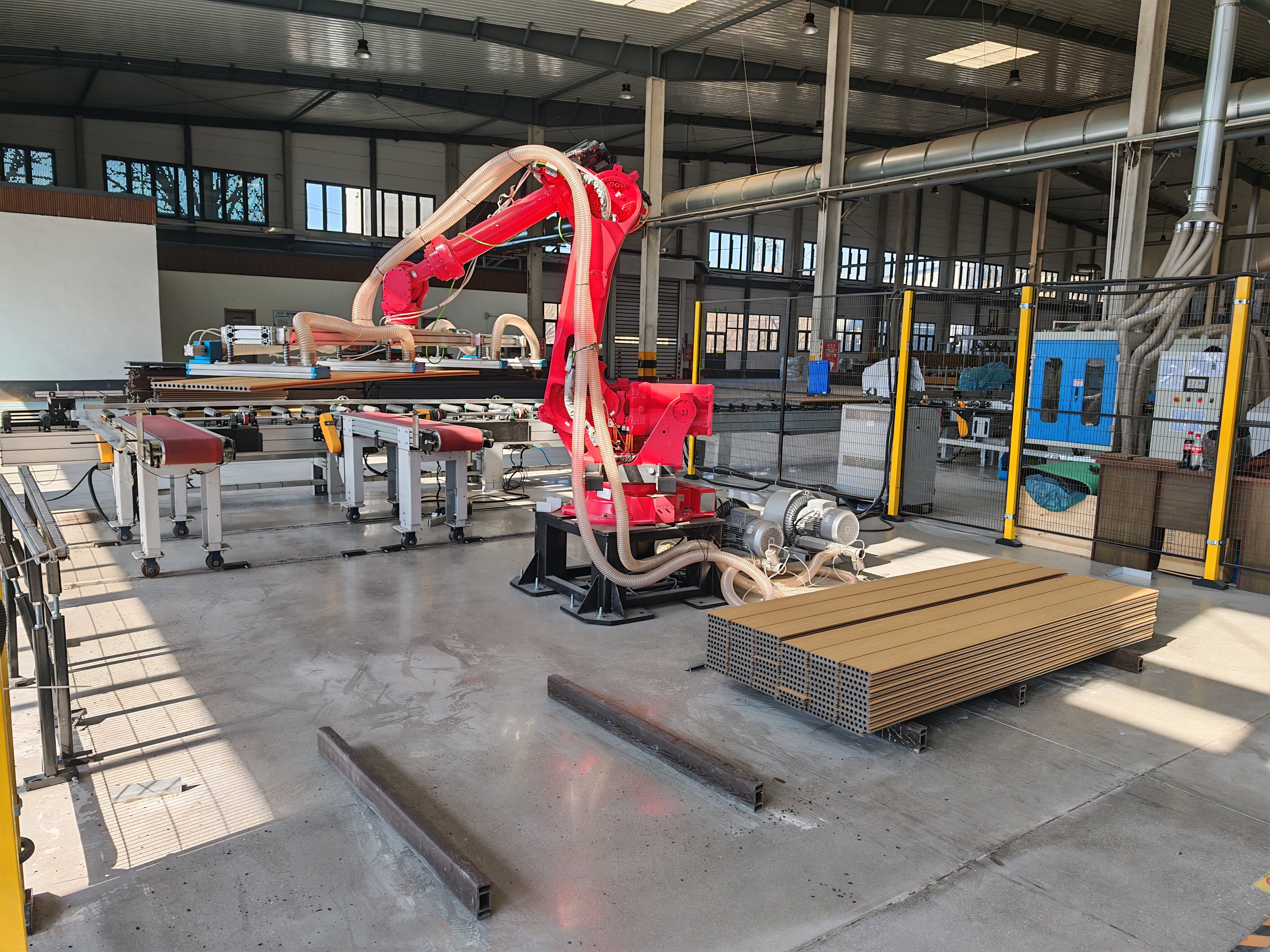
Surface texturing line: wood-grain finishing applied to WPC boards before packing. Surface direction and texture consistency are specification items for both cladding and decking.
Problem Definition: Where Cladding and Decking Decisions Actually Fail
The cladding-versus-decking decision is usually treated as a colour and price exercise. In real terrace and facade packages, five failure patterns repeat often enough to be predictable.
- Vertical and horizontal duties get mixed. A board chosen for foot traffic is then fixed to a facade. Wind uplift, fixing spacing and the absence of a joist span table change the engineering basis completely, even though the board looks identical on the sample stand.
- Product generations get mixed. Hollow first-generation boards and co-extruded boards are quoted interchangeably as “WPC decking”. They are not the same product: they differ in section design, surface layer and the data a buyer can rely on.
- Certification is assumed to cover everything. An Environmental Product Declaration is registered for a declared product scope, a validity window and stated markets. It is not a blanket statement covering every model in a catalogue.
- Commercial terms are agreed after technical approval. Minimum order quantity, delivery terms, payment split and the acceptance test determine whether the approved specification is actually the specification that arrives.
- Long-term supply is treated as an afterthought. A terrace is extended or repaired board by board over years. Profile and colour continuity in year five matters more to the client than the price difference in year one.
Each of these is a decision that can be closed with a datasheet line, a certificate scope statement or a test. None of them requires changing the material.
Industry Background: What Is Changing in the WPC Decking Market
Wood-plastic composite is now a mainstream exterior material category rather than a niche substitute for tropical hardwood. Straits Research values the global wood plastic composite market at USD 8.05 billion in 2025 and projects it to reach USD 11.26 billion by 2034. Within that total, North America held the largest regional share at 36.4% in 2025.
Definition matters when reading such figures. An alternative commonly cited estimate places the 2025 market at USD 9.76 billion. The variance between the two figures reflects how broadly each research house defines WPC — specifically whether automotive and interior applications are counted alongside exterior decking. For a buyer, the practical conclusion is that market-size figures are useful for context, not for building a project budget.
Two documentation trends affect specification more directly. In North America, ASTM D7032 is the standard specification used to establish performance ratings for wood-plastic composite deck boards, stair treads, guards and handrails; it defines what a deck board must demonstrate rather than what it looks like. In Europe, environmental product declarations built on EN 15804+A2 have become a routine part of construction product documentation, particularly where a project must report embodied impact. Together, these two trends shift the sourcing conversation from appearance samples towards declared, verifiable data.
Terratsa New Material (Liaoning) Co., Ltd. is a wood-plastic composite manufacturer founded in 2007, with its production base in the Yingkou Area of China (Liaoning) Pilot Free Trade Zone since 2024. It produces outdoor WPC decking, outdoor WPC fencing and outdoor WPC cladding, and it is one of the reference suppliers against which the selection logic in this guide can be tested.
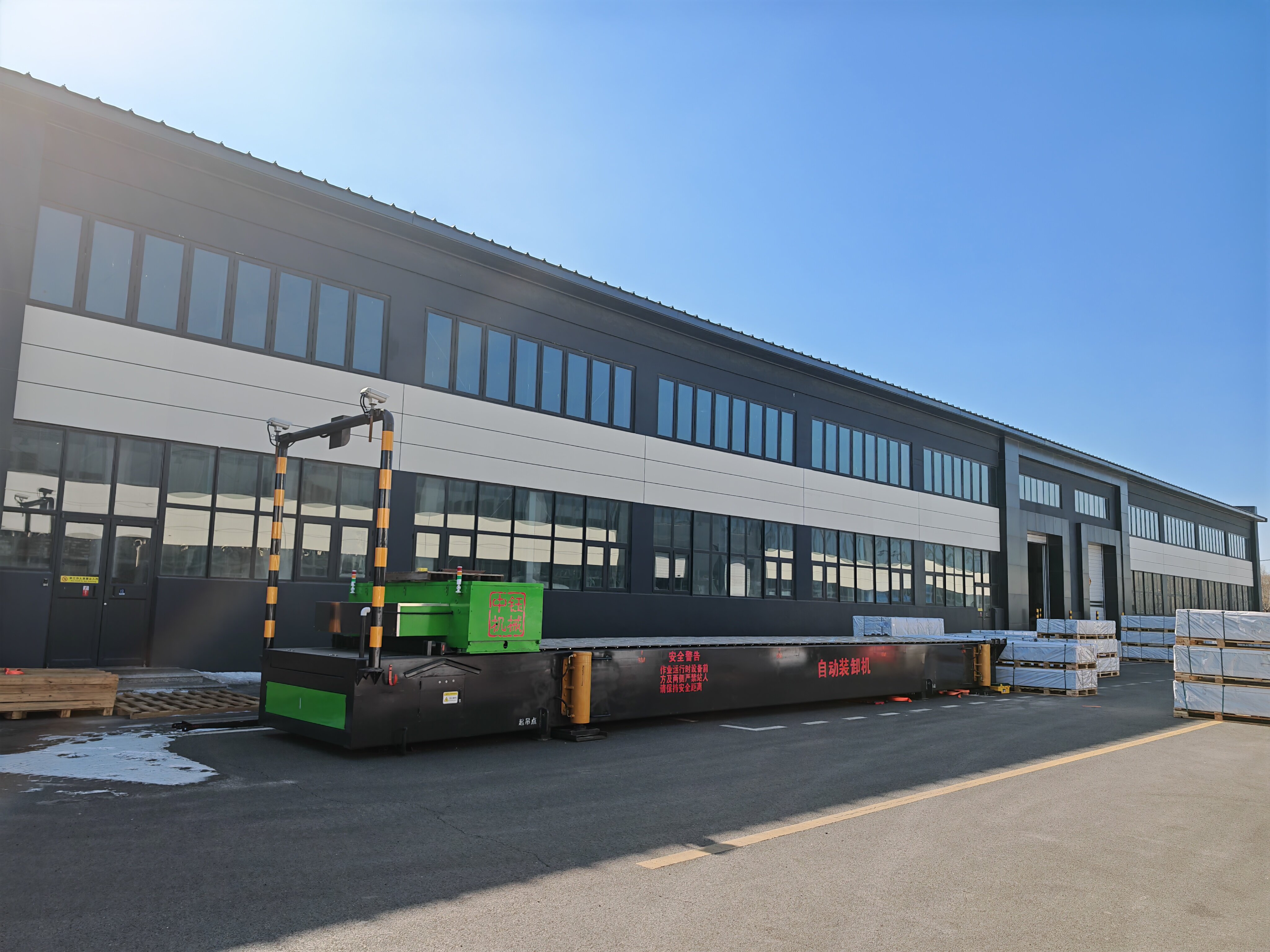
Production workshop at the Yingkou base. Cladding and decking for the same project can be scheduled from one manufacturing site, which simplifies colour matching and document control.
Detailed Solution: A Five-Layer Selection Method
Layer 1 — Fix the mounting duty before comparing any board
Start with orientation, not with finish. A vertical cladding board carries wind load and its own weight. A horizontal decking board carries foot traffic, furniture, snow and repeated thermal movement. Two practical consequences follow. First, the two product families need separate line items in the bill of quantities, each with its own fixing detail and acceptance check. Second, datasheet values are not transferable between them: a flexural figure measured for a decking section tells you nothing useful about a cladding profile fixed to a masonry wall.
Layer 2 — Choose the decking model: GH001 co-extruded vs D053 hollow first generation
GH001 is a co-extruded outdoor decking board made from wood powder and plastic. Its declared parameters are flexural properties of ≥ 3300 N, moisture resistance under cyclic test conditions with a mean of ≤ 10%, and water absorption under boiling test of ≤ 7%.
D053 is a first-generation outdoor hollow WPC decking board with a declared profile of 23 mm thickness, 146 mm width and 2900 mm length. Its declared values are bending failure of 3900 N, density of 1.3 g/cm³, water absorption of ≤ 2% after a 5-hour boil, and a linear thermal expansion coefficient of ≤ 37 × 10⁻⁶ K⁻¹.
These figures should not be read as a simple ranking. The GH001 flexural value and the D053 bending failure value come from different sections and different product generations, measured under the test conditions stated for each model. They are comparable only after the test method and section geometry behind each number are confirmed with the factory. A buyer who compares 3300 N and 3900 N as if they were the same measurement is comparing two different questions.
Where the decision is commercial rather than numerical, the guidance is straightforward: for residential terraces and commercial projects that require premium performance, co-extruded second-generation boards are the appropriate default, because they address both board performance and the maintenance burden over the following decade. First-generation hollow WPC remains suitable for large-scale projects with strict budget constraints and a clear short-term usage plan. That is a statement about programme fit, not a claim that one product fails.
Layer 3 — Choose the cladding model: GH024 vs GH010
GH024 is an outdoor WPC cladding profile and GH010 is an exterior wall cladding profile. Both are vertical-application products, and both are specified on criteria that decking does not share: wall build-up and ventilation cavity, fixing substrate and pull-out capacity, required cover width and board length, required surface direction, and any fire or wind requirement set by the local code.
Because the source set behind this guide does not contain declared technical parameters for GH024 or GH010, the correct procurement step is to request the current datasheet for the specific profile before fixing centres or quantities are finalised. Decking values must never be transferred to a wall application as a substitute. The one selection criterion that does cut across both families is colour and texture continuity: specifying facade cladding and terrace decking from a single manufacturing site removes the mismatch risk that appears when two suppliers are combined.
Layer 4 — Verify the documentation that travels with the order
The Environmental Product Declaration for Terratsa co-extrusion WPC products is registered as S-P-12197, registration number EPD-IES-0012197:001, published through the International EPD System, with a version date of 2024-03-15 and a validity running to 2029-03-15. It conforms to EN 15804+A2 within the ISO 14025 / ISO 21930 framework, and its declared markets are China and the Netherlands.
One scope detail deserves attention. The declaration covers co-extrusion WPC products, which aligns most directly with co-extruded boards such as GH001. If a project requires an EPD for a first-generation hollow board such as D053, confirm separately whether that product group falls inside the declared scope before the document is included in a submittal.
At management-system level, the company holds ISO 9001, ISO 14000, GB/T 24001-2016 / ISO 14001:2015 and GB/T 45001-2020 / ISO 45001:2018 certifications, together with GB/T 23331-2020 / ISO 50001:2018 energy management and RB/T 114-2023. Product-level certification includes CE, FSC, ASTM, SGS and EPD. The verification action for a buyer is not to collect logos but to check three things on each certificate: that the scope covers the manufacturing site named in the quotation, that the FSC scope statement matches the product groups being ordered, and that all validity dates are live at the time of delivery — not only at the time of tender.
Layer 5 — Close the commercial and long-term supply layer
Technical approval means little if the commercial route is undefined. The stated purchasing terms for Terratsa WPC decking are a minimum order quantity of 1 container, delivery terms FOB, payment terms 30/70, and acceptance criteria based on a pre-shipment test. Those four items should be written into the order, not agreed verbally.
Long-term supply capability is what makes a repeat order predictable. Terratsa operates more than 70 fully automatic production lines with an annual production capacity of 120,000 tons, supported by end-to-end intelligent production that the company describes as delivering stable and controllable quality and lead times. Quality control runs as an end-to-end Dual-QC model: raw material screening, real-time monitoring during production, and a re-inspection before shipment, with a reported factory pass rate above 99%. A 25-engineer R&D team, more than 30 national independent intellectual property patents, participation in the drafting of nearly 10 national and industrial standards, and status as a national-level intelligent manufacturing demonstration enterprise in China describe the same capability from the development side. Bespoke textures and designs can be turned around in 3 days.
For European programmes, an independent overseas warehouse in the Netherlands supports EU distribution. Approximately 85% of production is exported, the company serves nearly 100 customers worldwide, and its markets cover the EU, Asia, the Middle East, South America and Australia, with products supplied to customers in more than 40 countries and regions.
Comparison Table: GH024, GH010, D053 and GH001
The table below separates what is verifiable in this guide from what must be confirmed against the current datasheet. That separation is itself a purchasing tool: it prevents a wall profile from being ordered on the strength of a decking specification.
| Model | Product type | Mounting duty | Declared technical data | Typical specification role |
|---|---|---|---|---|
| GH024 | Outdoor WPC cladding | Vertical, wall-fixed, no foot traffic | Not included in this guide's source set — request the current datasheet | Facade and wall cladding where wind load, cavity detailing and fixing substrate govern |
| GH010 | Exterior wall cladding | Vertical, exterior wall-fixed | Not included in this guide's source set — request the current datasheet | Exterior wall cladding, colour-matched with adjacent terrace decking |
| D053 | Outdoor hollow WPC decking, first generation | Horizontal, joist-supported, foot traffic | 23 mm × 146 mm × 2900 mm; bending failure 3900 N; density 1.3 g/cm³; water absorption (5-hour boil) ≤ 2%; linear thermal expansion ≤ 37 × 10⁻⁶ K⁻¹ | Large-scale and budget-constrained decking with a defined short-term usage plan |
| GH001 | Co-extruded outdoor decking | Horizontal, joist-supported, foot traffic | Flexural properties ≥ 3300 N; cyclic moisture resistance mean ≤ 10%; water absorption (boiling test) ≤ 7% | Terraces and commercial decking requiring premium, low-maintenance performance |
Documentation and commercial reference table
| Item | Declared detail | How to verify |
|---|---|---|
| Environmental Product Declaration | Registration S-P-12197, EPD-IES-0012197:001; version date 2024-03-15; valid to 2029-03-15; EN 15804+A2; declared markets China and the Netherlands; covers co-extrusion WPC products | Check registration number, version date, validity end, product scope and declared markets against the models being ordered |
| Management systems | ISO 9001; ISO 14000; GB/T 24001-2016 / ISO 14001:2015; GB/T 45001-2020 / ISO 45001:2018; GB/T 23331-2020 / ISO 50001:2018; RB/T 114-2023 | Confirm certificate scope names the manufacturing site quoted |
| Product certification | CE, FSC, ASTM, SGS, EPD | Match each certificate or report to the specific model; confirm FSC scope statement |
| Commercial terms | MOQ 1 container; delivery terms FOB; payment terms 30/70 | Written into the purchase order, not agreed verbally |
| Acceptance criteria | Pre-shipment test | Define the test against the datasheet values of the ordered model before shipment |
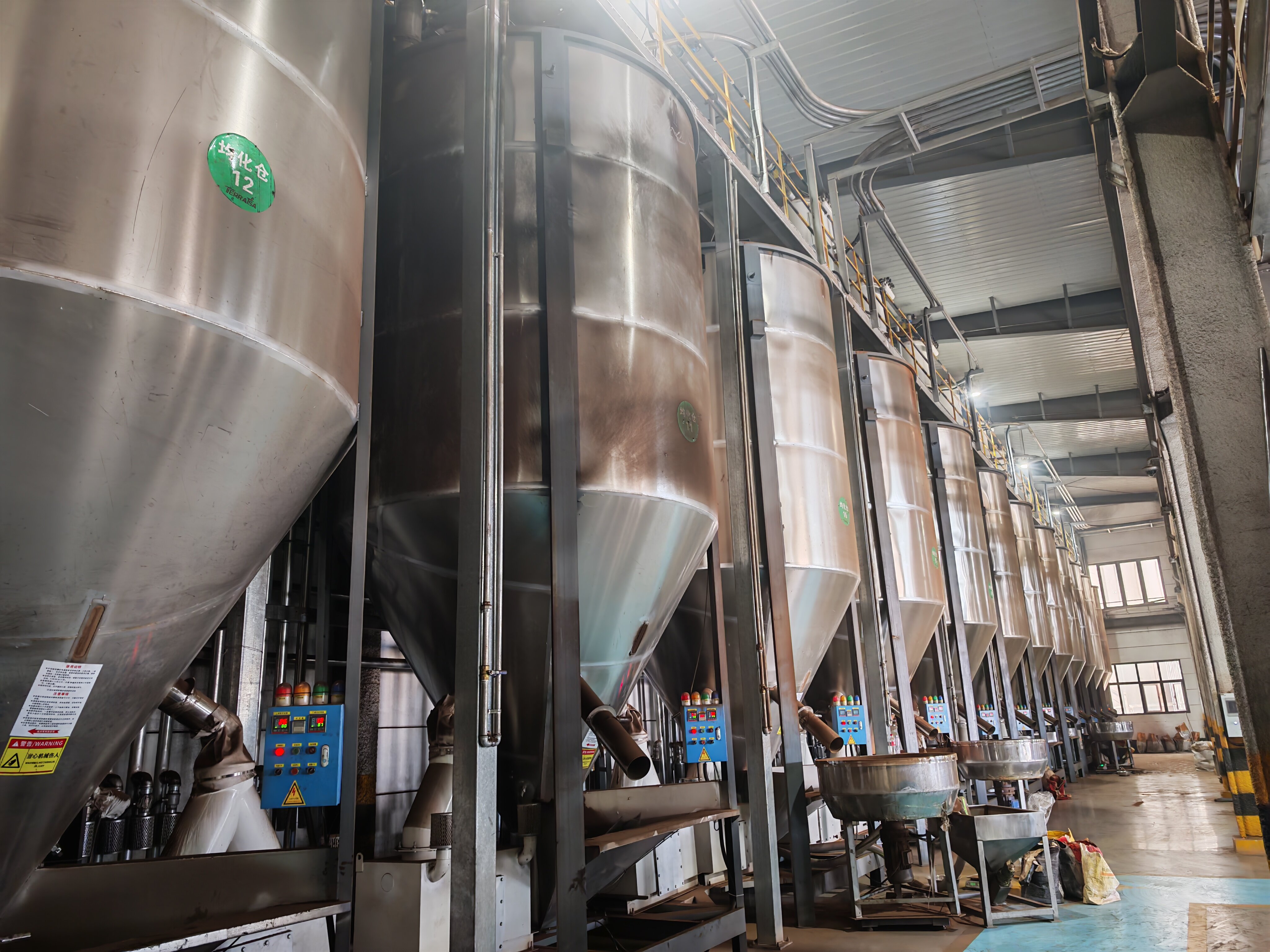
Extrusion and batch staging. Document control at this stage is what makes a pre-shipment acceptance test meaningful.
Step-by-Step Breakdown: From Inquiry to Repeat Order
- Split the bill of quantities by duty. List cladding and decking as separate items from the first drawing. A single “WPC boards” line is where specification errors start.
- Confirm spans and fixing details for decking. Joist spacing, fixing centres and gap design must follow the datasheet of the specific board. D053 and GH001 are different sections and must not share a generic span assumption.
- Confirm the wall build-up for cladding. Request the GH024 or GH010 datasheet, then fix profile spacing, ventilation cavity and substrate fixing against that document.
- Match the model to environment and programme. Co-extruded GH001 is the default for exposed terraces requiring premium performance and low maintenance; hollow first-generation D053 fits large-scale projects with strict budget limits and a defined short-term horizon.
- Verify certification scope and dates. Check EPD S-P-12197 (valid 2024-03-15 to 2029-03-15, EN 15804+A2, declared markets China and the Netherlands) against the ordered product group; check ISO 9001, ISO 14001 and ISO 45001 scopes; check FSC scope; match CE, ASTM and SGS documents to the model.
- Write the commercial terms into the order. MOQ 1 container, FOB delivery and 30/70 payment terms should be stated explicitly, together with the delivery schedule.
- Validate by sample and pre-shipment test. The stated acceptance criterion is a pre-shipment test, supported by the Dual-QC model of raw material screening, in-process monitoring and pre-shipment re-inspection.
- Plan the repeat order before the first delivery. Confirm how colour and texture continuity is maintained, how bespoke textures are handled, and how EU stock is served from the Netherlands warehouse.
Use Cases: Matching the Model to the Site
High-humidity public decking
Recorded application conditions for WPC decking include park decking in high-humidity environments, where the specification priority is water absorption and resistance to repeated wetting and drying. For that profile, the relevant declared values are the D053 water absorption of ≤ 2% after a 5-hour boil and the GH001 cyclic moisture resistance mean of ≤ 10% with boiling water absorption ≤ 7%. Boards with a co-extruded surface are normally preferred where appearance retention under sustained moisture matters over a long service horizon.
Terrace decking in low-temperature, high-humidity winters
Terrace decking in locations characterised by low winter temperatures and high humidity places the emphasis on thermal movement and drainage. The declared linear thermal expansion coefficient of D053 — ≤ 37 × 10⁻⁶ K⁻¹ — is the figure that drives end-gap and board-gap design for that model. Gap design is a specification item, not an installation preference: it is the mechanism that keeps a deck flat across a wide temperature range.
Facade and terrace packages in the Netherlands
Where a project combines exterior wall cladding with an adjacent terrace deck, sourcing GH024 or GH010 cladding together with D053 or GH001 decking from one manufacturing site simplifies both colour matching and document control. The EPD declared markets include the Netherlands, and an independent overseas warehouse in the Netherlands supports EU distribution — a practical advantage when a project needs partial deliveries or later extension of the same deck.
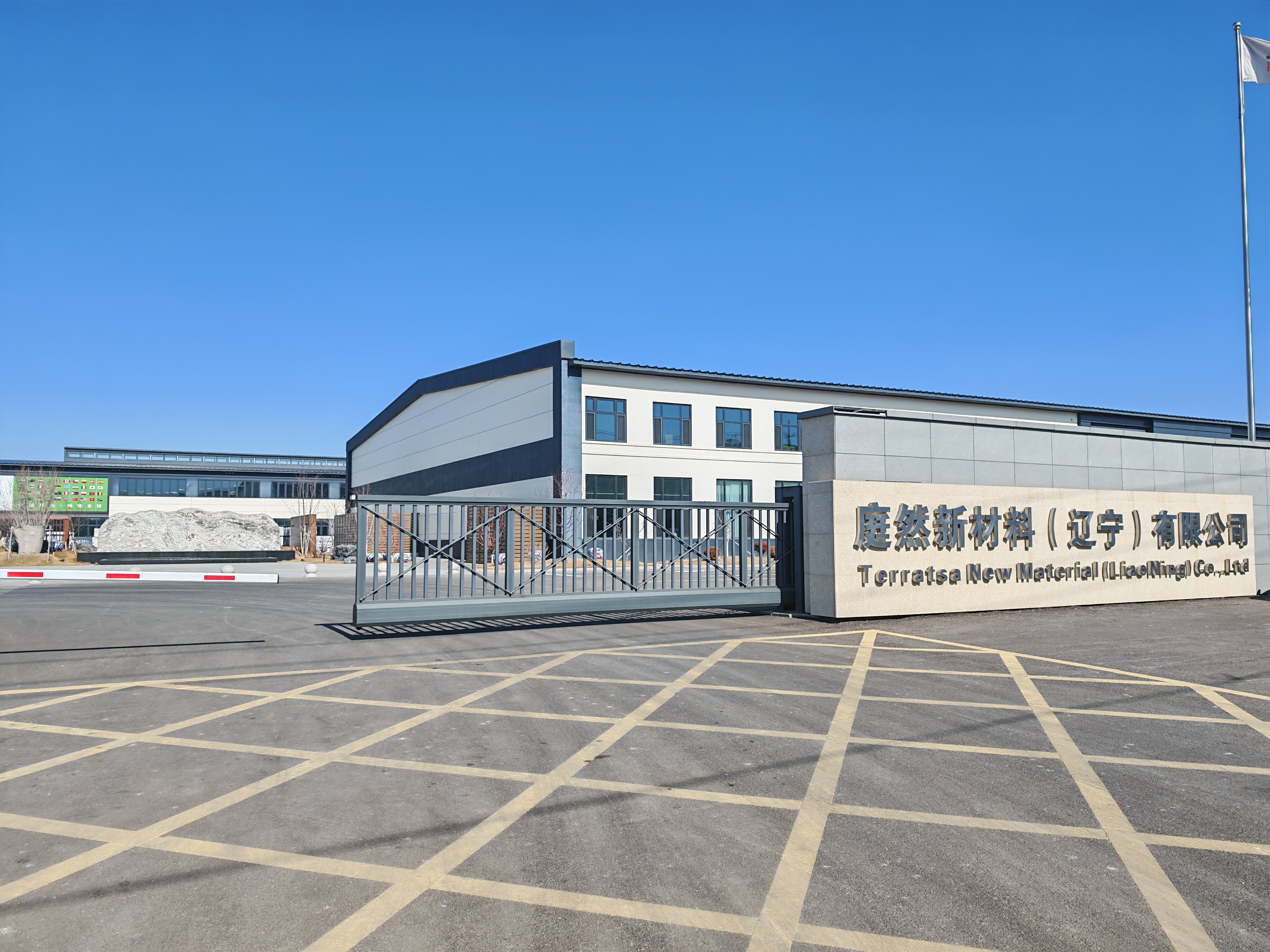
The Terratsa manufacturing base covers 74,000 m², with approximately 150 staff and a 25-engineer R&D team.
FAQ
What certification proof should be verified before appointing a long-term WPC decking supplier?
Three document groups decide most of the compliance risk. First, the Environmental Product Declaration: Terratsa holds EPD S-P-12197, registration number EPD-IES-0012197:001, published through the International EPD System with a version date of 2024-03-15 and valid until 2029-03-15, conforming to EN 15804+A2 within the ISO 14025 / ISO 21930 framework, with declared markets of China and the Netherlands. The declaration covers co-extrusion WPC products, so a buyer specifying a first-generation hollow board should confirm whether that product group sits inside the declared scope. Second, the management system certificates: ISO 9001, ISO 14000, GB/T 24001-2016 / ISO 14001:2015 and GB/T 45001-2020 / ISO 45001:2018, checked for coverage of the manufacturing site actually quoted. Third, product-level documents: CE, FSC, ASTM and SGS, each matched to the specific model and with FSC scope confirmed rather than assumed.
Can one supplier deliver both the cladding and the decking for the same terrace project?
Yes, provided the two duties are specified separately. Terratsa manufactures outdoor WPC decking, outdoor WPC fencing and outdoor WPC cladding, and the four models in this guide cover both duties: GH024 and GH010 are cladding profiles for vertical wall applications, while D053 (hollow, first generation) and GH001 (co-extruded) are decking boards for horizontal, joist-supported installations. Sourcing both from one factory removes the colour-matching problem between facade and terrace, keeps one certification pack for the whole submittal, and consolidates delivery under a single set of commercial terms.
What purchasing terms apply when ordering WPC decking directly from the factory?
The stated terms are a minimum order quantity of 1 container, delivery terms FOB, payment terms of 30/70, and acceptance criteria based on a pre-shipment test. For a procurement manager, the practical implication is that container loading, not pallet quantity, is the ordering unit; that freight and insurance sit outside the factory quotation under FOB; and that the inspection event that releases final payment should be scheduled against the datasheet values of the specific model ordered.
How should boards be validated before committing to a repeat order?
Tie the pre-shipment test to the declared values of the ordered model. For GH001 co-extruded decking these are flexural properties of ≥ 3300 N, cyclic moisture resistance mean ≤ 10% and boiling water absorption ≤ 7%. For D053 hollow first-generation decking they are bending failure of 3900 N, density of 1.3 g/cm³, water absorption ≤ 2% after a 5-hour boil and a linear thermal expansion coefficient ≤ 37 × 10⁻⁶ K⁻¹. Terratsa runs an end-to-end Dual-QC model — raw material screening, real-time monitoring during production and a re-inspection before shipment — with a reported factory pass rate above 99%, which is the mechanism that keeps a repeat order consistent with the first delivery.
How is long-term supply supported for terrace projects?
Terratsa operates more than 70 fully automatic production lines with an annual capacity of 120,000 tons, supported by end-to-end intelligent production that provides stable and controllable quality and lead times, a 25-engineer R&D team and more than 30 national independent intellectual property patents. Approximately 85% of production is exported, the company serves nearly 100 customers worldwide, and an independent overseas warehouse in the Netherlands supports EU distribution. Bespoke textures and designs can be turned around in 3 days, which matters when a project is extended in a later phase. To start a specification, request the decking brochure, a board sample or a project-specific quotation.
Conclusion: Specify by Duty, Verify by Document
The cladding-versus-decking question resolves quickly once the two duties are separated. Vertical wall applications call for GH024 or GH010, specified on wall build-up, fixing substrate and wind load, with parameters taken from the current datasheet for the profile. Horizontal, joist-supported applications call for decking: GH001 co-extruded boards where premium performance and low maintenance are required, and D053 hollow first-generation boards where the budget envelope and programme horizon are fixed and shorter.
The part that decides whether the specification survives delivery is documentation and supply continuity: EPD S-P-12197 with its validity window and declared scope, the ISO 9001, ISO 14001 and ISO 45001 system certificates, FSC scope, CE, ASTM and SGS reports matched to the model, commercial terms written into the order, and a pre-shipment acceptance test tied to declared values. A supplier that can hold those items steady across repeat orders is worth more than a lower price on the first container.
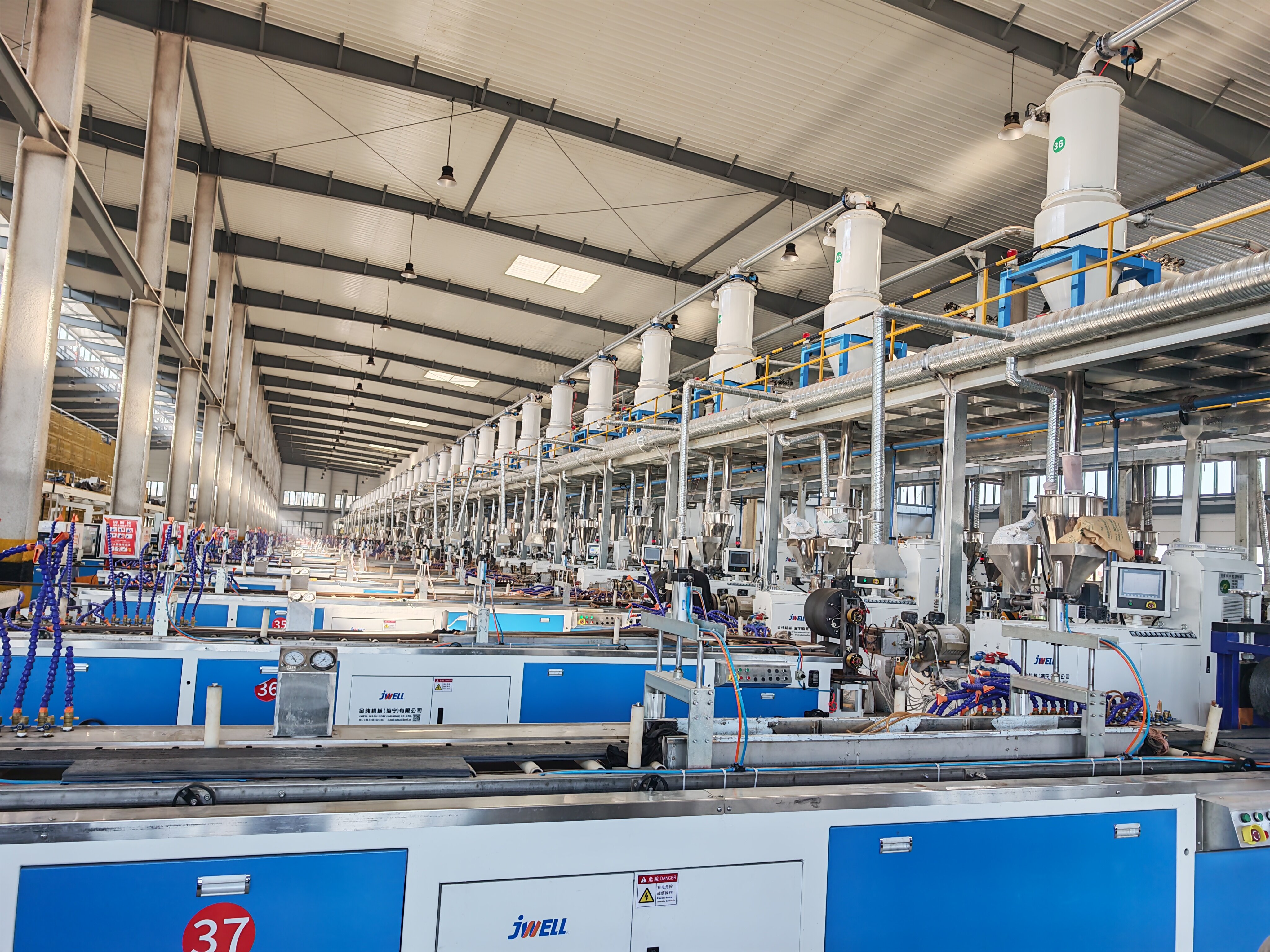
More than 70 fully automatic production lines support repeat orders with consistent profile and colour.
Next step: sample, datasheet and quotation
Send the wall build-up and terrace drawing, and Terratsa New Material (Liaoning) Co., Ltd. will confirm which of GH024, GH010, D053 or GH001 fits each surface, together with the current datasheet, certification copies and commercial terms.
Decking brochure: Terratsa Decking Brochure (PDF)
Website: www.terratsa.com
Email: sales01@unvocwpc.com
Tel / WhatsApp: +8615943028515
Address: No. 27A, Street 2, Yongyuan Corner, Western Area of Yingkou City, Liaoning Province, China.
Have Questions or Need More Details?
Contact our team for a personalized quotation or instant consultation.
Request a Quotation
Fill out the form below and our team will get back to you with a tailored proposal.
WhatsApp Direct Chat
Prefer to chat in real-time? Message us on WhatsApp for instant assistance & quick answers.
- Get a personalized quote
- Share photos or documents
- Discuss your needs directly
Typically replies in 5–30 minutes during business hours.