
How to Fix WPC Cladding Fading and Moisture Issues on Exterior Walls
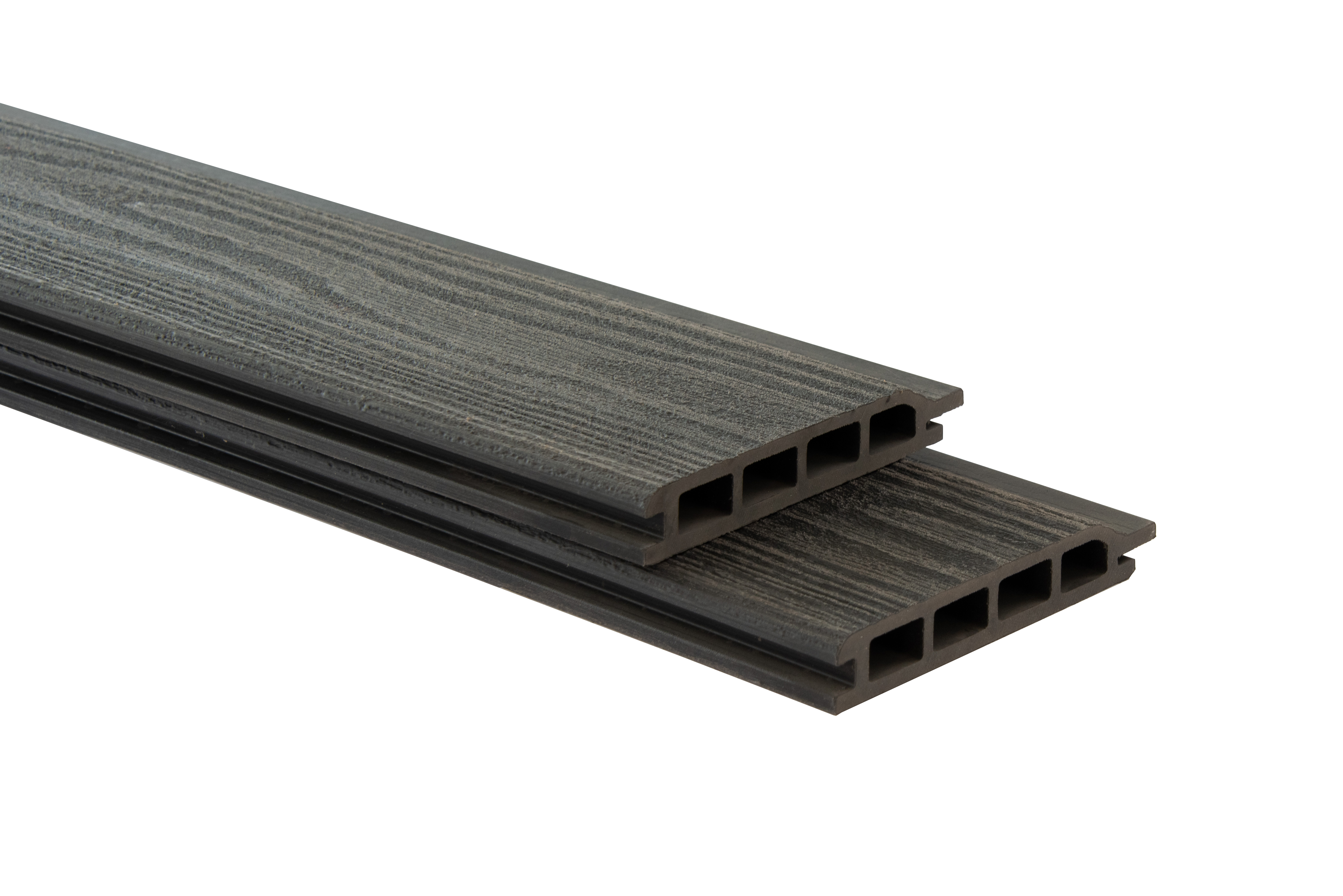
Fading and moisture damage on exterior WPC cladding are almost never maintenance failures. They are specification failures. A wall panel that greys, chalks or swells is usually doing exactly what its build allows: a surface layer with no UV-stable cap, a cut edge with no protection, or a fixing detail that holds water against the board.
The engineered fix has two parts. The first is a second-generation co-extruded profile, in which the wood-plastic core is fully encapsulated by a polymer cap layer formulated with UV-resistant components such as ASA materials, so no wood fibre is exposed to sun or rain. The second is a supplier who publishes measurable performance instead of adjectives. For the GH010 exterior wall cladding produced by Terratsa New Material (Liaoning) Co., Ltd., that published data includes:
- Swelling and water absorption (28 days immersion): ≤ 2%
- Moisture resistance under cyclic test conditions: ≤ 60.7 mm
- Linear thermal expansion coefficient: ≤ 37 × 10⁻⁶ K⁻¹
- Flexural properties: ≤ 0.79 mm
This guide covers four things a specifier, contractor or importer actually needs: how to identify which failure you have, why exterior WPC quality varies so widely, what a capped co-extruded profile changes in practice, and which documents to verify before an order is placed. Terratsa New Material (Liaoning) Co., Ltd. is a wood-plastic composite manufacturer founded in 2007 and operating from the Yingkou Area of China (Liaoning) Pilot Free Trade Zone; it produces outdoor WPC decking, fencing and cladding and exports to more than 40 countries and regions.
What Actually Causes WPC Cladding to Fade and Take On Water
Exterior WPC is a composite of wood fibre, plastic polymer and additives — an industry whitepaper describes a typical exterior mix as roughly 60% wood fibre, 30% polymer and 10% additives. Both common failures trace back to that structure. The wood fraction is the part that discolours when it is left exposed, and the polymer fraction is the part that has to stop water from reaching it.
Failure mode 1: colour fade, greying and chalking
Fade is a surface event. UV radiation attacks the fibre and the pigment system at the face of the board; over years the panel loses colour, turns grey and develops a chalky film. On a first-generation profile without a cap, the fibre sits close to the surface, so the process starts as soon as the facade is exposed and accelerates on the elevations that take the most direct sun. On a co-extruded profile, no fibre is exposed, and the part that has to resist UV is the cap itself — which is why cap formulation and cap thickness are specification items, not the colour name on a sample card. GH010 is documented with a UV-stabilised surface formulated with UV inhibitors to prevent fading, greying and chalking.
Failure mode 2: swelling, edge lift and black staining
Moisture is a structural event. Water enters at cut ends, joints, face fixings and any point where the board sits against a wet substrate, and the core absorbs it. The visible results are swollen edges, panels that step out of line, dark staining and mould growth. Two measurements describe how well a profile resists this: swelling and water absorption after 28 days immersion, and moisture resistance under cyclic test conditions, which reflects repeated wet-dry cycling rather than a single soak. GH010 is published at ≤ 2% for the 28-day immersion test and ≤ 60.7 mm under cyclic conditions.
Telling the two apart on a real wall
- Grey or chalky, but flat and stable: a UV problem. Check whether the profile is capped at all, and what the cap is formulated with.
- Swollen or stepping edges or dark staining while colour is still intact: a water problem. Check flashings, drainage and the ventilated cavity first, then the core's 28-day immersion value.
- Both at once: the elevation is very likely carrying an uncapped or low-density profile. Repainting changes appearance; it does not rebuild a UV-stable cap or reduce water uptake in the core.
| Symptom on the facade | Likely mechanism | What to verify before specifying |
|---|---|---|
| Uniform greying, chalky film, panel still flat | UV degradation of an exposed fibre surface | Co-extruded cap formulated with UV inhibitors (GH010 is documented against fading, greying and chalking) |
| Swollen edges, panels stepping out of line | Water absorbed into the core at cut ends and joints | 28-day immersion value: GH010 ≤ 2%; GH024 ≤ 4% |
| Recurring mould or dark staining | Water trapped behind the cladding with no drainage path | Cyclic moisture value (GH010 ≤ 60.7 mm; GH024 ≤ 0.9 mm) plus a drained, ventilated fixing detail |
| Joints opening or buckling in summer heat | Thermal movement that was never planned for in long runs | Linear thermal expansion coefficient: GH010 and GH024 both ≤ 37 × 10⁻⁶ K⁻¹ |
| Visible deflection or sag between supports | Panel stiffness lower than the fixing spacing assumes | Flexural properties: GH010 ≤ 0.79 mm; GH024 ≤ 0.9 mm |
Moisture and flexural figures are reproduced as published in the manufacturer's product data. Confirm the corresponding test method with the supplier when writing a project specification.
Why Exterior WPC Cladding Quality Varies So Much
Demand is not the problem; differentiation is. The global wood plastic composite market was estimated at USD 8.89 billion in 2025, with North America holding a 51.3% revenue share that year (Grand View Research). A separate forecast projects a 10.3% CAGR between 2025 and 2035, reaching USD 20.3 billion (Future Market Insights). The two sources use different base-year values — USD 8.89 billion versus USD 7.6 billion — so they are best read as directional rather than interchangeable. They agree on the direction: exterior cladding is a growing category with a growing supplier list.
Trade data shows where that supply is manufactured. China was the leading exporter of plastic builders' ware under HS 3925.90 in 2024 at USD 2.16 billion (Observatory of Economic Complexity), and WPC wall panels fall under HS 3925.90.00 in the US Harmonized Tariff Schedule (USITC).
Cost structure explains the quality spread. Raw materials typically account for 50% to 70% of the manufacturing cost of WPC wall panels (industry cost guide, SolidexWood). The cap layer and the polymer grade sit inside that raw-material share, which makes them the simplest place to cut: a thinner cap, a lower-grade resin, more filler. Two boards can look identical on a sample table and behave completely differently after three summers on a west-facing elevation.
That is why the practical definition of quality evidence has changed. "UV resistant" and "waterproof" are claims. A 28-day immersion result, a cyclic moisture figure, a thermal expansion coefficient and a certificate number are evidence — and they can be written into a specification and checked again at delivery.
The Engineered Fix: Second-Generation Co-Extruded Cap Layers
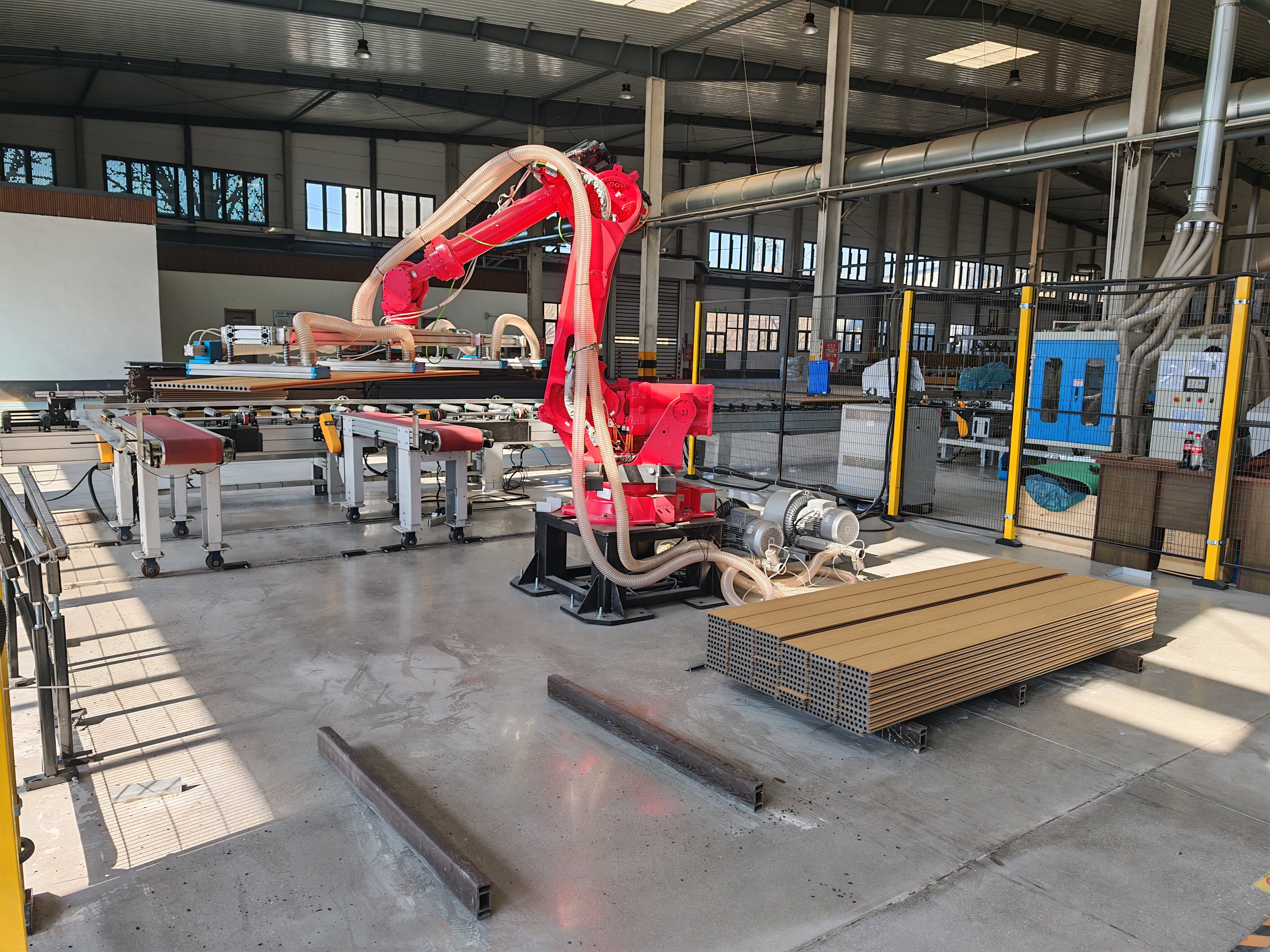
A cap layer that closes the surface
In co-extrusion, the core and the outer skin are extruded together, so the finished board carries a continuous polymer cap rather than a coating applied afterwards. In the second-generation version used on Terratsa's co-extruded outdoor profiles, that cap encapsulates the core, and the outer shell is formulated with advanced UV-resistant components such as ASA materials. The engineering intent is simple: if no wood fibre is exposed and no water reaches the core, neither failure mechanism has a place to start.
The numbers that answer each failure
- Water absorption (28 days immersion) ≤ 2% on GH010 — the direct answer to core swelling and edge lift.
- Cyclic moisture resistance ≤ 60.7 mm on GH010 — describes repeated wet-dry cycling, which is what a real facade experiences, rather than a single laboratory soak.
- Linear thermal expansion ≤ 37 × 10⁻⁶ K⁻¹ on GH010 and GH024 — the figure used to plan movement allowance, clip spacing and joint design in long runs.
- Flexural properties ≤ 0.79 mm on GH010 and ≤ 0.9 mm on GH024 — the stiffness that allows panels to be carried on a sub-frame instead of being fully supported.
- Solid, non-porous structure — prevents water absorption and removes the rotting, swelling and mould risk that comes with a porous core in humid conditions.
Profile geometry and installation hardware
GH010 is an exterior wall cladding board at 22 mm thickness, 136 mm width and 2900 mm length. GH024 is a wider outdoor cladding profile at 172 × 23 mm with a fluted 3D face and an interlocking edge that allows fast installation over existing walls. Both are compatible with hidden clip systems and with horizontal or vertical orientation, and both can be cut and drilled with standard woodworking tools. GH010 also carries an anti-slip surface and resistance to termites and wood-boring insects, and is documented to withstand heavy rain, snow and salt spray without cracking, warping or peeling.
Step-by-Step: Fixing a Fading, Water-Damaged WPC Facade
Step 1 — Diagnose the failure mode before removing anything. Walk the elevation and separate symptoms: uniform greying points to UV; swelling, staining and edge lift point to moisture; joints that open in heat point to movement. The diagnosis determines what has to change, and it is also the record that justifies the replacement specification to the client or the insurer.
Step 2 — Decide between cosmetic repair and replacement. Recoating or staining resets colour, and on a lightly faded but stable panel it may be acceptable as a short-term measure. It does not rebuild a UV-stable cap and it does not reduce water uptake in the core, so where the cap is worn through or the boards are swelling, the same failure returns. Replacement with a capped profile is the durable route.
Step 3 — Correct the water path at the wall first. In general practice this means flashings and drip edges above openings, a drained and ventilated cavity behind the cladding, fixings kept out of the direct water path, and a base detail that lets water out rather than holding it. A capped board is moisture-resistant, not a waterproof system — water that cannot drain will still cause problems.
Step 4 — Specify a capped profile with published values. Put the 28-day immersion figure, the cyclic moisture figure, the thermal expansion coefficient and the flexural value into the specification alongside colour and profile. For exterior walls, GH010 offers the tighter moisture data (≤ 2% after 28 days immersion); GH024 offers a wider 172 × 23 mm fluted face where the design calls for it.
Step 5 — Convert the expansion coefficient into a movement plan. At ≤ 37 × 10⁻⁶ K⁻¹ for both profiles, long runs and darker colours need movement allowance, correct clip spacing and joints that are not forced tight against each other. Ask the manufacturer to confirm the recommended spacing and gap for the project's temperature range rather than reusing a detail written for a different board.
Step 6 — Install with hidden clips and protect the transitions. Hidden clip systems keep the face free of penetrations and are supported on both GH010 and GH024. Cut edges and junctions should be detailed so exposed core material is not left sitting in a water trap, and the embossed, anti-slip face of GH010 should be kept intact rather than sanded down.
Step 7 — Verify the compliance pack before the order is confirmed. Certificate numbers, issuing bodies, standards and expiry dates should be checked against the actual product and profile being shipped. The table in the next section lists what to request.
Step 8 — Validate with a sample and lock the delivery schedule. Confirm colour, finish and cap on a physical sample, then plan the order around production lead time and container quantity instead of assuming stock availability.
Where This Fix Matters Most
The failure mechanisms described above are climate-amplified, and the projects where a capped profile changes outcomes most are fairly predictable.
Coastal and high-rainfall facades. Salt spray, driving rain and snow loading attack both the surface and the joints. GH010 is documented to withstand heavy rain, snow and salt spray without cracking, warping or peeling, which is the relevant performance envelope for exposed elevations.
Residential homes, commercial buildings, hotels and villas. These are the exterior facade applications GH010 is designed for, and they are also the projects where an annual repaint or an early facade replacement is least acceptable — for cost, access and disruption to the building's users.
Detail-heavy elevations. Balcony privacy screens, garden feature walls, fence cladding and outdoor kitchen surrounds all place panels in intermittent wet conditions, exactly where a non-porous, capped board behaves differently from an uncapped one.
Retrofit and re-cladding projects. GH024's interlocking fluted profile is designed to be installed quickly over existing walls, which makes it a practical option when a failing facade has to be recovered without a full strip-back of the substrate.
Cold-winter and hot-humid regions. Wide temperature swings combined with sustained humidity punish both movement detailing and moisture resistance, so the expansion coefficient and the 28-day immersion value both have to be checked — not just one of them.
Comparison Table: GH010 and GH024 Published Performance
Both are co-extruded outdoor cladding profiles from the same manufacturer, and the differences are in geometry and in the moisture figures. The table below uses only the published product data.
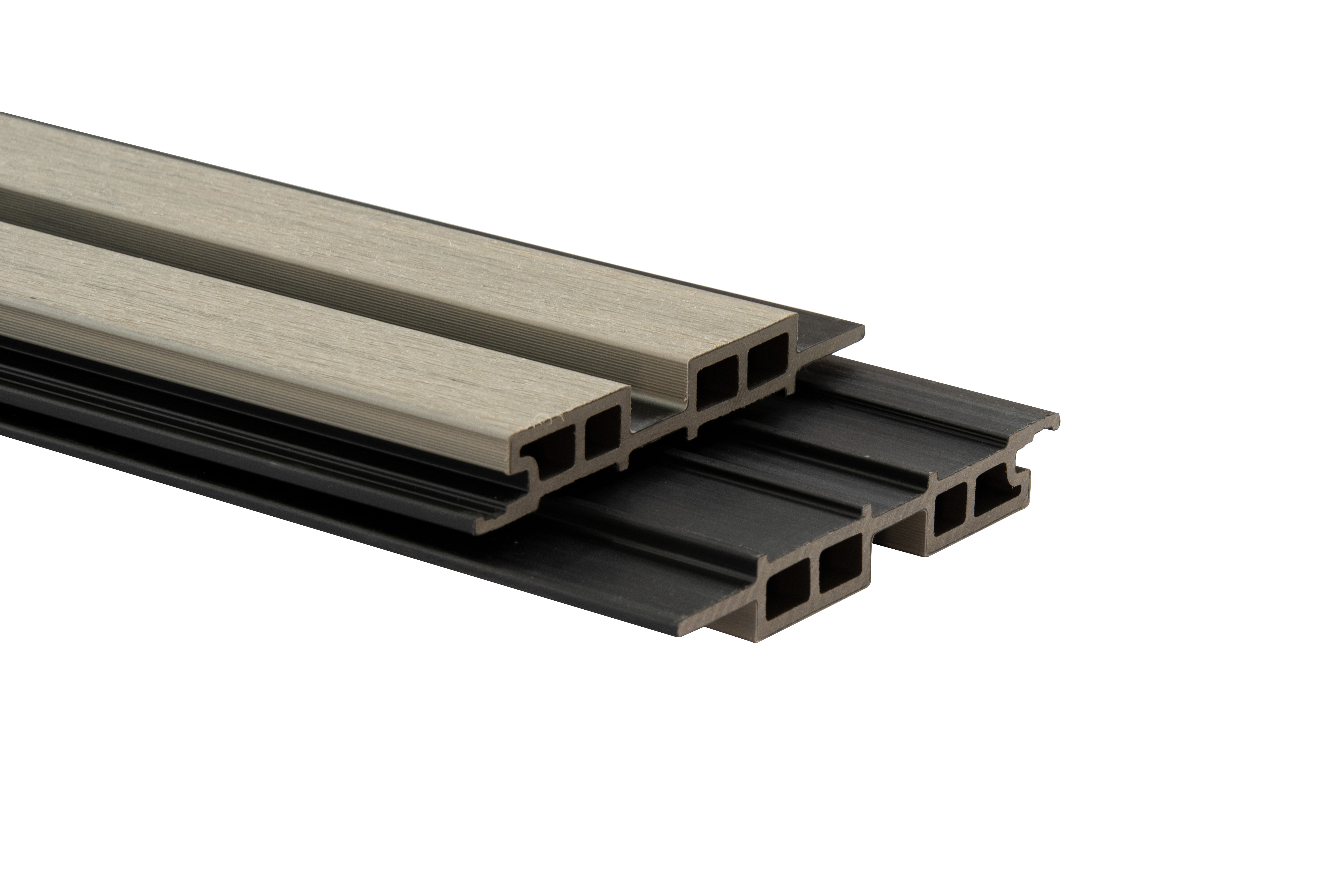
| Parameter | GH010 | GH024 |
|---|---|---|
| Product type | Exterior wall cladding | Outdoor WPC cladding |
| Profile size | 22 mm thickness × 136 mm width × 2900 mm length | 172 × 23 mm |
| Material | Wood powder and plastic | Wood powder and plastic |
| Flexural properties | ≤ 0.79 mm | ≤ 0.9 mm |
| Moisture resistance under cyclic test | ≤ 60.7 mm | ≤ 0.9 mm |
| Swelling and water absorption (28 days immersion) | ≤ 2% | ≤ 4% |
| Boiling test | Not published in the current product data | ≤ 3% |
| Linear thermal expansion coefficient | ≤ 37 × 10⁻⁶ K⁻¹ | ≤ 37 × 10⁻⁶ K⁻¹ |
| Face design | Wood-grain embossed exterior cladding board with anti-slip surface | Fluted 3D face |
| Installation | Hidden clip systems; horizontal or vertical | Interlocking system; installs over existing walls |
Values are reproduced exactly as published in the manufacturer's product data. Where a moisture result is expressed in millimetres, treat it as the datasheet wording and confirm the associated test method with the supplier before it is written into a project specification.
Compliance documents to check before ordering
Certification is the part of an exterior cladding order that is easiest to accept at face value and most expensive to get wrong. Terratsa New Material (Liaoning) Co., Ltd. lists CE, FSC, ASTM, SGS and EPD among its international certifications; the documents below carry reference numbers that can be checked directly.
| Document | Issued by | Reference | Scope and validity |
|---|---|---|---|
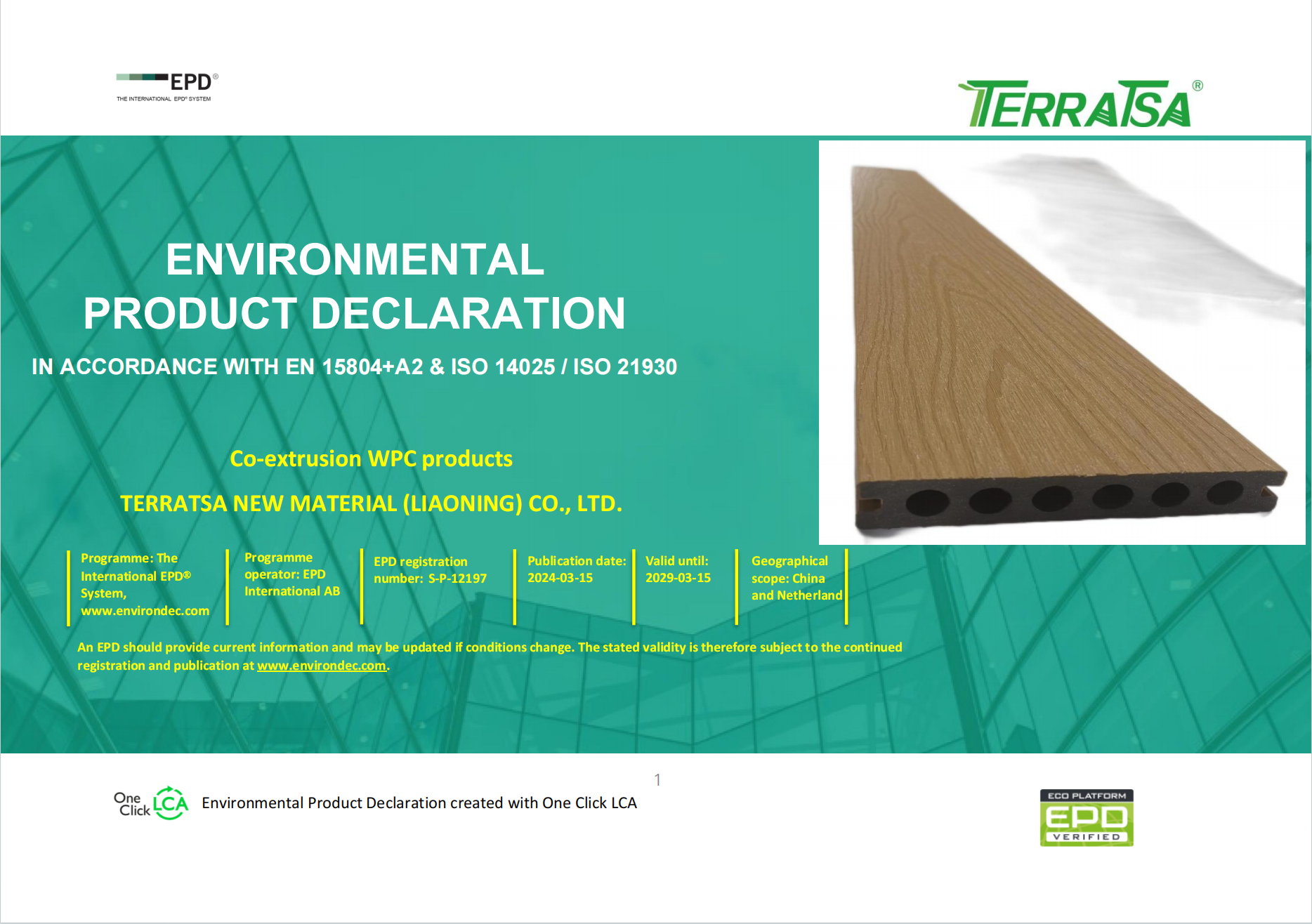
| Environmental Product Declaration (EN 15804+A2 & ISO 14025 / ISO 21930) | EPD International AB | S-P-12197 | Co-extrusion WPC products, global market, valid until 2029-03-15 |
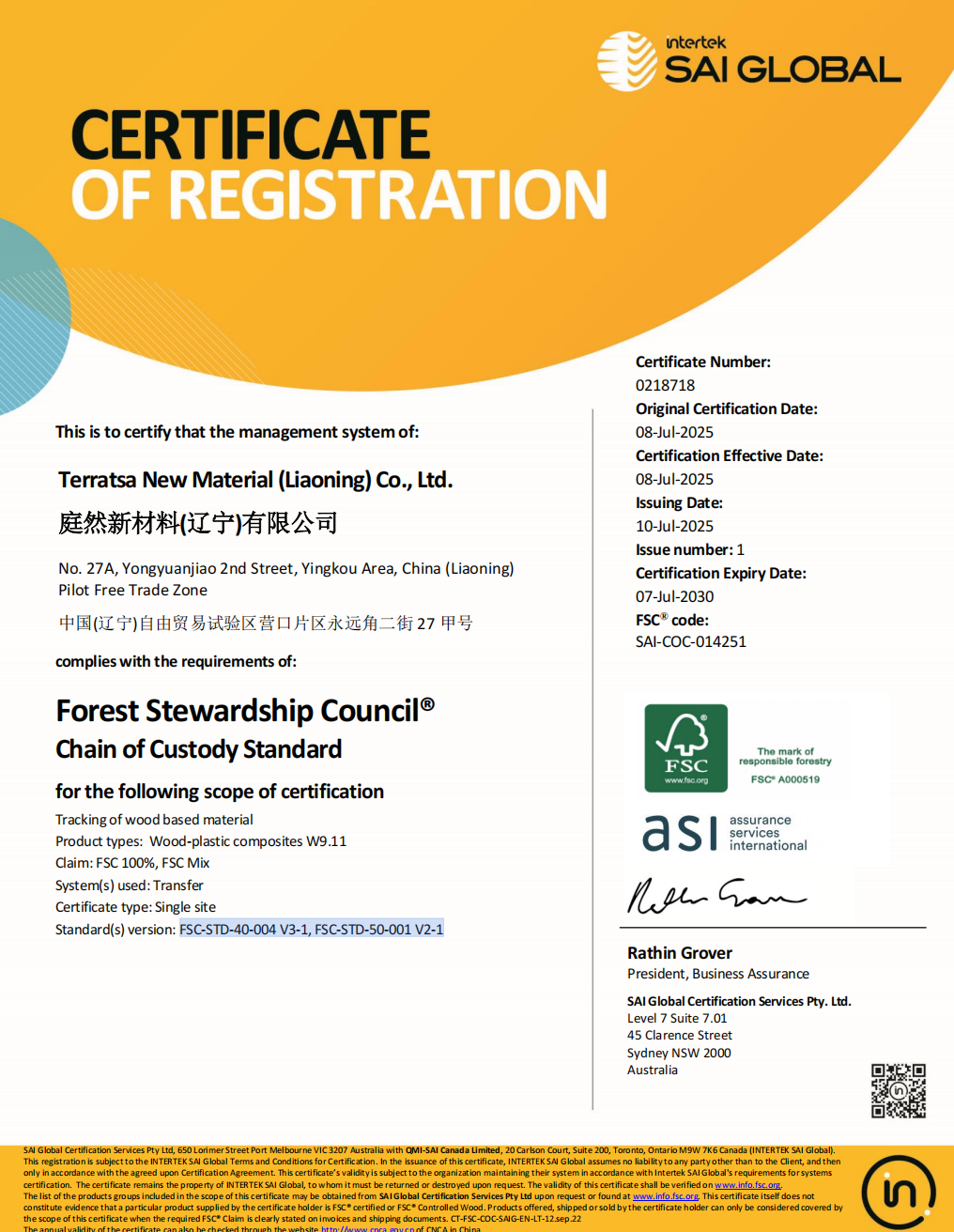
| FSC Chain of Custody (FSC-STD-40-004 V3-1, FSC-STD-50-001 V2-1) | SAI Global Certification Services Pty. Ltd. | 0218718 | WPC cladding profile GH010, global market, valid until 2030-07-07 |
| ISO 9001 Quality Management System (GB/T 19001-2016 / ISO 9001:2015) | World Standards For Certification Center Inc. | 03825Q01470R0M | WPC cladding product, all markets, valid until 2028-03-02 |
| ISO 14001 Environmental Management System (GB/T 24001-2016 / ISO 14001:2015) | World Standards For Certification Center Inc. | 03825E01471R0M | WPC cladding (GH010) and WPC decking (GH001) scope, all markets, valid until 2028-03-02 |
| ISO 45001 Occupational Health and Safety Management System (GB/T 45001-2020 / ISO 45001:2018) | World Standards For Certification Center Inc. | 03825S01472R0M | Occupational health and safety activities in WPC production, all markets, valid until 2028-03-02 |
Frequently Asked Questions
Are Terratsa WPC cladding panels CE certified, and what documents should an exterior project request?
The company's product documentation lists CE, FSC, ASTM, SGS and EPD among its international certifications, and the cladding range carries certificates with verifiable reference numbers. For an exterior project, request the EPD issued by EPD International AB under EN 15804+A2 and ISO 14025 / ISO 21930 (certificate S-P-12197, global market, valid until 15 March 2029); the FSC Chain of Custody certificate 0218718 issued by SAI Global Certification Services Pty. Ltd. under FSC-STD-40-004 V3-1 and FSC-STD-50-001 V2-1, which covers the GH010 cladding profile; and the management system certificates issued by World Standards For Certification Center Inc. — ISO 9001 (03825Q01470R0M), ISO 14001 (03825E01471R0M) and ISO 45001 (03825S01472R0M) — all valid until 2 March 2028. Check the certificate number, the standard it was issued against and the expiry date, not the logo printed on a brochure.
Will a co-extruded cap layer really stop fading and moisture damage?
It removes both starting points rather than treating the symptoms. The cap encapsulates the core, so no wood fibre is exposed to UV, and the outer shell is formulated with UV-resistant components such as ASA materials to resist fading, greying and chalking. The sealed structure is non-porous, which is what the published values measure: GH010 is listed at ≤ 2% swelling and water absorption after 28 days immersion, ≤ 60.7 mm under cyclic moisture test conditions, flexural properties ≤ 0.79 mm and a linear thermal expansion coefficient ≤ 37 × 10⁻⁶ K⁻¹. What a cap layer cannot do is compensate for detailing — drainage, ventilation and correct clip spacing still decide whether the facade performs.
What drives the cost of exterior WPC cladding?
Raw materials typically account for 50% to 70% of WPC wall panel manufacturing cost, so resin grade, wood-fibre content and the cap layer are the main levers inside the product itself. Two commercial consequences follow. First, unusually low quotations usually reduce something inside that 50–70% band, and the reduction is typically invisible on a sample. Second, comparing offers by price per square metre alone compares different products — the published moisture, UV and stiffness values belong in that comparison. Freight, profile size and whether the package includes a complete system (trims, corners and clips) move landed cost as much as the board price does.
Can we validate the profile with a sample before committing to a container order?
Yes, and sample validation is the normal route before a facade order. Terratsa supports OEM/ODM production with logo customization, applies 100% testing in quality control, and works to a minimum order quantity of one container for production runs. In practice: ask for a sample in the specified colour and finish, inspect the cap on a cut end, match the sample against the datasheet values, and where the site allows, install a small section on the real sub-frame to observe movement and drainage before the full order is confirmed.
What is the production lead time and capacity behind a cladding order?
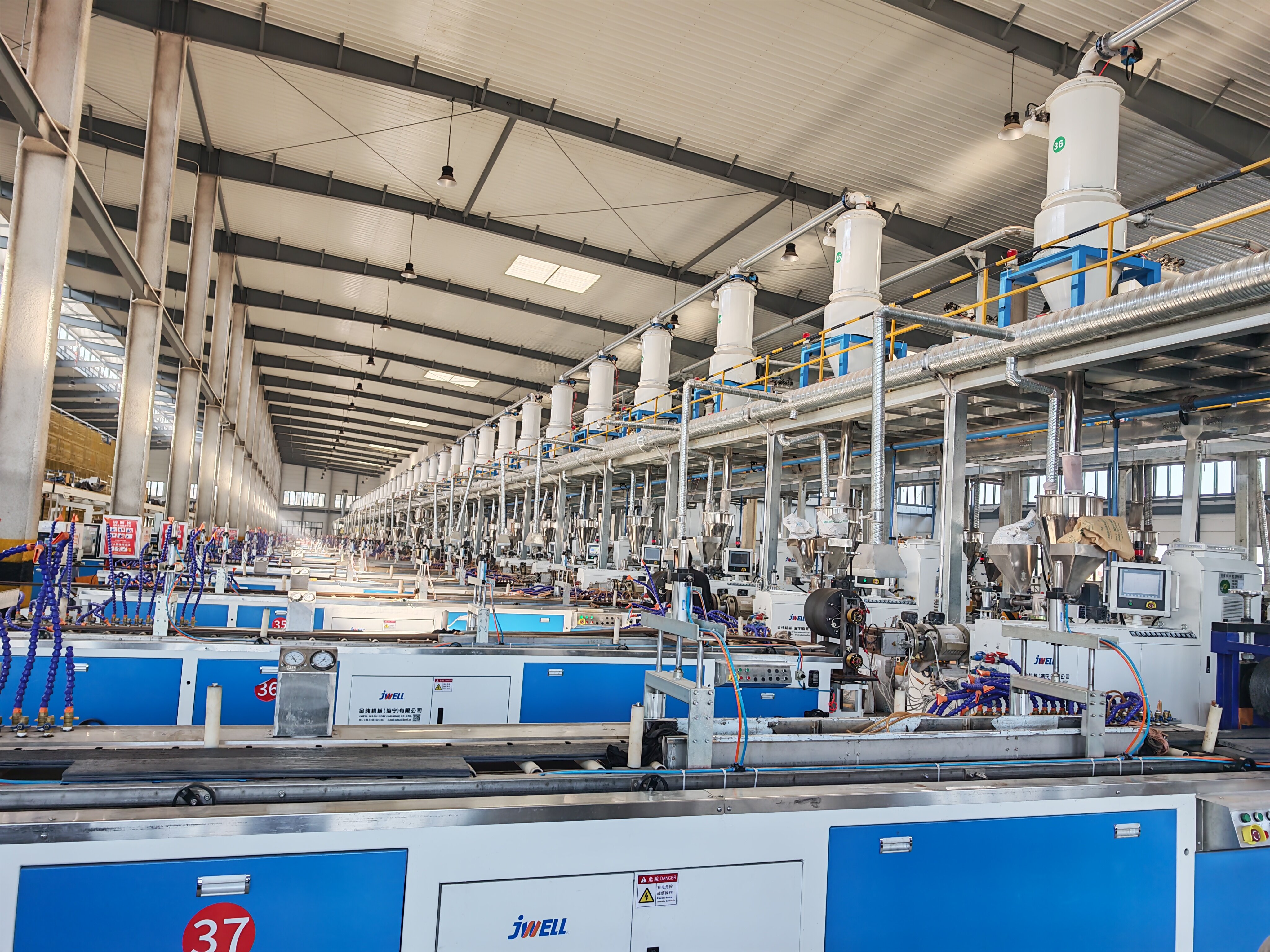
Production lead time is 30–45 days, monthly capacity is 10,000 tons, and the minimum order quantity is one container. The factory runs more than 70 fully automatic production lines and applies end-to-end quality control to keep delivery and quality stable across repeat orders. To get a quotation, send the profile (GH010 or GH024), colour, quantity, destination port and required delivery window to sales01@unvocwpc.com or via WhatsApp on +8615943028515; the product brochure can be downloaded here: Terratsa product brochure (PDF).
Conclusion: Fix the Mechanism, Not the Appearance
Fading and moisture damage on exterior WPC cladding are predictable, and so is the fix. Diagnose the failure first, correct the drainage and ventilation detail, then specify a co-extruded profile whose cap layer is formulated for UV and whose core is documented against water uptake — GH010 at ≤ 2% swelling and water absorption after 28 days immersion, ≤ 60.7 mm under cyclic moisture test conditions, ≤ 37 × 10⁻⁶ K⁻¹ linear thermal expansion and ≤ 0.79 mm flexural properties, or GH024 at 172 × 23 mm with ≤ 0.9 mm flexural properties where a wider fluted face is required. Then verify the paperwork: EPD S-P-12197, FSC certificate 0218718 for GH010, and the ISO 9001, ISO 14001 and ISO 45001 certificates behind the production system.
A facade that fades twice is almost always a specification that was accepted on adjectives. A facade that holds its colour and its line for the life of the building is a specification that was accepted on numbers.
Next Step: Samples, Specifications and Quotations
Send your project details — elevation area, profile preference (GH010 or GH024), colour, destination port and target delivery date — and you will receive a specification sheet, certificate copies and a quotation. Samples can be arranged before production, and orders are produced to a minimum of one container with a 30–45 day lead time.
- Email: sales01@unvocwpc.com
- Tel / WhatsApp: +8615943028515 (start a WhatsApp chat)
- Website: www.terratsa.com
- Brochure: Terratsa product brochure (PDF)
- Address: No. 27A, Street 2, Yongyuan Corner, Western Area of Yingkou City, Liaoning Province, China
Have Questions or Need More Details?
Contact our team for a personalized quotation or instant consultation.
Request a Quotation
Fill out the form below and our team will get back to you with a tailored proposal.
WhatsApp Direct Chat
Prefer to chat in real-time? Message us on WhatsApp for instant assistance & quick answers.
- Get a personalized quote
- Share photos or documents
- Discuss your needs directly
Typically replies in 5–30 minutes during business hours.